
TL;DR
Agencies can create good content, but SaaS SEO execution breaks when handoffs slow publishing, monitoring, and refreshes. Infrastructure wins when you need bulk updates, governed templates, and measurable AI citation coverage.
You can have a brilliant SEO plan and still lose because nothing ships.
I’ve watched teams pay for “content production” and end up with a folder of drafts, a messy CMS, and no clear answer to the only question that matters: did this improve qualified pipeline?
SaaS SEO execution is the ability to turn search insights into published, measured, and refreshed pages without handoff friction.
Here’s the uncomfortable part: the gap isn’t usually talent. It’s operating model. Agencies are built to sell deliverables and time. Modern SEO (and especially AI search) punishes anything that can’t be instrumented, updated in bulk, or governed consistently.
Point of view: If you can’t see how work moves from keyword → page → citation → click → conversion, you don’t have an SEO program. You have a content purchase.
And in an AI-answer world, brand is your citation engine. AI systems pull from sources that are easy to extract, internally consistent, and uniquely useful.
Below are the seven places the “execution gap” shows up most clearly, plus what to do about each one.
1) The handoff tax: why “done” becomes 47 Slack messages
When you hire a content agency, you’re not just buying writing.
You’re buying a chain of handoffs:
- Strategy call → brief → writer → editor → SEO check → revisions → upload → internal links → QA → analytics → refresh
Agencies can do this well.
The problem is you still own the hardest parts: access, approvals, product truth, and publishing rights. That’s where SaaS SEO execution breaks.
What this looks like in real life
- Your product team changes a feature name.
- An old comparison page keeps ranking.
- Sales notices prospects are quoting outdated limitations.
Now you have to open a ticket, wait for agency capacity, re-brief context, and re-QA.
That lag is not “just process.” It’s a ranking risk.
Why it matters more in 2026
Search is faster now.
AI answers compress the journey. Users get summarized options before they ever click. If your page is outdated, you don’t just lose a ranking—you lose the right to be cited.
Search Engine Land captured the directional shift well: top SEOs are moving from manual task execution to shipping systems and tooling that can adapt quickly (source). That’s basically a polite way of saying: “handoffs don’t scale.”
The tradeoff you’re actually making
- Agency advantage: flexible labor for uneven workloads.
- Agency downside: every update is a request, not a capability.
If your SEO motion includes frequent updates (pricing pages, integrations, competitor comparisons, support content), the handoff tax compounds.
This is why Skayle is positioned as a ranking and visibility system, not a “content generator.” The win isn’t faster drafts. It’s fewer handoffs and tighter control across planning, publishing, and measurement (see the platform overview here).
2) “We ran an audit” isn’t the same as continuous site monitoring
Most agencies do audits.
Fewer run monitoring as a product.
And almost none can do it economically at the page counts modern SaaS sites actually have (docs, templates, integration pages, changelogs, programmatic hubs).
Darkroom’s 2026 roundup makes the scale problem explicit: for sites with thousands of pages, manual technical auditing becomes impractical, which is why AI-powered crawlers and automation are becoming standard (source).
The execution gap shows up as “surprise problems”
- A template change breaks canonical tags.
- A JS rendering update hides key content from crawlers.
- Old URLs start 404’ing after a CMS migration.
You don’t want to discover those during a quarterly review.
You want to discover them the week they happen.
What to demand (agency or platform)
If you’re paying anyone for SEO execution, require these as explicit outputs:
- A crawl-based issue list that’s prioritized by revenue intent (not just “severity”).
- Proof of fixes shipped (not “recommendations sent”).
- A recurring cadence for re-checking templates and critical sections.
If you’re trying to build this internally, it’s worth reading Skayle’s take on technical SEO for AI visibility, because the monitoring requirements now include “can an LLM extract this cleanly?” not just “can Google crawl it?”
Contrarian stance (and yes, it upsets some people)
Don’t pay an agency for audits if they can’t deploy fixes.
An audit that doesn’t translate into shipped changes is just expensive documentation.
3) Bulk updates beat per-page edits, and agencies are priced for per-page edits
SaaS SEO execution often comes down to repeating work across a lot of pages:
- Updating titles/meta across a template set
- Rolling out internal links across a topic cluster
- Rewriting intros across dozens of near-duplicate pages
- Adding structured data consistently
Tools are built for bulk operations.
Service businesses are built for billable hours.
SE Ranking’s 2026 review explicitly calls out bulk on-page automation—updating titles, meta descriptions, headings, and content across many pages at once—as a major advantage of modern AI SEO tooling (source). That’s the exact kind of work agencies usually do page-by-page.
Internal linking is the clearest example
Internal linking is rarely “hard.”
It’s repetitive.
And repetition is where agency overhead shows. You get spreadsheets, partial rollouts, and link placements that aren’t governed.
The same SE Ranking piece highlights automated internal linking that deploys context-based links automatically (source). Whether you use that tool or not, the underlying point matters: the market is moving toward systems that can apply linking logic consistently.
If you want a practical way to think about this, Skayle’s breakdown of internal linking for topic clusters is basically a playbook for turning “good intentions” into controlled execution.
What this means for choosing an agency
If your site is small and you publish slowly, per-page edits are fine.
If your site is scaling, per-page edits become your bottleneck.
When you’re evaluating cost, don’t compare “agency retainer vs platform subscription” at face value.
Compare:
- How many pages can be updated per week without creating a project plan?
- How many of those updates are validated in the CMS?
- How quickly can you roll back mistakes?
That’s the real execution gap.
4) AI answers changed the definition of “SEO done”
Agencies still sell “rankings + content.”
That’s not wrong.
It’s just incomplete.
In 2026, you also need to know:
- Where you’re mentioned in AI answers
- Where you’re cited (linked) versus paraphrased without attribution
- What competitors are being recommended in the same answer
Airefs notes that AI visibility tracking is becoming a distinct capability, calling out that some platforms track visibility across multiple LLMs and experiences (including Google AI Overviews) and that Semrush’s AI tracking covers eight LLMs (source).
Why agencies struggle here
Even good agencies tend to treat AI visibility as “reporting.”
But the only reporting that matters is reporting that changes what gets shipped next:
- Which pages need stronger entity clarity
- Which comparisons need explicit differentiators
- Which product claims need tighter proof
- Which schema blocks need to be added or corrected
That’s why Skayle treats AI visibility as an execution input (see how the AI search visibility layer connects citations to what you publish next).
A simple rule you can enforce
If a partner (or internal team) can’t answer these three questions weekly, you’re not doing modern SaaS SEO execution:
- “Which AI prompts cite us this week?”
- “Where did competitors replace us?”
- “What did we ship as a response?”
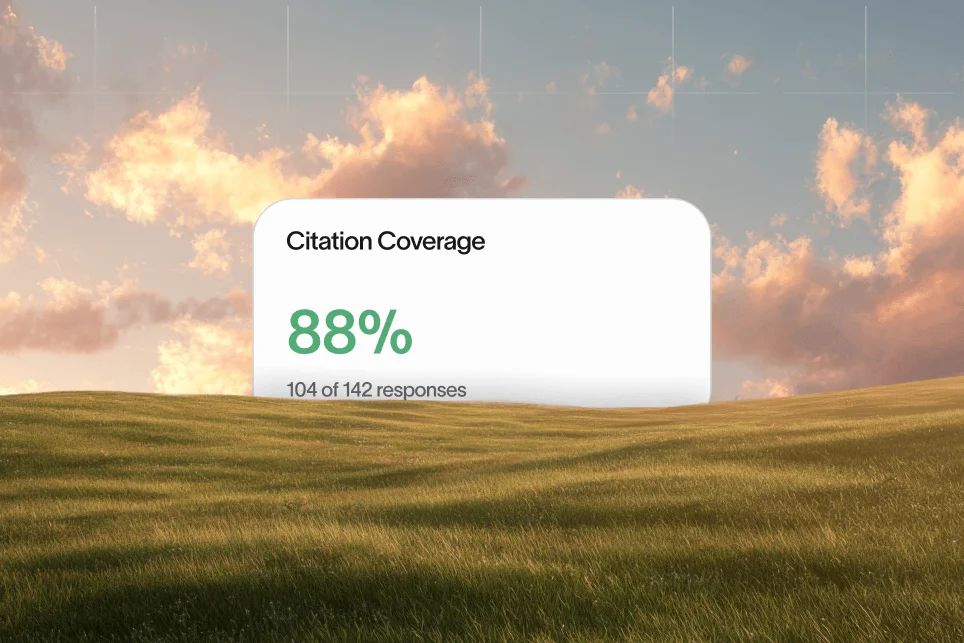
If you want the deeper mechanics (especially around citation gaps), Skayle’s guide on measuring citation coverage is a solid baseline.
5) A named model you can reuse: the Control-to-Citation Model
You need a way to diagnose the execution gap quickly.
Here’s the model I use when evaluating “platform vs agency” for SaaS SEO execution:
The Control-to-Citation Model (4 parts)
- Control: Who owns final truth (product facts, positioning, proof points) and can enforce it across pages?
- Shipping: Can you publish and update without waiting for capacity?
- Instrumentation: Can you tie pages to outcomes (rankings, citations, clicks, conversions) with clean analytics?
- Refresh: Do winners get updated on a schedule, or only when traffic drops?
If any part is missing, SEO becomes a series of campaigns instead of a compounding system.
A practical 30-minute diagnostic
Pick 10 revenue-intent pages (pricing, integrations, comparisons, alternatives, “best for” pages).
Then score each page 0–2 on these signals:
- Extractable answer: Does the page contain short, quotable definitions and lists that an LLM can lift cleanly?
- Citation readiness: Is there structured data and clear entity naming (product, category, audience)?
- Conversion path: Is the next step obvious (demo, trial, pricing, contact), with minimal friction?
- Refresh history: Has the page been updated in the last 60–90 days for accuracy?
You’re not hunting perfection. You’re hunting systemic inconsistency.
The action checklist I’d run next (in order)
- Inventory your revenue-intent pages and map them to owners.
- Set up citation monitoring for your core prompts (category, “best X,” “X vs Y,” “alternatives to X”).
- Fix template-level technical issues before rewriting copy.
- Standardize page components (proof blocks, FAQs, schema, comparison tables).
- Roll out internal links based on cluster intent, not “nice to have.”
- Ship updates in batches and annotate releases in analytics.
- Refresh the top 20% pages monthly; refresh the next 30% quarterly.
- Retire or noindex pages that can’t be made unique.
- Re-run the 10-page diagnostic every month.
If you want a cost lens for this, Airtop’s 2026 overview is a useful reminder that total cost of ownership includes subscription fees plus analyst time, learning curves, and implementation work (source). Agencies often hide that cost inside retainers.
6) What “proof” looks like when you can’t fabricate numbers (and still need rigor)
A lot of SEO content pretends every improvement is a neat before/after chart.
In practice, you need proof that’s operational, not theatrical.
Here are proof blocks you can produce in 30 days without making up stats.
Proof block A: publishing velocity with governance
- Baseline: average time from approved brief → published page (track in your PM tool)
- Intervention: remove handoffs by centralizing context + publishing workflow
- Outcome: shorter cycle time and fewer revision loops
- Timeframe: 30 days
Even if rankings take longer, cycle time will move fast. Cycle time is your leading indicator for SaaS SEO execution.
Proof block B: citation coverage gap closure
- Baseline: list 20 prompts where competitors are cited and you are not
- Intervention: ship 5 pages designed for extractability (definitions, lists, FAQs, schema)
- Outcome: increased citation rate and branded mentions in AI answers
- Timeframe: 4–8 weeks
Skayle has a detailed workflow for identifying and fixing those gaps in its guide on LLM citation gaps.
Proof block C: template-level technical fixes
- Baseline: count of pages failing structured data validation, missing canonicals, or blocked by rendering
- Intervention: fix the template once
- Outcome: hundreds of pages improved instantly
- Timeframe: 1–2 weeks (often faster than rewriting even one “pillar” page)
Airefs also frames AI-driven audits as a way to catch crawlability barriers and technical blockers more consistently than manual checking (source).
Where agencies can still be useful
Agencies aren’t “bad.”
They’re just optimized for different work:
- Brand narrative development
- Expert interviews
- One-off creative assets
- High-stakes positioning pages
If your problem is volume + consistency + refresh, infrastructure wins.
7) The decision matrix: when agencies win, when Skayle wins, and when you should do both
If you’re trying to choose, don’t start with “features.”
Start with constraints.
Agencies tend to win when…
- You need editorial horsepower for thought leadership
- You lack internal subject-matter access (or can’t get it reliably)
- Your publishing cadence is low and you’re okay with per-page work
Infrastructure tends to win when…
- Your site has hundreds to thousands of pages
- You need bulk updates, consistent templates, and governed internal linking
- You care about AI citations as a measurable channel, not a vibe
Conductor’s overview of enterprise SEO platforms highlights exactly why larger teams lean into platforms: they provide site auditing, crawling, and monitoring at scale (source). Even if you never buy an enterprise suite, the underlying expectation is now standard.
The hybrid model that actually works
If I were setting this up for a SaaS team today, I’d do this:
- Use a platform as the system of record for planning, structure, publishing, and measurement.
- Use an agency (or freelancers) for specific inputs: SME interviews, narrative polish, design support.
That hybrid keeps execution inside your control while still buying expertise where it’s highest leverage.
And it’s not just brands doing this—agencies are adopting AI SEO software themselves to scale, including white-label tools for rank tracking across many search engines (source). The market is telling you the direction.
One more practical way to sanity-check the decision
Eesel’s hands-on comparison of AI SEO platforms is a decent example of how practitioners evaluate real workflow automation versus manual steps (source). Use that lens: if the “automation” still requires ten human handoffs, it won’t close your execution gap.
FAQ: questions I hear from SaaS teams making this choice
Should I fire my agency and switch everything to a platform?
Not automatically. If your agency is providing real strategic leverage (SME access, positioning clarity, creative direction), keep that input. Move the repeatable work—publishing, internal links, refreshes, monitoring—into an infrastructure layer so execution doesn’t depend on their capacity.
What’s the biggest risk of relying on agencies for SaaS SEO execution?
The risk is latency. By the time an update request gets scoped, queued, written, approved, and shipped, the market—and now AI answer behavior—may have already moved. That’s how you end up with “good content” that’s chronically behind.
How do I measure whether my execution model is working?
Track leading indicators (cycle time from brief to publish, number of pages refreshed per month) and lagging indicators (rankings, citations, qualified clicks, demo starts). If you can’t connect citations to the pages you shipped, your reporting is disconnected from action.
Do AI citations really matter if my Google rankings are strong?
They’re becoming a separate surface area. Strong rankings help, but AI answers can summarize options without requiring a click, and citations often become the only “credit” you receive. Treat citation coverage like share of voice: you want to know where you’re included, excluded, and compared.
What’s the fastest way to close an execution gap in 30 days?
Start with governance and bulk fixes. Standardize templates, fix technical extraction issues, and roll out internal linking across clusters before you rewrite dozens of pages. Then publish a small set of citation-ready pages (definitions, lists, FAQs, schema) targeting prompts where competitors are already being cited.
Is it realistic to do this without hiring more people?
Yes, if you remove handoffs and tool sprawl. Skayle’s perspective on scaling AI visibility without new hires is that automation should turn monitoring signals into shipped updates, not dashboards (more here).
The cleanest next step: measure the execution gap before you argue about vendors
If you take one thing from this comparison, make it this: don’t debate “agency vs platform” in the abstract.
Run the 10-page diagnostic, map your cycle time, and measure your citation coverage gap. Once you can see where SaaS SEO execution is breaking, the right operating model becomes obvious.
If you want to see how Skayle connects planning, publishing, and AI citation measurement into one workflow, you can book a demo and bring one of your revenue-intent pages. We’ll walk through what’s blocking rankings and citations, and what to fix first.
What would you rather control this quarter: the number of pages you publish, or the number of prompts where buyers see (and trust) your brand?
References
- Search Engine Land: AI search visibility predictions for 2026
- Darkroom Agency: AI SEO tools that deliver results in 2026
- SE Ranking: best AI SEO tools in 2026
- Airefs: best AI SEO tools to dominate search in 2026
- Conductor: best enterprise SEO platforms in 2026
- Airtop: SEO visibility and AI search tools for 2026
- Eesel AI: hands-on AI SEO tools comparison for 2026
- LLM Pulse: white label AI SEO software for 2026