
TL;DR
A citation coverage gap is where competitors get cited in AI answers and you don’t. Measure it with a repeatable prompt set, score gaps by revenue proximity, then close them with comparison pages, structured answers, and technical extractability.
The first time you see an AI answer recommend your competitor by name, it feels like a glitch. Then you run the same question five different ways and realize it’s not a glitch—it’s a pattern. That pattern is measurable, and once you measure it, you stop guessing what to publish next.
Your citation coverage gap is the set of AI prompts where competitors get cited and you don’t, even though you have (or could have) a relevant page.
Why citation coverage gaps are the new organic blind spot
In 2026, “ranking” isn’t the only gate to demand. Your buyers are asking questions in AI surfaces (and AI layers inside search), getting summarized answers, and only clicking when something feels credible and specific.
If you’re not being cited, you’re not even in the consideration set.
This is why “AI search visibility” can’t be a vanity metric like impressions used to be. You need a coverage model you can improve.
What “citation coverage” actually means (in plain terms)
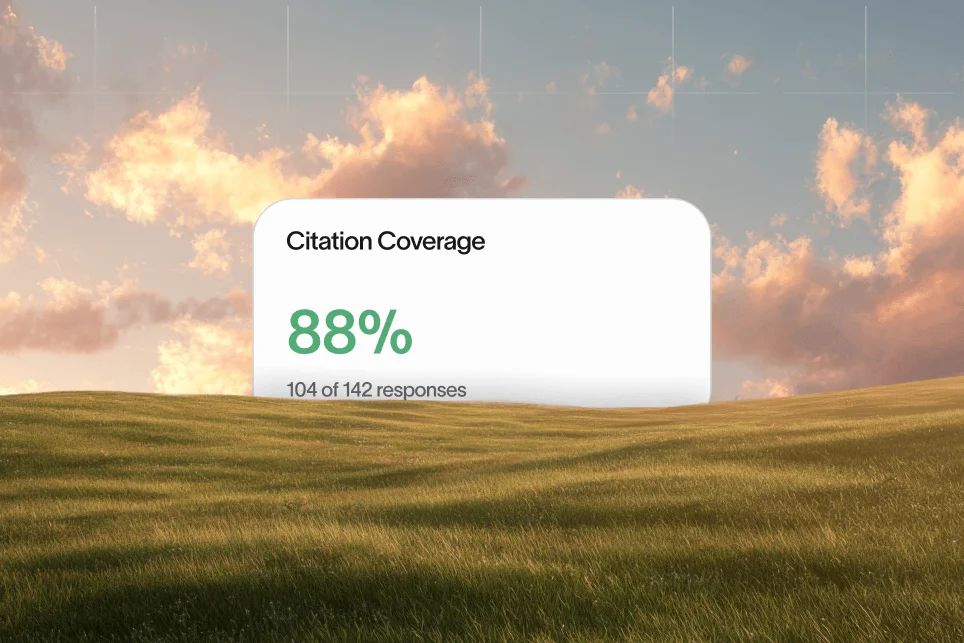
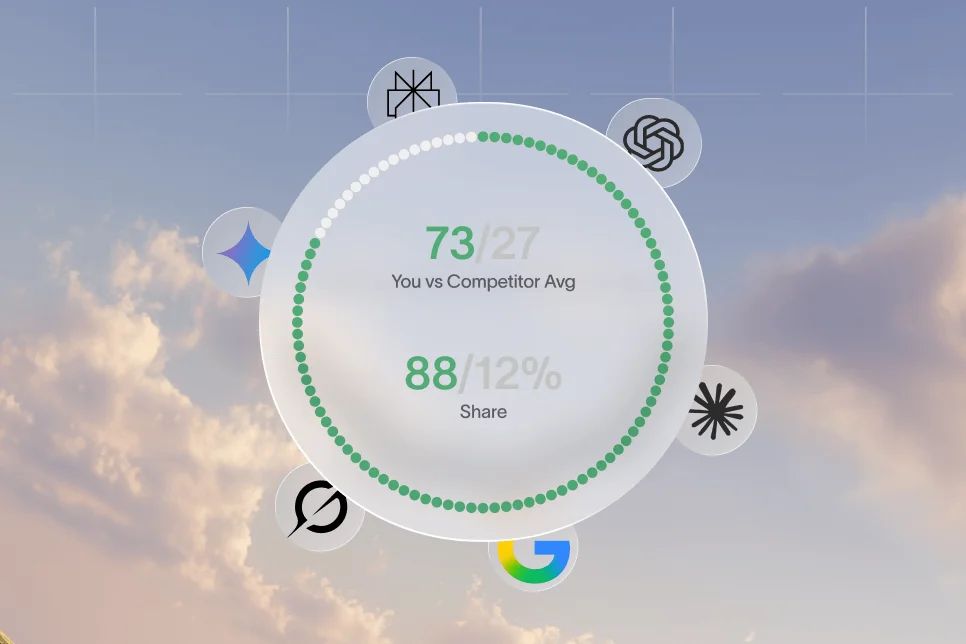
Citation coverage is how often your brand (and your pages) are used as a source in AI answers for the questions you care about.
Not just mentioned. Not just implied.
Cited.
That’s important because citations create a chain:
- Impression (the AI answer shows up)
- Inclusion (your brand is in the answer)
- Citation (your URL is a source)
- Click (the user wants proof or depth)
- Conversion (demo, trial, signup)
If you’re missing step 2 or 3, you’re optimizing the wrong funnel.
Where citation gaps usually come from
In practice, the gap usually isn’t because “AI doesn’t like you.” It’s structural.
Here are the patterns I keep seeing when we audit teams:
- You have the info, but it’s buried. A great explanation exists… inside a webinar recap, a PDF, or paragraph 17 of a blog post.
- You cover the topic, but not the question. Your page is “What is SOC 2?” but the prompt is “SOC 2 vs ISO 27001 for startups.” Different intent.
- Your page doesn’t feel citeable. No definitions, no lists, no clear claims, no scannable sections.
- Competitors have comparison pages. You have feature pages. They have “X vs Y” and “best for” pages.
- Your technical layer blocks extraction. Rendering issues, canonicals, weak internal linking, missing schema—so the AI system can’t confidently pull and attribute.
If you want the technical checklist side of this, Skayle’s breakdown of crawl and extract fixes is a solid reference.
The CITE Gap Method you can run every month
Most teams fail here because they treat AI visibility like SEO rank tracking: watch numbers move, then argue about it in a meeting.
Instead, you want a tight loop that turns “we aren’t cited” into “here’s the page we’re shipping next week.”
Here’s the framework I use:
The CITE Gap Method: Collect → Identify → Triage → Execute.
It’s simple on purpose. If it’s not repeatable, it doesn’t compound.
Collect: build a controlled set of prompts
You’re not tracking “all prompts.” You’re tracking the prompts that represent:
- your revenue topics (the ones that lead to pipeline)
- your product category language
- buyer comparisons and objections
You’ll do this in two ways:
- Top-down: start from your existing keyword universe (GSC, Ahrefs, Semrush)
- Bottom-up: start from sales calls, objections, competitor pages, and “vs” queries
Tools you’ll likely touch:
- Google Search Console for queries you already show up for
- Ahrefs or Semrush for competitor discovery
- A spreadsheet (or database) for the prompt inventory
Identify: capture who gets cited, and where
For each prompt, you’re recording:
- which brands are mentioned
- which URLs are cited
- what type of page is being cited (blog, comparison, docs, community, etc.)
- whether the answer is informational, evaluative, or transactional
If you’re doing this manually, you’ll hate your life by prompt #40.
This is where a system matters. Skayle’s AI search visibility approach is designed around turning this into an operational workflow instead of a one-off audit.
Triage: decide what’s worth fixing first
Not every gap matters.
A prompt like “what is data encryption” might be high volume, but it’s often low intent and crowded.
A prompt like “best SOC 2 compliance software for Series A startups” might be lower volume, but it’s closer to money.
Your triage should answer:
- Is the prompt tied to a buying stage?
- Do we have a page that should be cited?
- If we don’t, can we create a page that’s uniquely useful?
Execute: close the gap with specific page work
Execution isn’t “write an article.”
Execution is a scoped set of changes that increase extraction and trust:
- publish the missing page type (often comparison)
- restructure the existing page to be citeable
- add schema and internal links so the page becomes the obvious source
- align the page with conversion (because citations without conversion are just ego)
If you’re building a system for this (not a one-time sprint), Skayle’s guide to answer-ready SEO systems is the right mental model.
Building a prompt set that mirrors real buying questions
This is the part teams rush, and it breaks everything downstream.
If your prompt set is fluffy, your gap report becomes a vanity report.
The three prompt buckets that actually matter
I usually group prompts into three buckets. You can steal this.
Category definition prompts (problem-aware)
- “What is endpoint monitoring?”
- “How does warehouse automation work?”
Evaluation prompts (solution-aware)
- “Endpoint monitoring vs SIEM”
- “Best warehouse automation software for mid-market”
Decision prompts (vendor-aware)
- “Datadog vs New Relic for Kubernetes”
- “Is Vendor X HIPAA compliant?”
Notice what’s missing: generic “top of funnel” prompts that never turn into deals.
How many prompts you need (and how to pick them)
You don’t need 1,000 prompts to start.
A good first pass is 60–120 prompts split across:
- 10–20 category definitions
- 25–50 evaluation prompts
- 25–50 decision prompts
Those ranges are not a benchmark. They’re just a practical unit of work.
If you want a simple selection method:
- Pull 20 queries from GSC that already drive clicks.
- Pull 20 competitor “vs” and “alternative” topics.
- Pull 20 sales-objection questions from call notes.
That’s your first 60.
Don’t test prompts like a marketer—test them like a buyer
Here’s a contrarian stance I’ll defend:
Don’t chase the prompts you wish buyers asked. Track the prompts buyers ask when they’re about to switch.
That means your prompt set should include:
- switching triggers (“alternatives”, “replace”, “migrate from”)
- pricing and packaging questions
- “best for” constraints (team size, industry, compliance)
- integration concerns (“works with”, “compatible with”)
And yes, it means you’ll end up writing “boring” pages.
Those pages get cited.
Where to run the prompts (so you don’t fool yourself)
Run prompts across multiple systems because outputs differ.
At minimum, I’d sample:
- ChatGPT
- Perplexity
- Claude
- Google surfaces where you can observe citations and source links, using Google’s own guidance via Search Central
If you’re testing in a logged-in environment, note it. Personalization and history can change results.
A gap report format your team will actually use
If your gap report is a 40-tab spreadsheet that only you understand, it dies the moment you take PTO.
You want a format that makes decisions obvious.
The minimum viable columns
Here’s the simplest structure that still works.
For each prompt, capture:
- Prompt text
- Intent stage (definition / evaluation / decision)
- Our citation? (yes/no)
- Our cited URL (if yes)
- Competitors cited (brand + URL)
- Page type cited (comparison, blog, docs, category page)
- Fix type (new page / refresh / restructure / technical)
- Priority score (we’ll define it next)
- Owner
- Ship date
This is also where having a structured content system helps. If your “page type” isn’t defined anywhere, you’ll struggle to scale programmatic and refresh work. (Skayle’s programmatic engine guide is a good reference for how teams formalize templates and data layers.)
A simple scoring model that doesn’t lie
I like scoring models that don’t pretend to be more precise than they are.
Use a 0–3 score for each factor:
- Revenue proximity (0–3): how close is this prompt to a demo/trial decision?
- Winnability (0–3): do we already have a relevant page and authority?
- Citation delta (0–3): how many competitor citations appear where we have none?
- Conversion readiness (0–3): if we get the click, will the page convert?
Total score: 0–12.
This avoids fake math like “search volume x CPC x domain rating.”
If you want to make it slightly more grounded, you can add a binary flag:
- “This prompt has surfaced in sales calls: yes/no”
Sales truth beats tool estimates.
Example: what a single-row decision looks like
Let’s do an example row (made-up prompt, real process).
- Prompt: “Best SOC 2 compliance software for startups”
- Intent: decision
- Our citation: no
- Competitors cited: 3 vendors + 1 review site
- Page type cited: comparison list + vendor category pages
- Fix type: new page (category roundup) + add “best for startups” section to product page
- Priority score: 10/12
That row should lead to a clear next step: ship the page type the AI is already citing.
Visual you should build (so leadership gets it)
Create a simple 2x2 chart:
- X-axis: revenue proximity (low → high)
- Y-axis: citation coverage (low → high)
Plot prompts as dots.
Then circle the “high revenue / low coverage” quadrant.
That quadrant is your roadmap.
If you’re presenting this, put it in Looker Studio so it stays live, and store raw logs in something queryable like BigQuery if you have volume.
Closing gaps: content, technical SEO, and conversion cues
Most people jump straight to “write more.”
That’s usually the wrong move.
You close citation gaps by increasing:
- extractability (AI can pull clean answers)
- trust (AI systems prefer sources that feel stable and authoritative)
- fit (page matches the prompt intent)
- conversion readiness (clicks turn into pipeline)
The fastest content patterns for citation wins
If you’re behind, start with page types that AI answers love to cite:
Comparison pages
- “X vs Y”
- “X alternatives”
- “best X for Y”
Decision support pages
- “pricing explained”
- “security and compliance”
- “implementation timeline”
Definition pages with sharp structure
- short definition
- when to use / when not to
- common mistakes
- comparison to adjacent concepts
A lot of teams already have the raw material. It’s just scattered.
A restructure template I keep reusing
When a page should be cited but isn’t, I’ll often restructure it like this:
- 40–80 word direct answer paragraph
- “Key takeaways” (3–5 bullets)
- “Step-by-step” (numbered list)
- “Common mistakes” (bullets)
- “Decision checklist” (short)
- FAQ
This isn’t for Google.
It’s for extraction.
If you’re trying to systematize refreshes like this across a library, you’ll want a process similar to Skayle’s content refresh approach.
The technical layer that makes citations more likely
You don’t need exotic tricks.
You need basics done consistently:
- Clean canonicals: don’t split signals across duplicate URLs
- Indexability: obvious, but you’d be surprised
- Internal links: make sure your “citable” page is easy to discover
- Structured data: give machines a predictable shape
For schema, stick to what’s supported and relevant. Start at Schema.org and implement using Google’s structured data documentation. If you’re generating JSON-LD, follow Google’s JSON-LD guidance.
One practical note: don’t spam schema types. Add the one that matches the page.
The conversion part everyone forgets
Citations are upstream.
But if you finally earn the click and the page looks like a generic blog post, you waste the moment.
When I’m fixing a citation gap, I’ll check:
- Does the first screen confirm “you’re in the right place”?
- Is there a clear comparison table (even a simple one)?
- Is the CTA aligned to intent? (demo for decision-stage, newsletter for definition-stage)
- Is there proof? (customer names, screenshots, integration lists, security badges)
If you want to be cited and convert, you need both:
- an answer-ready section for AI extraction
- a decision-ready section for humans
The action checklist (run this on your top 10 gaps)
Take the top 10 prompts in your “high revenue / low coverage” quadrant and do this:
- Confirm the intent. Write the one-sentence “what they’re really asking” under the prompt.
- List current cited sources. Capture the 3–8 URLs that appear most often.
- Classify the page type. Comparison? Docs? Review? Category page?
- Decide: build or rebuild. If you don’t have the page type, create it. If you do, restructure it.
- Add a citeable block. 40–80 words + bullets + a numbered list.
- Add schema that matches. Don’t overdo it.
- Strengthen internal links. Link from high-authority pages to the gap page.
- Instrument the click path. Track clicks, assisted conversions, and demo starts.
- Re-run prompts weekly for 4 weeks. Look for new citations, not vibes.
- Refresh what starts to slip. Treat it like rankings: decay happens.
If you’re building this as an ongoing motion, you’ll also want monitoring. Skayle’s take on ASV monitoring explains why the “we don’t track it” tax is real.
Proof block (process evidence you can replicate)
Here’s a version of what this looks like when it’s working—not as a promise, but as a measurable plan.
- Baseline: you run 80 prompts and get cited on 9 of them, mostly on definition-stage questions.
- Intervention: you ship 6 pages (4 comparisons, 2 decision pages), restructure 10 existing pages with citeable blocks, and fix internal links + schema on the top 20 pages.
- Expected outcome: within 4–8 weeks, citations start showing up first on the new comparison pages, then on refreshed pages for evaluative prompts.
- Timeframe and instrumentation: weekly re-runs of the prompt set, plus click/conversion tracking in Google Analytics or your product analytics like Amplitude or Mixpanel.
The key is that the loop is closed. You’re not “doing AI visibility.” You’re shipping specific assets tied to specific missing citations.
Common mistakes that make citation tracking useless
Most of these are self-inflicted.
- Tracking only brand prompts. “What is {your company}?” will make you feel good and teach you nothing.
- Mixing intent stages. A definition prompt and a purchase prompt shouldn’t share the same KPI.
- Ignoring page type. If AI is citing comparisons and you keep publishing thought leadership, you’re playing a different game.
- Over-optimizing for mentions, not citations. Mentions don’t create attributable traffic.
- Not refreshing. AI answers drift as the web changes. Treat your citeable pages like living assets.
If you want a deeper “what changes now” view, Skayle’s breakdown of GEO vs SEO frames the tradeoffs well.
FAQ: Measuring your citation coverage gap
How is a citation coverage gap different from a content gap?
A content gap is “we don’t rank for this keyword.” A citation coverage gap is “AI answers cite competitors for this question, and we’re missing from the sources.” The fix is often page type + structure, not just another article.
Do I need to rank on page one to get cited?
Not always. AI systems pull from sources that are clear, trustworthy, and easy to extract from, and those can be outside the top 3 results. But if you’re invisible in organic search entirely, it’s harder to build sustained citations.
What pages tend to earn citations fastest?
Comparison pages and decision support pages (pricing, security, implementation) tend to show up quickly because they match evaluative prompts. Definition pages can work too, but only when they’re structured with direct answers, lists, and clear distinctions.
How often should I re-run my prompt set?
Weekly is ideal for the first month after changes, then monthly once you’ve stabilized. The goal is to detect drift early, not to watch numbers for entertainment.
What’s the minimum tracking setup I need?
A prompt inventory in a spreadsheet, a consistent place to run prompts, and a way to log citations and URLs. Then tie cited URLs to clicks and conversions in GA4, Amplitude, or Mixpanel so “AI search visibility” connects to pipeline.
Should I block AI crawlers if they don’t send traffic?
Usually no. If your market uses AI answers, being excluded often hurts more than it helps because competitors become the default cited sources. The better play is to make your best pages citeable and conversion-ready so citations turn into high-intent clicks.
If you want to see where you’re already showing up—and where competitors are getting cited instead—measure your AI search visibility with a repeatable prompt set and a gap report your team can ship against. If you want a second set of eyes on your prompt list or scoring model, book time and I’ll ask a few questions about your category and sales cycle—what are the 10 prompts you’d be upset to lose to a competitor this quarter?