
TL;DR
Product-led programmatic SEO turns SaaS product data into scalable landing pages that rank and earn AI citations. Start with one defensible dataset, build a deep template, publish in controlled batches, and measure indexing, conversion, and citation coverage by template type.
Product-led programmatic SEO is how SaaS companies turn their own product data into hundreds or thousands of landing pages that match high-intent searches. Done well, it compounds: each new dataset becomes a reusable page type, each page strengthens a cluster, and each cluster improves both rankings and AI citations.
Programmatic SEO works when the “program” is the product: real entities, real constraints, and real comparisons that users (and AI systems) can verify.
This guide covers: how to choose datasets, how to design templates that aren’t thin, how to roll out in controlled batches, and how to make pages extractable for AI answers.
Product-led programmatic SEO: the 2026 definition and business case
Programmatic SEO is often misread as “mass publishing.” In SaaS, it is closer to “structured product marketing at search scale.”
A precise definition helps:
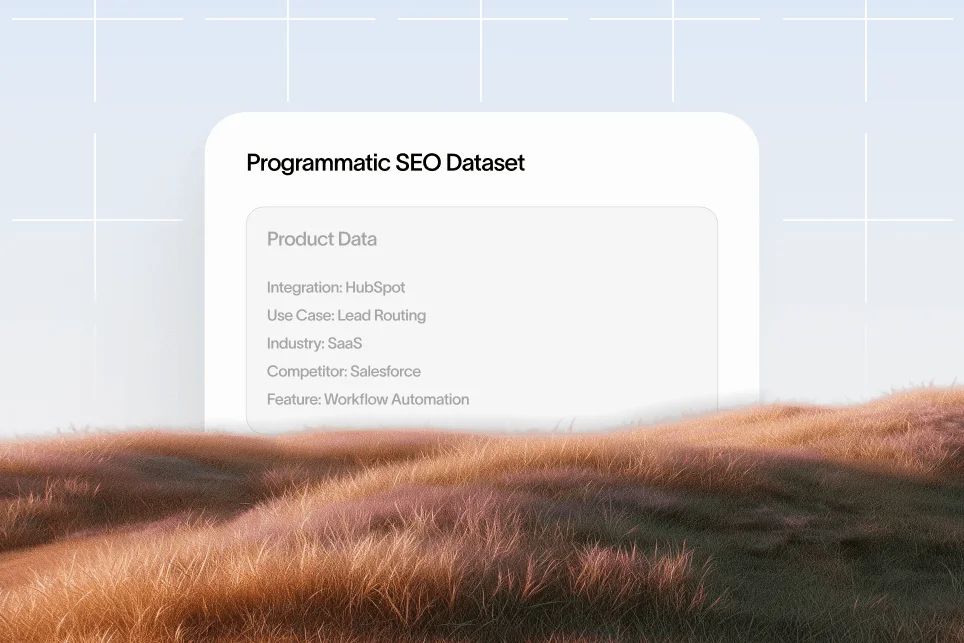
Product-led programmatic SEO is the practice of generating scalable, indexable landing pages from verified product data (integrations, use cases, industries, competitors, ICP attributes) to capture long-tail demand and drive conversions. The core is the data layer and template logic, not the writing velocity.
That definition matches how programmatic SEO is framed for B2B SaaS: unique product data populates repeatable page templates, commonly around integrations, use cases, or comparisons, with human review to avoid low-value pages (as described in Apricot Studio’s 2026 overview of programmatic SEO for B2B SaaS at Apricot Studio).
Why it matters more in 2026 than it did in “classic SEO”
Three shifts make product-led programmatic SEO more valuable now:
- SERPs are crowded with summary layers. AI Overviews and answer experiences compress clicks, which increases the value of pages that are reference-worthy and transaction-adjacent.
- Long-tail searches still exist, but they fragment. Users search in “combo intent”: tool + integration + use case + industry. Programmatic pages map cleanly to that structure.
- Teams need repeatable execution. Programmatic SEO replaces “new page = new project” with “new page = a new row in a dataset,” which is the only realistic way to scale without adding headcount.
Point of view: don’t scale pages; scale decisions
Most programmatic SEO failures come from scaling output before scaling governance.
The contrarian stance is simple: publishing 5,000 pages is not a moat if 4,000 of them can’t be defended as uniquely useful. A smaller, defensible dataset plus a deep template will outperform a huge shallow inventory over time because it earns links, engagement, and citations.
What “good” looks like (and what to measure)
A programmatic SEO program should be measured as a system, not a page-by-page lottery. The baseline measurement set should include:
- Indexing rate by template type (indexed / submitted)
- Impressions and clicks by template type
- Non-brand conversion rate for programmatic landers (trial, demo, signup)
- Assisted conversions (programmatic lander → later conversion)
- AI citation coverage (prompts where competitors are cited and the brand isn’t)
For teams that want a citation-specific measurement layer, Skayle has covered the workflow for identifying prompt-level gaps in citation gap measurement, which becomes more actionable when tied to template types.
Proof that the model can compound (with real baselines)
A concrete example of compounding impact comes from a SaaS programmatic SEO case study published by Suso Digital: it reports 398% monthly organic traffic growth, from 1,920 to 9,571 users/month over 18 months, attributed to a scalable programmatic approach (Suso Digital).
That result should not be generalized as “typical.” The operational takeaway is what matters: the timeline is long enough to reflect compounding, not just a temporary spike, and it reinforces why controlled rollout and refresh loops are non-negotiable.
The PLATE framework for picking datasets and page types
Picking the dataset is the real strategy. Everything else is mechanics.
A practical model used by strong SaaS teams is a five-part decision framework that forces discipline before templates are built.
The PLATE Framework (named so it’s easy to reference internally):
- P — Product entities: What objects are true and stable in the product? (Integrations, features, workflows, industries, roles, competitors, compliance standards.)
- L — Long-tail demand patterns: What query structures repeat? (“X integration with Y”, “X for Y industry”, “alternative to X”, “best X for Y”.)
- A — Advantage proof: What can be shown with data, not adjectives? (Supported triggers, limits, compatibility, setup steps, screenshots implied by the product reality.)
- T — Template depth: Can the page carry 800–1,500 words of distinct value without fluff? If not, it’s not a page type.
- E — Expansion path: If the pilot works, what is the next dataset that reuses 70% of the template logic?
High-performing SaaS datasets (and what makes them “product-led”)
Product-led programmatic SEO works best when the dataset lines up with how buyers evaluate software.
Common SaaS page families:
- Integration pages: “Product + Salesforce integration” (with setup steps, supported triggers/actions, limitations).
- Use-case pages: “Product for customer onboarding” (with workflows, templates, role-based outcomes).
- Industry pages: “Product for fintech marketing teams” (with compliance considerations, reporting needs).
- Comparison pages: “Product vs Competitor” (with decision criteria and feature constraints).
- Template/resource pages: “Email sequence templates for X” when tightly connected to product execution.
Apricot Studio explicitly calls out integrations and use cases as common SaaS programmatic page types built from product data (Apricot Studio). SmartClick’s 2026 implementation guide also frames programmatic execution around scalable SaaS landing pages and template-driven production (SmartClick Agency).
When programmatic SEO should be delayed
Some companies should not start with programmatic SEO. The warning signs are operational:
- Product data is inconsistent (integration names, statuses, or plan availability change weekly without a source of truth).
- The brand can’t support claims with documentation.
- Analytics cannot separate template types.
- Internal linking rules don’t exist.
In those cases, it is better to first build the content infrastructure and governance. Skayle’s view is that a stable foundation reduces crawl waste and improves extractability; the technical audit approach is outlined in SEO infrastructure systems.
Template anatomy: depth, trust, and conversion
A programmatic template should read like a product marketer and a solutions engineer collaborated, not like a text spinner.
The goal is to produce pages that:
- rank (search relevance + internal authority)
- get cited (extractable answers + entity clarity)
- convert (clear next steps tied to intent)
The minimum viable “deep template”
A strong programmatic SaaS landing page typically includes these blocks, in this order:
- One-sentence outcome statement (what the user can do)
- Compatibility and requirements (plans, prerequisites, limitations)
- Setup walkthrough (steps, time estimates, ownership)
- Common workflows (3–5 scenarios with concrete inputs/outputs)
- Troubleshooting / edge cases (what breaks, how to fix)
- Security / compliance notes (only if relevant and accurate)
- Alternatives / decision criteria (help the buyer choose, even if it’s uncomfortable)
- CTA aligned to intent (demo for enterprise workflows, trial for self-serve)
This is how a template avoids “thinness.” It earns its indexability by carrying operational detail that cannot be mirrored without product knowledge.
Conversion design for programmatic pages (the part most teams skip)
Programmatic pages often get traffic but under-convert because they inherit blog UX. A product-led template should instead:
- Repeat the CTA after each decision block (compatibility, workflows, comparison)
- Use intent-matched CTAs (e.g., “See supported triggers” → product docs; “Book a demo” for complex setups)
- Add micro-proof near friction points (uptime commitments, support response, migration effort)
The conversion goal isn’t “push harder.” It’s to reduce uncertainty at the exact moment the visitor is checking constraints.
A practical internal linking pattern that compounds
Programmatic SEO pages tend to exist as islands unless links are planned.
A proven approach is:
- Each template type rolls up into a hub (e.g., /integrations/, /use-cases/, /industries/).
- Each page links to:
- the hub
- 2–4 related pages within the same template type
- 1–2 “explainer” pages (glossary, conceptual guide)
This is where topic cluster architecture matters. If the site is building hubs intentionally, the linking rules should be standardized. Skayle breaks down those rules in topic cluster architecture and shows how to operationalize it with internal linking automation.
“Dynamic” templates are now expected
Static templates are easier, but they waste a 2026 advantage: datasets can be updated in near real time, and pages can reflect that without full rewrites.
Gracker’s 2026 programmatic playbook emphasizes dynamic templates that integrate real-time data sources and pair them with schema markup (Gracker.ai). The key operational implication for SaaS teams is governance: if the page can change automatically, change control needs to exist (versioning, approvals, rollback).
Rollout plan: pilot batches, index controls, and refresh loops
The difference between “programmatic SEO that works” and “programmatic SEO that hurts the domain” is rollout discipline.
A 90-day rollout that prioritizes learnings over volume
Averi.ai’s 2026 playbook recommends launching in batches and monitoring indexing and performance before scaling. It explicitly suggests publishing 50–100 test pages in Weeks 1–2, monitoring indexing in Weeks 3–4, and analyzing performance in Weeks 5–6 before scaling further (Averi.ai).
Zumeirah also recommends starting with a mini-dataset of 20–50 rows and piloting around 50 pages, then monitoring for roughly 30 days before expanding (Zumeirah).
Combined, those ideas form a practical rollout logic:
- Prove indexing behavior with a small dataset.
- Prove engagement and conversion with a realistic template.
- Only then scale pages and datasets.
A 10-point launch checklist for product-led programmatic pages
This is the point where most teams miss basics and then blame Google.
- Define one template type (integration OR use case) for the pilot.
- Audit the dataset for duplicates, missing values, and naming collisions.
- Write and approve the template’s “truth rules” (what can never be claimed without support).
- Build URL patterns and breadcrumbs that match hub structure.
- Ship a dedicated XML sitemap for that template type.
- Add canonical logic for parameter variants and near-duplicates.
- Implement noindex rules for incomplete rows (or “coming soon” states).
- Instrument analytics by template type (content grouping or URL regex).
- Publish 50–100 pages, then wait for indexing signals before scaling.
- Schedule the first refresh cycle at day 30 (data updates + content improvements).
This is also where infrastructure work matters. For teams scaling to thousands of pages, crawl and index controls need to be designed upfront; Skayle’s programmatic scaling guidance covers those mechanics in programmatic SEO infrastructure.
Common failure modes (and what to do instead)
These issues show up repeatedly in SaaS programmatic SEO programs:
Failure mode: thin “SEO copy” above the fold.
Fix: move constraints and setup steps earlier; reduce generic “benefits.”
Failure mode: duplicate intent across templates.
Fix: map each page type to one primary job-to-be-done; use canonicalization and hub rules.
Failure mode: indexing spikes, then deindexing.
Fix: scale slower; strengthen internal linking; improve uniqueness in the data blocks.
Failure mode: traffic with low conversion.
Fix: align CTA to intent stage; add workflow-specific proof and edge cases.
Scaling beyond the pilot without breaking quality
Scaling is not “more pages.” It is “more datasets with the same governance.”
DesignRevision’s 2026 SaaS SEO playbook frames programmatic expansion as something that should accelerate after foundational clusters exist, expanding to new datasets and page types later in the lifecycle (often months 9–18) (DesignRevision).
That staged approach protects brand trust. It also aligns with an operational reality: the first template is the hardest because it sets the rules.
Volume is possible, but it’s not the target
CapGo’s 2026 write-up describes scaling output with AI to large volumes, citing an example of 150 pages × 10 languages = 1,500 pages/month (CapGo.AI).
That scale can be useful for multi-market SaaS. The caution is that multilingual programmatic SEO multiplies governance complexity: entity consistency, hreflang logic, canonical rules, and conversion tracking per market.
GEO-proofing: earning citations in AI answers
Ranking is no longer the only visibility outcome that matters. In 2026, AI answers can act like a “pre-click SERP,” and the citation line is often the only brand exposure.
The funnel that matters is: impression → AI answer inclusion → citation → click → conversion.
What AI systems tend to cite (and why programmatic pages can win)
AI answer systems cite sources that are:
- specific (clear entities and constraints)
- consistent (repeatable facts across pages)
- extractable (clean structure, lists, definitions)
- defensible (not just opinions)
Programmatic templates can produce those qualities if the page is built around verifiable blocks: requirements, workflows, supported features, and limitations.
Schema and structure: treat extraction as a product requirement
GEO isn’t “adding schema and hoping.” It’s ensuring the page’s key facts are easy to extract and hard to misinterpret.
Practical steps that tend to help:
- Add schema aligned to the page type (SoftwareApplication, FAQPage where appropriate, HowTo for setup steps when accurate).
- Use stable headings and list blocks for repeatable extraction.
- Maintain a clean entity layer (product name, integration names, competitor names) across pages.
For teams building a structured data layer specifically for citations, Skayle’s structured data blueprint and its complementary AI Overviews technical playbook give a modern checklist of what tends to break extraction.
Measuring “citation coverage” at template level
Citation tracking is most useful when it is mapped to templates:
- Are integration pages cited for “X integrates with Y” prompts?
- Are comparison pages cited for “best alternative to X” prompts?
- Are use-case pages cited for “how to do X workflow” prompts?
This is why reporting needs to connect to action. Teams should treat prompts as “queries” and templates as “landing page families,” then prioritize fixes where the gap is largest. A practical way to design that system is outlined in Skayle’s AI visibility tooling guide.
ROI claims: keep them source-bound and operationally honest
Apricot Studio cites a benchmark that specialized programmatic strategies can show 340% average ROI when built from unique SaaS data with human review (attributed there to SeoPage.ai data) (Apricot Studio).
That number may not apply to every company. The practical takeaway is: ROI comes from high-intent page types (integrations, comparisons, use cases) plus conversion-ready templates—not from publishing “more content.”
Zumeirah also claims that programmatic SEO targets high-intent long-tail queries that can yield 30–50% higher conversion rates than blog readers (Zumeirah). Teams should treat this as a hypothesis to validate in their own analytics by comparing conversion rates across content types.
A simple measurement plan that avoids guesswork:
- Baseline: last 30 days conversion rate on existing SEO landing pages.
- Target: +15–25% relative lift on the pilot template type.
- Timeframe: 60 days post-indexing stabilization.
- Instrumentation: conversion events + template-level grouping + assisted conversion reporting.
FAQ: product-led programmatic SEO for SaaS
How is product-led programmatic SEO different from “regular” programmatic SEO?
Product-led programmatic SEO uses verified product data (integrations, limits, workflows, compatibility) as the differentiator, not generic keyword variations. It produces pages that are defensible because they map to real entities and constraints.
What’s the safest first page type to pilot?
Integration pages are often the safest because they have clear intent and naturally support depth: prerequisites, setup steps, triggers/actions, and troubleshooting. A focused pilot also makes indexing and conversion behavior easier to diagnose.
How many pages should a SaaS company publish in the first batch?
Several 2026 playbooks recommend starting small. Averi.ai suggests publishing 50–100 test pages early, then monitoring indexing before scaling (Averi.ai), while Zumeirah recommends a mini-dataset of 20–50 rows as a pilot (Zumeirah).
What causes programmatic pages to get deindexed?
The most common causes are thin templates, duplicate intent across pages, and datasets that produce near-identical content blocks. Fixes usually involve adding unique, product-specific blocks (workflows, constraints) and improving internal linking so Google understands the template family.
How should teams handle “coming soon” integrations or incomplete data rows?
They should not be indexed. Treat incomplete rows as internal inventory: keep them accessible for users via on-site UI if needed, but apply noindex and exclude them from sitemaps until the data is complete enough to justify an indexable page.
Does programmatic SEO help with AI citations?
It can, if the pages are structured for extraction: stable headings, list blocks, clear definitions, and schema aligned to the page type. Without that structure, programmatic pages can rank yet still fail to be cited because AI systems struggle to extract reliable facts.
If a SaaS team is considering programmatic SEO in 2026, the fastest path to clarity is a controlled pilot: one dataset, one deep template, and one measurement dashboard that ties indexing, conversions, and citation coverage together. To see how that measurement layer can work in practice, teams can measure AI visibility and use the results to prioritize which template types to improve first.
References
- Averi.ai — Programmatic SEO for B2B SaaS Startups: The Complete 2026 Playbook
- DesignRevision — The SaaS SEO Playbook: Complete Guide (2026)
- CapGo.AI — Ultimate Guide – The Best Programmatic SEO Service of 2026
- Gracker.ai — 2026 Programmatic SEO Playbook: AI, Real-Time Data, and Market Domination
- Zumeirah — Programmatic SEO In 2026: The Best Guide To Scaling Traffic
- Apricot Studio — Why traditional SEO is failing B2B SaaS companies (and what works in 2026)
- Suso Digital — 398% Monthly Traffic Growth: SaaS Programmatic SEO Case Study
- SmartClick Agency — Programmatic SEO for SaaS: Implementation Guide (2026)