TL;DR
If organic growth won’t compound, the bottleneck is often content infrastructure: update workflows, information architecture, production consistency, actionable reporting, and conversion-ready templates. Fix the system first, then scale output so rankings and AI citations compound.
Compound organic growth doesn’t stall because the team “needs more content.” It stalls because the operating layer behind content can’t support volume, change, or measurement without heroics.
A simple definition that holds up in practice: content infrastructure is the repeatable system—people, process, data, and tooling—that turns ideas into indexable, updateable pages that earn clicks and citations.
Point of view: If organic growth is supposed to compound, content cannot be treated like a series of one-off projects. In 2026, AI answers and citations reward sources that are consistent, structured, and easy to verify. A messy workflow doesn’t just slow publishing—it reduces trust signals that AI systems use to decide what to cite.
The Content Infrastructure Stack
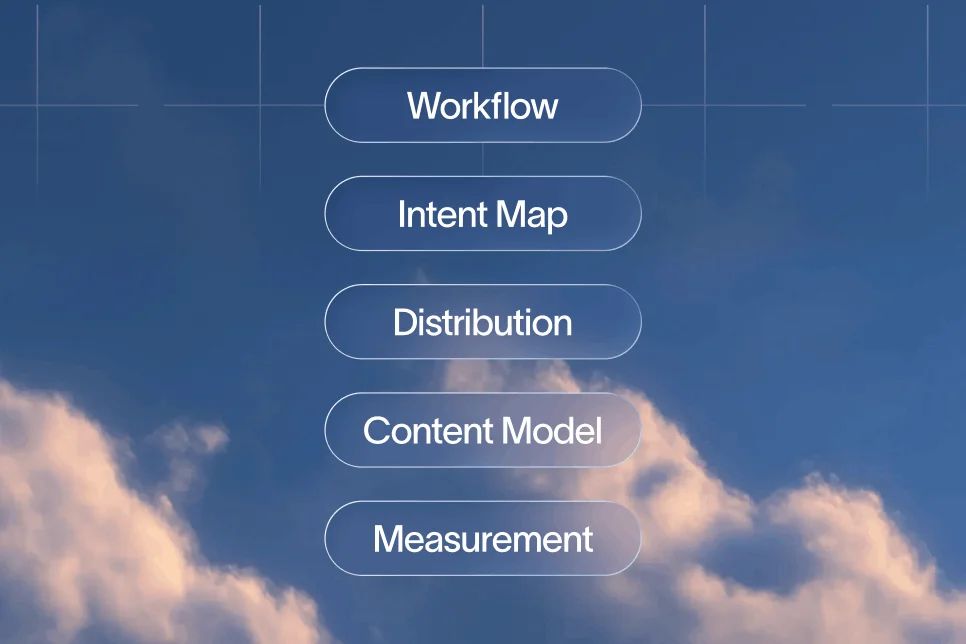
When diagnosing why organic growth won’t compound, look at the same four layers every time:
Intent map: what topics the business should own, tied to pipeline and use-cases.
Content model: templates, fields, and page structure that keep pages consistent and extractable.
Production workflow: briefs → drafts → reviews → publishing → refreshes, with clear ownership.
Distribution + measurement: internal links, indexation, updates, and reporting that drives action.
If any layer is brittle, “publish more” becomes the wrong answer.
1) Your team ships pages, but can’t ship updates without breaking things
A content program compounds when old pages keep earning.
The tell is simple: publishing a new page feels doable, but updating a page feels risky. It’s a sign the underlying content infrastructure is brittle.
What it looks like day-to-day
Updates are handled via manual doc edits, Slack pings, and “please don’t touch this section” warnings.
Product messaging changes, but top pages keep the old positioning for months.
No one can answer: “Which 50 pages drive most assisted conversions?” without rebuilding a spreadsheet.
This is an infrastructure problem, not a writing problem.
As Agility CMS frames it, content infrastructure is about structured workflows for defining, saving, approving, publishing, retrieving content, and triggering processes in an orderly way, as described in Agility CMS’s explanation of content infrastructure. If retrieval and change are painful, compounding slows.
Why it matters more in 2026
In an AI-answer world, the “latest trustworthy version” wins. That doesn’t always mean “new.” It means:
consistent definitions
stable page structures
obvious provenance (what is this page and who is it for?)
fast refresh cycles when the product or market changes
If your update loop is fragile, you train the org to avoid updates. Organic growth becomes linear.
A practical proof block (expected outcome, not a promise)
Baseline: A SaaS knowledge base has 180 pages. The top 30 pages drive most organic entry sessions, but 20 of those pages haven’t been updated since a pricing and positioning change.
Intervention: Define a “top pages refresh queue” (top entries + top conversion assists), standardize sections, and implement a two-person review process.
Expected outcome: 30 pages refreshed in 4–6 weeks, with messaging consistency restored and fewer conversion drops from “out-of-date intent.”
Timeframe: 6 weeks to complete the first refresh cycle; ongoing monthly queue thereafter.
The key is that the update process becomes repeatable, not heroic.
AI visibility angle: updates create citation stability
AI systems prefer sources that look maintained and internally consistent. A page that gets refreshed on a predictable cadence is easier to trust than an “SEO relic.” If you’re actively closing citation gaps, pair this with a clear workflow to fix LLM citation gaps so high-intent pages don’t disappear from AI answers when the market moves.
2) You can’t explain your information architecture without drawing it on a whiteboard
If the site structure only exists in someone’s head, the infrastructure is already failing.
A healthy content infrastructure makes the site’s content architecture legible:
what the core topics are
what supporting pages exist
how users (and crawlers) move between them
What it looks like when architecture is the bottleneck
Topic clusters exist in a doc, but the site doesn’t reflect them.
Multiple pages compete for the same intent (cannibalization), because no one owns the map.
Internal linking is ad hoc, because templates don’t enforce relationships.
When this happens, “more content” often makes performance worse.
Contrarian stance: stop publishing until the map is stable
Don’t scale content output if the architecture is unstable.
Do this instead:
define 10–20 core topics you intend to own
decide which page type represents “the hub” vs “the support” vs “the comparison/alternative”
enforce internal links as part of publishing, not as a later fix
This isn’t about perfection. It’s about preventing entropy.
What to fix first (in priority order)
Duplicate intent pages: pick a primary URL, merge, redirect, and standardize.
Missing supporting pages: create the minimum set that makes hubs coherent.
Internal link consistency: ensure every supporting page points to a hub and adjacent supports.
If you’re scaling lots of long-tail landing pages, the same logic applies—just with stricter template rules. This is where programmatic approaches can work if the infrastructure is solid; our 2026 playbook on scaling programmatic hubs goes deeper on how to avoid thin templates and crawl waste.
AI visibility angle: architecture becomes “retrieval infrastructure”
AI answers don’t just rank pages; they retrieve passages. Clear architecture increases the odds that:
definitions appear consistently across pages
supporting evidence is easy to locate
your brand becomes a repeated “source node” across related queries
A chaotic architecture fragments authority and reduces citation likelihood.
3) Content production depends on tribal knowledge (and that’s why velocity hits a ceiling)
Manual workflows eventually break because they rely on memory. Every time someone leaves, quality drops and the team slows.
A scalable content infrastructure makes quality predictable:
brief quality is consistent
page structure is consistent
review criteria are consistent
publishing is consistent
Where the ceiling shows up
Two writers produce very different “versions” of the same page type.
Editors spend time re-teaching the same rules.
SMEs are overused because the brief didn’t isolate what matters.
If you need a growth lead in every doc to keep it on track, you don’t have infrastructure.
The “brief-to-publish” checklist that removes heroics
Use this as a diagnostic and a build plan. The goal is to make publishing boring.
One owner per page: one person accountable for shipping and updating.
One intent per URL: define primary intent in one sentence.
Fixed section order by page type: readers and reviewers know what to expect.
Reusable proof inputs: a central place for product claims, screenshots, and definitions.
Review gates: SEO review and product accuracy review are separate steps.
Publishing criteria: indexability checks, internal links, and metadata are validated.
Refresh triggers: define what causes an update (product changes, SERP shifts, stale stats).
Post-publish QA: verify rendering, links, and tracking.
Monthly maintenance time: a small recurring block prevents “content debt.”
If this feels heavy, that’s the point: infrastructure is weight-bearing.
A concrete workflow example (what “repeatable” means)
For a SaaS feature page refresh:
Start with a fixed template (problem → use cases → how it works → FAQs → proof).
Update the proof inputs first (pricing, claims, UI language).
Update internal links last (hub pages, alternatives, implementation guides).
This sequence matters because it reduces rewrite churn.
AI visibility angle: structured writing increases extractability
AI systems cite pages that contain clean, answer-ready segments. That usually means:
concise definitions (40–80 words)
labeled lists
consistent terminology
If every writer invents a new structure, you’re making your content harder to cite.
4) Your “reporting” doesn’t tell you what to fix next
When content infrastructure is weak, reporting becomes a dashboard, not an operating tool.
The symptom: a monthly report exists, but it doesn’t change what the team does next week.
What broken reporting looks like
Rankings are tracked, but indexation problems aren’t surfaced.
Traffic is tracked, but the team can’t tie pages to conversions or assisted conversions.
Updates happen randomly, not because the system flagged a problem.
This is where organic growth stops compounding. You can’t compound without feedback loops.
What “actionable measurement” looks like
At minimum, content infrastructure should produce a weekly list of:
pages that lost visibility (and why: intent shift vs competition vs technical)
pages that are decaying (aging content, lower CTR, reduced engagement)
pages that are performing but under-monetized (high entry, low conversion)
You don’t need perfect attribution. You need consistent direction.
Why this matters now: infrastructure is the scaling constraint everywhere
The broader infrastructure market is being reshaped by scale demands across digital systems. IBM notes that infrastructure categories like hybrid cloud are forecast to grow dramatically, including a cited projection of hybrid cloud expanding to $558.6B by 2032, and broader infrastructure growth context in IBM’s overview of infrastructure. The analogy holds for content: if the system can’t scale cleanly, costs rise and outcomes stall.
McKinsey also highlights how AI-driven demand is pushing data center capacity needs to triple by 2030 with large capital requirements, as outlined in McKinsey’s infrastructure explainer. Whether it’s compute or content, scale rewards systems designed for change.
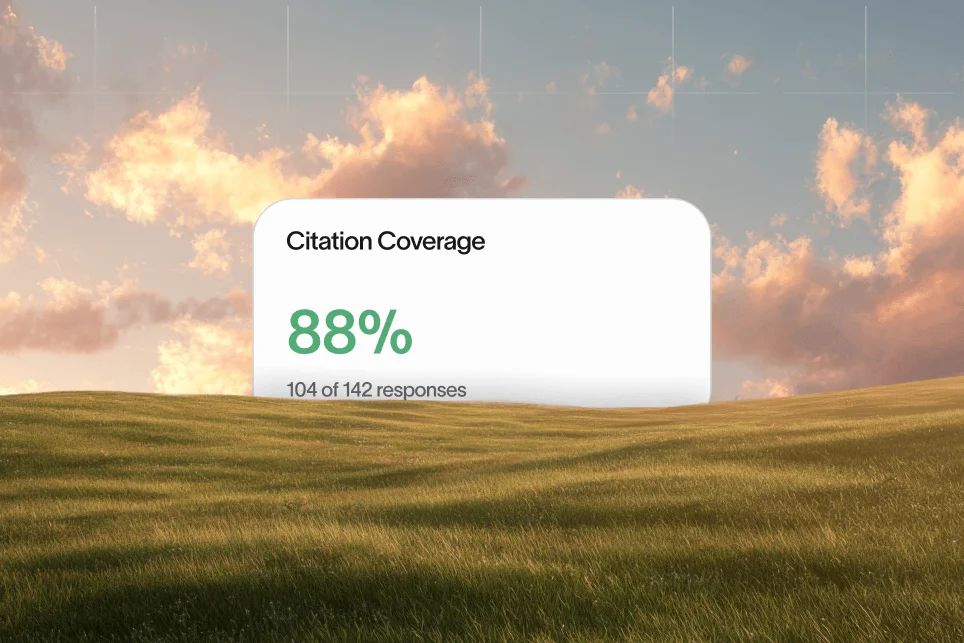
AI visibility angle: measure citation coverage, not just rankings
In 2026, “visibility” includes:
whether the brand appears in AI answers
whether the brand is cited as a source
which pages are being used as evidence
If you only track rankings, you’ll miss the visibility channel that increasingly shapes clicks.
For deeper technical hygiene that supports both ranking and citation eligibility, pair this with SEO infrastructure work that reduces crawl waste and stabilizes page quality over time.
5) You’re scaling content volume, but conversions don’t move (because the pages aren’t built to sell)
Infrastructure isn’t only operational. It’s also design and conversion structure.
When content volume rises but conversions stay flat, it’s often because the page system doesn’t include conversion intent by design.
The common pattern
Blog posts get traffic, but they don’t route readers to next steps.
Feature and use-case pages exist, but they’re inconsistent and hard to compare.
CTAs vary randomly and aren’t tied to intent stages.
That’s not “copy.” It’s missing page architecture.
How to build conversion into content infrastructure
For each page type, define:
Primary conversion: demo request, trial, sign-up, or contact.
Secondary conversion: email capture, template download, checklist, etc.
Proof requirement: what evidence must exist for the page to be credible.
Internal link requirement: where the user should go next.
Then enforce it at the template level.
A practical mini-case (baseline → intervention → expected outcome)
Baseline: A SaaS site has 60 high-intent pages (use cases, comparisons, integrations). Conversion paths vary by page, and proof sections are inconsistent.
Intervention: Standardize templates with a fixed proof block, consistent CTA placement, and internal links to adjacent “decision pages.”
Expected outcome: Higher conversion consistency across pages, fewer “dead-end” entries, and clearer next steps for both humans and AI retrieval.
Timeframe: 4–8 weeks to migrate the top pages first; then roll across the long tail.
This is how infrastructure turns traffic into pipeline.
Why “content as infrastructure” is a real business concept
Infrastructure is not the content itself. It’s the enabling system that supports distribution and economic activity.
That definition is consistent with how public institutions describe infrastructure. The U.S. Congressional Research Service discusses infrastructure as the basic structures and facilities that facilitate economic activity in Infrastructure and the Economy (CRS). Content infrastructure plays the same role for organic growth: it’s what makes distribution repeatable.
KPMG also expands the concept of infrastructure to include technologies and systems that enable connectivity and growth, described in KPMG’s overview of infrastructure. Organic growth compounds when content is treated with that level of operational seriousness.
AI visibility angle: pages must be “citable” and “convertible”
AI answers pull passages that look definitive. Humans convert when the page is clear and credible.
Infrastructure should enforce both:
citable structures (definitions, lists, consistent sections)
conversion structures (proof, next steps, internal links)
If you do only one, you’ll either get visibility without pipeline or pipeline pages without reach.
FAQ: Content infrastructure for compound organic growth
What is content infrastructure in SaaS SEO?
Content infrastructure is the system that turns SEO decisions into maintainable pages: intent mapping, structured templates, production workflows, and measurement. It exists to make quality and updates repeatable without adding headcount.
How do I know if my content infrastructure is “manual” in the bad way?
If publishing and updating require constant coordination through docs, Slack, and spreadsheets—and quality varies by author—it’s manual. Manual isn’t the problem; unstructured manual work that can’t scale is.
Should I fix content infrastructure before publishing new pages?
If you have cannibalization, inconsistent templates, or no reliable refresh process, yes. Publishing into a broken system often increases crawl waste and spreads authority thinner.
What’s the fastest first step to improve content infrastructure?
Standardize one high-impact page type (for example: use-case pages) with a fixed structure, proof requirements, and internal link rules. Then create a refresh queue for the top 20–50 pages so the system starts compounding.
How does content infrastructure impact AI search and LLM citations?
AI systems cite sources that are structured, consistent, and easy to verify. Infrastructure that enforces definitions, proof blocks, and clean internal relationships increases the odds your pages are retrieved, cited, and clicked.
What should a content infrastructure roadmap include in 2026?
A roadmap should include: an intent map tied to revenue, templates and content models, workflow ownership and review gates, indexation and internal linking standards, and measurement that produces weekly “fix next” priorities. Arvato Systems and ACL Digital both emphasize alignment and modernization as core infrastructure principles in Arvato Systems’ view of IT infrastructure and ACL Digital’s guidance on aligning infrastructure to business goals.
If compound organic growth matters, treat content infrastructure as a product: define the system, measure it, and iterate it. Skayle is built to make that operating layer visible—so teams can measure AI visibility, understand citation coverage, and keep ranking pages maintained as the market changes.