
TL;DR
A 2026 AEO strategy is an answer-ready system, not a keyword-density exercise. Use the Citation-to-Conversion Loop to ship extractable pages, reinforce entities, add truthful schema, and measure inclusion-to-conversion with Search Console and analytics.
AEO in 2026 is not a content format problem. It is a systems problem: what you publish, how it is structured, how it is validated, and how you measure whether AI engines trust it enough to cite.
An AEO strategy is the set of technical, editorial, and measurement systems that make your brand a safe source for AI answers—so you earn citations, clicks, and conversions.
Why AEO in 2026 is an infrastructure problem (not “better copy”)
Search used to reward pages that matched queries. AI answers reward sources that are extractable (easy to quote), credible (easy to trust), and consistent (reinforced across a site).
If your SEO motion still optimizes for keyword density, you will keep producing pages that look “SEO’d” but do not behave like reference material.
What changed: the ranking unit is becoming the answer
For many queries, the primary user action is no longer “click a blue link.” It is “read the synthesized answer.” That moves your objective from:
- Rank for the keyword
- Win the click
To:
- Be included in the AI answer
- Be cited (linked/attributed)
- Earn the click when the user needs depth
- Convert because the page matches the promise of the answer
This is why the funnel to optimize in 2026 is:
impression → AI answer inclusion → citation → click → conversion
If you only measure rankings and sessions, you are blind to the two steps in the middle.
Point of view: stop “writing for SEO”; start building citation surfaces
Most teams treat AEO as “add an FAQ section” or “tighten definitions.” That is table stakes.
A practical AEO strategy treats your site like a knowledge base that happens to market a product. It prioritizes pages that can be quoted, verified, and updated with minimal friction.
Contrarian stance: don’t optimize density; optimize packaging
Don’t spend cycles pushing exact-match phrases from 0.8% to 1.2% density.
Do spend cycles making your core claims answer-ready:
- One-sentence definitions
- 40–80 word answer blocks
- Explicit entity references (product category, use case, constraints)
- Proof primitives (how to verify, what to measure, what changes after implementation)
Density is a local signal. Packaging is a site-wide system.
What “good” looks like in practice
In 2026, the pages that get cited tend to share repeatable traits:
- They answer a narrow question quickly, then expand.
- They define terms precisely (and consistently across pages).
- They use structure that machines can parse (headings, lists, schema).
- They include “how to validate” steps (instrumentation, definitions, acceptance criteria).
For the technical baseline, assume Google’s crawler and indexer rules still apply. If a page is not reliably discoverable and indexable, it will not be cited.
Reference docs worth keeping open while you build:
The Citation-to-Conversion Loop (C2C Loop) that drives a 2026 AEO strategy
AEO fails when it is treated as a one-off optimization. What works is a loop that turns “answers” into “revenue outcomes.”
The model below is designed to be referenced and reused.
The C2C Loop (4 parts)
- Discoverability: engines can reliably crawl, render, and index the page.
- Extractability: the page contains answer blocks that can be quoted without rewriting.
- Credibility: claims are supported by sources, constraints, and consistent entities.
- Conversion: the click lands on a page that continues the answer and routes to the right action.
If any part is missing, the loop breaks:
- No discoverability → no inclusion.
- No extractability → no citation.
- No credibility → inconsistent inclusion.
- No conversion → “visibility” that doesn’t pay for itself.
How to use the model to prioritize work
Treat the loop like a diagnostic sequence. For each target topic (e.g., “SOC 2 compliance automation” or “product analytics onboarding”), ask:
- Are the pages indexable and stable (canonicals, redirects, no rendering surprises)?
- Do they contain a definition and a direct answer within the first screen?
- Do they cite primary sources or authoritative docs where appropriate?
- Do they route the reader to the next action without bait-and-switch?
“Brand is your citation engine” is operational, not philosophical
AI systems tend to cite sources that look like they have:
- A consistent vocabulary
- Repeatable frameworks
- Cross-page agreement on definitions
- A habit of being right (or at least being verifiable)
That is brand in a measurable form. Not “awareness.” A system of consistent, reference-grade content.
Step 1: Define the answers you want to own (query → entity → proof)
If you start with “write 50 AEO articles,” you will build noise. Start by specifying the answers you want to be the default source for.
1) Build a question inventory that maps to buying intent
Create a table (sheet, database, or your content system) with these columns:
- Question (verbatim): “What is X?”, “How does X work?”, “X vs Y?”, “Is X compliant with Y?”
- Audience: founder, practitioner, security lead, RevOps, etc.
- Intent class: definition, evaluation, implementation, troubleshooting
- Decision risk: what could go wrong if they choose poorly?
- Primary entity: product category / feature / standard (e.g., “SOC 2”, “reverse ETL”, “vector database”)
- Proof requirement: what would make the answer trustworthy?
This is where keyword tools still help, but the objective changes. You are not only chasing volume; you are building coverage for questions that AI answers will synthesize.
You can source questions from:
- Support tickets and help center searches
- Sales call notes
- Internal Slack threads (“how do we explain…?”)
- SERP features and “People also ask”
- Your own Search Console query reports in Google Search Console
2) Turn each question into an “answer spec”
An answer spec is a small contract between SEO, content, product marketing, and subject matter experts.
For each target answer, define:
- One-sentence definition (must be usable as a quote)
- Answer block (40–80 words, plain language)
- Constraints (when the answer is not true)
- Comparison hooks (what it is not; where it wins/loses)
- Verification path (how to measure or validate)
This is how you transition from “keyword density” to “answer readiness.”
3) Pick a citation target type for each page
Different questions map to different page archetypes. Decide up front.
- Definition page: “What is X?”
- How-to page: “How to implement X in Y stack”
- Comparison page: “X vs Y for Z use case”
- Decision page: “Best X for Y constraints”
- Troubleshooting page: “Why is X not working?”
Mixing archetypes creates pages that do not resolve intent cleanly.
4) Confirm you can actually win the answer
AEO is not only about writing. It is about authority and proof.
Before committing to a topic, check:
- Do you have a uniquely useful point of view?
- Can you cite primary docs (standards, vendor docs, specs)?
- Can you demonstrate the workflow (screens, steps, configuration)?
When you mention tools, link to their primary documentation, not third-party reviews. This is both user-helpful and credibility-positive.
Examples of primary references you can legitimately cite for technical topics:
Step 2: Ship answer-ready pages (templates, schema, internal links)
This is where most teams under-execute. They add “FAQ” and stop. Answer-ready pages require consistent structure, entity clarity, and machine-readable markup.
Use an answer-ready page template (copyable structure)
For each page you want cited, standardize the content blocks.
A practical template for an AEO strategy in SaaS:
- Definition line (1 sentence)
- Direct answer block (40–80 words)
- When this is true / when it is false (constraints)
- How it works (steps, diagram description, pseudo-code)
- Implementation checklist (numbered)
- Common mistakes (and fixes)
- Measurement (what to track; how to instrument)
- Next step CTA (demo/trial/docs, depending on intent)
This structure is readable for humans and extractable for machines.
Make entities explicit (stop relying on implied context)
AI systems struggle with implied meaning across ambiguous pages. You reduce ambiguity by naming:
- The product category (“customer data platform”, “APM”, “feature flagging”)
- The environment (“AWS”, “Kubernetes”, “Snowflake”, “HubSpot CRM”)
- The standard (“SOC 2”, “HIPAA”, “GDPR”)
- The job-to-be-done (“reduce onboarding time”, “prevent churn”, “improve attribution”)
When you reference widely known platforms, link once to the canonical resource. For example: HubSpot for CRM context.
Add schema only where it clarifies the page (not as decoration)
Structured data will not compensate for weak content. But it can clarify page type and reduce extraction friction.
Common schema types for AEO-oriented pages:
- FAQPage: for question/answer sets that are truly FAQs
- HowTo: when you have explicit steps and requirements
- Article: for editorial content with clear authorship
- Organization: to reinforce brand entity
Start with FAQPage when you have stable questions. Use JSON-LD.
Below is a minimal FAQPage JSON-LD example. Keep it accurate and consistent with on-page content.
{
  "@context": "https://schema.org",
  "@type": "FAQPage",
  "mainEntity": [
    {
      "@type": "Question",
      "name": "What is an AEO strategy?",
      "acceptedAnswer": {
        "@type": "Answer",
        "text": "An AEO strategy is the system for making your content extractable, credible, and measurable so it can be cited in AI answers and still convert on click."
      }
    }
  ]
}
If your team needs a refresher on JSON structure, MDN’s JSON guide is a clean reference.
Internal linking is not navigation; it is entity reinforcement
In an AEO strategy, internal links do three things:
- Consolidate definitions (one canonical page for “what is X”)
- Push depth to supporting subtopics (implementation, comparisons)
- Signal topical completeness
A simple rule: every page should link “up” to the cluster definition and “down” to at least two supporting pages.
The 14-day action checklist for shipping your first AEO cluster
Use this to get from “we agree AEO matters” to a deployed system quickly.
- Pick one product-adjacent topic with real sales relevance.
- Write the answer spec: definition, answer block, constraints, verification path.
- Create a definition page and two supporting pages (how-to + comparison).
- Add a consistent on-page structure (definition line, answer block, constraints).
- Add FAQPage schema where the questions are stable.
- Validate schema with Google’s Rich Results Test.
- Ensure crawlability: check robots rules and canonicals.
- Add the pages to your XML sitemap.
- Request indexing in Search Console for the new/updated URLs.
- Add internal links from existing relevant pages (don’t orphan the cluster).
- Add at least one authoritative external reference link per page (primary docs).
- Set measurement baselines (queries, impressions, assisted conversions).
This is small enough to execute without reorganizing the company.
Common mistakes that block citations
These show up repeatedly in AEO audits.
- Burying the answer: if the first 200 words are “context,” extraction suffers.
- Inconsistent definitions: two pages define the same term differently.
- Schema mismatch: FAQ schema for content that is not actually Q/A.
- Template sprawl: every writer invents a new layout, so the site stops looking like a coherent reference.
Fixes are boring: standardize structure, enforce definitions, and keep markup truthful.
Step 3: Measure citations, clicks, and revenue impact
If you cannot measure AI visibility, your AEO strategy will devolve into opinions. Measurement in 2026 needs to cover the full path: inclusion → citation → click → conversion.
Set up a measurement spine (tools + identifiers)
At minimum, instrument:
- Search performance: Google Search Console
- On-site behavior and conversion: Google Analytics (GA4) or your preferred analytics
- Server-side truth (optional but valuable): log files via your CDN (e.g., Cloudflare)
Add consistent UTM conventions for links you control (newsletters, outbound campaigns) so you can isolate organic from everything else.
Define three AEO KPIs you can actually operationalize
Avoid vanity metrics like “AEO score.” Use KPIs that map to decisions.
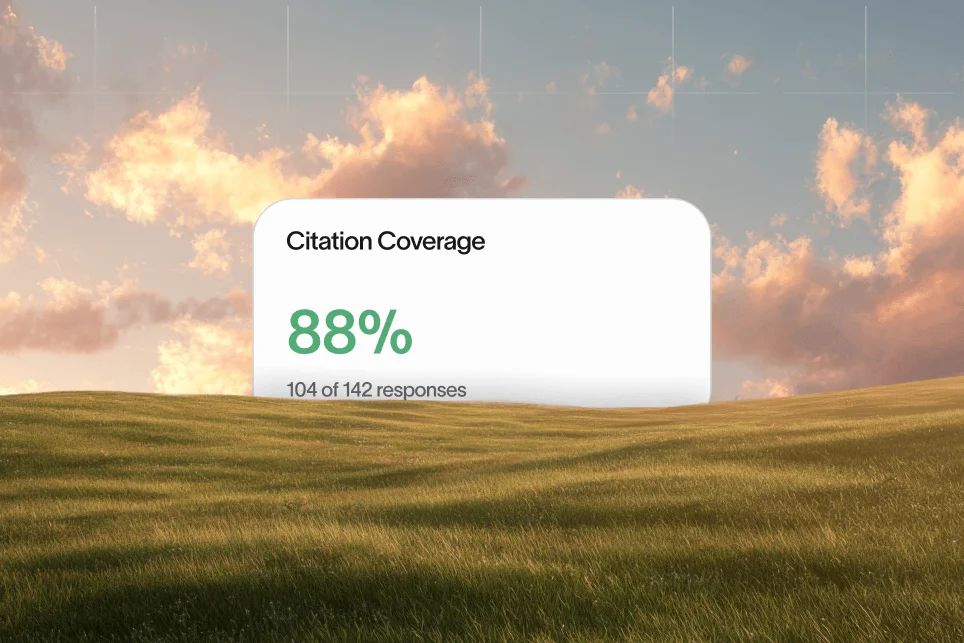
- Citation coverage (cluster-level): how many priority questions have a page that meets your answer spec.
- Query expansion (Search Console): whether the page starts appearing for question-form queries and comparisons.
- Conversion continuation (on-site): whether users who land from informational queries take the next step you intended.
Citations themselves are harder to measure perfectly because AI surfaces differ. The goal is not a single number; it is directional confidence backed by multiple signals.
A practical “baseline → intervention → outcome” proof block you can run
You can produce proof without inventing performance numbers by treating your next cluster as an experiment with explicit instrumentation.
Baseline (week 0)
- Existing page has no definition line, no answer block, and inconsistent headings.
- Search Console shows impressions mostly for broad keywords, with few question-form queries.
- Analytics shows high bounce on informational landings and low progression to product pages.
Intervention (weeks 1–2)
- Rewrite top section into: definition line + 40–80 word answer block + constraints.
- Add FAQPage schema where questions are stable.
- Add internal links: definition → how-to → comparison.
- Add one authoritative external reference per key claim.
Expected outcome (weeks 3–6)
- Search Console begins surfacing more long-tail question queries for the cluster.
- Average time on page and scroll depth increase for those landings.
- Assisted conversions increase (users return later via branded search or direct).
How to validate
- Create a Search Console query filter for question modifiers (“what is”, “how to”, “vs”, “best”).
- Track a GA4 exploration for landing page → next page path.
- Compare 28-day windows pre/post change.
This is not hype. It is a measurable loop.
Technical considerations that quietly make or break AEO
AEO visibility still depends on basic SEO hygiene.
- Renderability: if critical content is client-rendered, test with Google’s URL Inspection and mobile rendering.
- Indexation control: keep canonicals correct; avoid accidental noindex on template variants.
- Site speed: slow pages reduce engagement, which can reduce downstream conversions. Use PageSpeed Insights and web.dev performance guidance.
- Structured data validation: validate frequently; schema drift is common.
Designing for the post-citation click
When a user clicks from an AI citation, they are not “browsing.” They are checking you.
Design requirements for that click:
- Repeat the answer at the top (don’t force re-reading).
- Show constraints and tradeoffs early (signals honesty).
- Provide a clear next step based on intent:
- definition intent → deeper explainer or use cases
- evaluation intent → comparison table, security page, pricing page
- implementation intent → docs, integration guide, checklist
AEO that wins citations but loses trust on click is wasted effort.
Where AI engines fit into your testing workflow
Even if you cannot fully instrument every AI surface, you can still run controlled checks.
Use a repeatable prompt set against major models and answer engines you care about (and log results):
The goal is not to “game” prompts. It is to detect whether your pages are:
- being recalled at all,
- being attributed correctly,
- being summarized in a way that matches your positioning.
Treat this like QA, not a growth hack.
FAQ: Defining your 2026 AEO strategy
What is the difference between SEO and an AEO strategy?
SEO primarily optimizes for ranking and traffic from search results. An AEO strategy optimizes for inclusion and citation inside AI answers, then ensures the landing page continues the answer and converts. In 2026, the strongest programs run both: technical SEO for discoverability and AEO for extractability and trust.
Do I need schema to show up in AI answers?
Schema is not mandatory, but it helps clarify page type and Q/A structure. Use schema when it truthfully matches the content (FAQPage for real FAQs, HowTo for real steps). Validate with tools like Google’s Rich Results Test and keep the markup aligned with visible copy.
How do I pick which questions to target first?
Start with questions that appear in sales cycles and onboarding, not only high-volume keywords. Prioritize by decision risk (compliance, pricing, integrations) and your ability to provide verifiable detail. A good first cluster is a definition page plus two supporting pages that cover implementation and comparisons.
How long does it take to see results from an AEO strategy?
Expect leading indicators within 3–6 weeks for updated pages: broader query coverage in Search Console, improved engagement on informational landings, and more assisted conversions. Citations can be inconsistent across AI surfaces, so measure the full path (inclusion signals, clicks, and conversion continuation) rather than waiting for a single “citation count.”
What are the most common reasons pages don’t get cited?
The usual causes are structural: the answer is buried, definitions are inconsistent across the site, and claims are not supported by constraints or primary references. Technical issues also block inclusion (rendering problems, indexing mistakes, canonical errors). Fixing these is mostly templates, governance, and QA.
Can small SaaS teams execute AEO without hiring a large content team?
Yes, if the work is systematized. Use a consistent page template, an answer spec for each target question, and a 14-day shipping cadence for small clusters. The leverage comes from standardization and refresh workflows, not from publishing volume.
Measure your current AI visibility and use it to pressure-test your AEO strategy: identify which questions you are already being associated with, where citations break, and which clusters need answer-ready structure before you scale production.