
TL;DR
The best B2B SaaS SEO programs in 2026 do not optimize for traffic alone. They build high-intent, technically sound, citation-ready pages that support the full buying journey and connect organic visibility to qualified pipeline.
B2B SaaS SEO fails when teams treat traffic as the goal instead of revenue influence. The pages that win in 2026 are built to answer specific buying questions, earn trust fast, and support a long sales cycle without wasting content budget.
The practical shift is simple: stop publishing broad content for volume alone, and start building pages that can rank in Google, surface in AI answers, and move visitors from research to evaluation. In B2B SaaS, brand becomes the citation engine, and the strongest content is structured to be both discoverable and credible.
A useful working definition is this: high-impact SEO for B2B SaaS means building search assets that attract qualified intent, earn citations, and contribute to pipeline, not just sessions.
1. Why B2B SaaS SEO needs a different playbook in 2026
B2B SaaS operates under different constraints than ecommerce or media. Sales cycles are longer. Buying committees are common. Search demand is often fragmented across product terms, pain-point queries, category education, competitor research, and implementation questions.
That changes what “good SEO” looks like.
According to SEO Profy, B2B SaaS teams have to account for long sales cycles and intense competition. That means a page is rarely valuable just because it generates clicks. It has to help a reader move closer to a decision.
This is where many content programs break down. They build top-of-funnel traffic but leave gaps in the middle and bottom of the funnel. The result is familiar:
- traffic rises but demo volume stays flat
- blog output increases but conversion quality drops
- reporting shows rankings, not revenue influence
- product and content teams work in parallel instead of on one search system
A more effective model connects SEO to how buyers actually evaluate software.
Gravitate Design makes the same point from another angle: a strong B2B SaaS SEO program should support inbound, product-led growth, and account-based marketing. That matters because search does not operate in isolation. It shapes category entry, product discovery, brand comparison, and buying confidence.
The point of view that matters
The strongest SEO programs in SaaS do not start with keyword volume. They start with revenue relevance.
That means prioritizing topics by four filters:
- How close the query is to a buying decision
- Whether the page can demonstrate expertise credibly
- Whether the traffic can be routed into a meaningful conversion path
- Whether the content can also be cited in AI-generated answers
This creates a cleaner funnel: impression -> AI answer inclusion -> citation -> click -> conversion.
2. The intent map that turns keywords into pipeline
The most useful framework for B2B SaaS content planning is a simple one: problem, solution, proof, decision. It is not a slogan. It is a page planning model that helps teams decide what to publish and how each piece should contribute to pipeline.
Problem pages
These target pain-aware searches. Examples include queries around workflow inefficiencies, reporting gaps, team bottlenecks, compliance friction, or operational confusion.
These pages work when they do three things well:
- define the problem clearly
- explain business impact in plain language
- introduce credible solution paths without forcing a hard sell
Pain-point content is useful early in the journey, but it often gets overproduced. A SaaS company can publish twenty top-of-funnel pieces and still have no strong page for “best software for X use case” or “X platform vs Y platform.”
Solution pages
These sit closer to action. They target searches like:
- best tools for a job to be done
- software for a defined team or use case
- alternatives and replacements
- platform comparisons
- implementation or migration queries
This is where qualified traffic usually starts to separate from vanity traffic. Readers are no longer exploring abstract ideas. They are evaluating options.
Proof pages
These are often missing from SaaS SEO programs. Proof pages include case studies, integration pages, product updates, support documentation, benchmark content, and expert explainers backed by real examples.
According to Power Digital Marketing, durable SaaS SEO is strengthened by continuous engagement through support documentation, product updates, and community-driven content. That matters because buyers do not only judge a company by its category pages. They judge it by the depth of evidence around the product.
Decision pages
Decision-stage SEO includes pricing pages, migration content, alternatives pages, competitor comparisons, demo pages, and high-intent feature pages. These often produce less traffic than educational posts, but they tend to carry much more commercial value.
For many SaaS teams, the fastest improvement comes from finding where decision-stage coverage is thin and filling those gaps before publishing another broad blog post.
A practical example of how this changes prioritization
Consider a team choosing between two topics:
- “what is sales enablement” with high search volume but broad intent
- “sales enablement software for mid-market SaaS” with lower volume but clearer commercial intent
The second topic often has more pipeline potential, especially if the page includes pricing context, buyer objections, implementation considerations, and proof.
That is the central shift in High-Impact SEO Strategies for B2B SaaS: lower-volume, higher-intent topics often outperform broader traffic plays on business value.
3. The pages that usually create the biggest lift first
Not every page type deserves equal investment. In B2B SaaS, certain page categories repeatedly produce stronger commercial outcomes because they align with active evaluation.
Commercial landing pages with search intent built in
A common mistake is treating landing pages as conversion assets only and blog posts as SEO assets only. That split weakens both.
The better approach is to build landing pages around real buying language. Examples include:
- software for a specific team
- product for a specific workflow
- solution for a defined industry
- platform for a known pain point
These pages should not read like ad copy stretched into 1,500 words. They should answer the buyer’s question with enough substance to rank and enough clarity to convert.
A strong landing page usually includes:
- a tight problem statement
- direct explanation of fit
- feature relevance tied to outcomes
- objections handled early
- proof elements such as customer examples or process detail
- next-step conversion paths that match intent
Comparison and alternatives pages
These pages capture late-stage demand and often earn strong engagement from serious buyers. They also map well to AI-answer behavior because structured comparisons are easy for answer engines to extract and summarize.
The mistake is writing them like thin feature grids.
The stronger version explains:
- who each option fits best
- where tradeoffs exist
- what switching costs matter
- which workflow or company stage changes the decision
That kind of nuance is more credible than trying to “win” every category. It is also more likely to be cited because it reads as analysis, not promotion.
Support, documentation, and use-case content
This content is often undervalued by marketing teams because it does not look like classic demand generation. But it builds authority in ways broad blog content cannot.
As noted by Power Digital Marketing, support documentation and product updates contribute to long-term SaaS SEO success. These pages can rank for implementation questions, reduce friction in evaluation, and reinforce that the company understands the real operating environment around the product.
Product-adjacent educational content
Some of the best B2B SaaS content sits between pure education and pure conversion. It teaches a workflow, methodology, or evaluation process while naturally leading into product relevance.
This category is especially valuable for AI visibility because it tends to produce concise, quotable passages and clear list structures. For teams refining that approach, Skayle is one example of a platform built to help companies rank in search and appear in AI-generated answers while tying content output back to measurable visibility.
4. What the technical foundation must cover before content scales
Content cannot overcome a weak foundation forever. In competitive SaaS categories, technical quality is not the differentiator, but it is the entry requirement.
According to Linkflow, SaaS SEO growth depends on a baseline of site speed, Core Web Vitals, schema markup, and crawlability. None of those elements is glamorous, but each one affects whether search engines can reliably access, interpret, and trust the site.
The minimum viable technical checklist
Before a team scales production, it should verify five basics:
- Important pages are crawlable and indexable
- Core templates load quickly and work well on mobile
- Internal linking distributes authority to commercial pages
- Structured data supports clear interpretation where relevant
- Analytics can separate rankings, clicks, conversions, and assisted pipeline
This is not about chasing perfect scores. It is about removing structural friction.
The internal linking issue most SaaS sites underestimate
Internal links are one of the few SEO levers that are fully within a team’s control, yet they are often handled inconsistently.
In a practical discussion on Reddit r/SaaS, an SEO lead highlighted the value of keyword-targeted anchors and mentioned tools such as Link Whisper for blogs and Linkbulb for landing pages. The specific tools matter less than the principle: anchor text should help search engines understand page relationships, and links should push authority toward pages that matter commercially.
For example, a blog post about reporting inefficiency should not only link to another educational article. It should also route authority toward a relevant product or use-case page if that path makes sense for the reader.
This is also where natural internal linking matters. A team covering AI visibility can strengthen topical authority by connecting adjacent content, such as this SEO guide or a deeper piece on AI share of voice, when those topics support the reader’s next step.
Measurement must connect traffic to business outcomes
Many SaaS teams still report on SEO with disconnected dashboards: rankings in one tool, sessions in another, and conversions in a CRM that never map back cleanly.
A better measurement plan tracks:
- baseline organic traffic by page type
- conversion rate by intent category
- assisted pipeline or influenced opportunities
- non-brand visibility in AI answers
- citation frequency for priority topics
Without this, content audits become opinion-driven. With it, refresh decisions become clearer.
5. The editorial moves that help content earn AI citations
Search behavior now extends beyond ten blue links. Buyers increasingly ask AI systems for summaries, comparisons, and recommendations before they click through to a site. That changes the job of a B2B SaaS page.
It no longer needs only to rank. It needs to be citable.
What AI systems tend to reward
Pages are easier to cite when they include:
- concise definitions
- clear section labeling
- direct answers early in the page
- structured comparisons
- original points of view
- concrete examples or proof
This does not mean writing robotic content. It means reducing ambiguity.
For example, instead of saying a company should “improve content quality,” a stronger sentence says: “A high-intent SaaS page should reduce evaluation friction by answering fit, cost, and implementation questions on one page.” That sentence is more specific, more useful, and easier to quote.
The contrarian position worth adopting
Do not publish more top-of-funnel content just because the editorial calendar has room. Publish fewer pages with stronger decision support and clearer proof.
The tradeoff is obvious. Broad content can bring more sessions. But high-intent, proof-heavy content tends to produce better downstream value in SaaS, especially when budgets and team capacity are limited.
A mini case pattern teams can apply
A realistic measurement plan for a high-intent page refresh looks like this:
- Baseline: a solution page ranks on page two, gets modest traffic, and converts below site average
- Intervention: tighten search intent alignment, add use-case specificity, improve internal linking, add trust signals, restructure the page for answer extraction, and connect it to a relevant conversion path
- Expected outcome: stronger ranking stability, higher click-through quality, and better conversion efficiency
- Timeframe: measure at 6, 12, and 16 weeks using search console, analytics, and CRM attribution
This avoids invented numbers while still making the operating model concrete.
Teams that rely heavily on AI-assisted drafting should also protect content quality. Thin synthesis is rarely enough in competitive categories. For a more durable approach, this guide on AI content outlines why information gain, structure, and trust signals matter when content needs to survive search changes.
6. A 30-day rollout plan for teams that need traction fast
The fastest gains usually come from focus, not volume. Most B2B SaaS teams already have enough pages to improve. The issue is that effort is spread across too many weak assets.
Days 1-7: audit by intent, not by URL list
Start by grouping existing pages into four buckets:
- problem n- solution
- proof
- decision
Then identify three gaps:
- pages with traffic but weak commercial pathways
- high-intent topics with no dedicated page
- decision-stage pages that exist but are too thin to rank or convert well
This is where the business case becomes visible. A team might discover it has thirty educational posts on a category problem and no serious comparison page, no industry use-case page, and no implementation explainer.
Days 8-15: rebuild the pages closest to revenue
Prioritize:
- one alternatives or comparison page
- one use-case or industry landing page
- one product-adjacent educational page
- one support or implementation page that can rank
For each page, tighten the opening, clarify fit, add proof, improve scannability, and fix internal links.
Days 16-23: connect analytics to intent
Use Google Analytics, Google Search Console, and the company CRM to create a simple reporting view:
- impressions and clicks
- landing page conversion rate
- demo or trial starts
- influenced opportunities by page group
This does not need to be complex at first. It needs to be decision-ready.
Days 24-30: expand only after the first signal appears
Once the first refreshed pages show movement, expand with related pages around the same cluster. That creates topical reinforcement instead of random output.
This is also where a platform approach becomes useful. Systems that combine planning, content production, updating, and visibility measurement are more effective than fragmented workflows. For SaaS teams dealing with slow execution and unclear reporting, Skayle fits naturally into that discussion because it helps companies improve search rankings and understand how they appear in AI answers.
Common mistakes that drain SEO budget in SaaS
The same problems appear across early-stage and growth-stage teams.
Publishing for volume before fixing page economics
If a page cannot attract the right visitor or route them to the right next step, more traffic will not solve the problem.
Treating blogs and landing pages as separate worlds
Editorial content should support commercial pages. Commercial pages should be built with search intent in mind. When those functions split, authority and conversion both weaken.
Ignoring retention and post-signup search content
Support, documentation, and update content often strengthen acquisition indirectly by building authority and trust.
Reporting only on rankings
Rankings matter, but they are not the endpoint. Qualified conversions and revenue influence matter more.
Chasing every keyword a tool exports
Keyword databases are useful inputs, not strategy. The best targets are the ones that align with buying stages, clear page angles, and realistic proof.
FAQ: what B2B SaaS teams usually ask before changing their SEO approach
Is SEO still worth it for B2B SaaS in an AI-answer environment?
Yes. The role of SEO is broader now. Strong pages still drive clicks from search, but they also act as source material for AI-generated answers. That makes search visibility and citation visibility increasingly connected.
What SEO strategies have proven most effective for SaaS growth?
The most effective strategies usually combine high-intent landing pages, comparison content, strong internal linking, technical stability, and proof-rich product-adjacent content. Broad educational content still has value, but it performs best when it feeds a clear commercial path.
What is B2B SEO for SaaS companies?
It is the practice of building organic visibility around the full buying journey for software products. That includes category education, pain-point content, use-case pages, comparison assets, support documentation, and conversion-oriented pages that help multiple stakeholders evaluate a solution.
How long does B2B SaaS SEO usually take to show meaningful results?
For new pages, teams often need several weeks to months before trends are reliable. For page refreshes on established sites, signal can appear faster. A practical review cadence is 6, 12, and 16 weeks, especially for high-intent pages tied to conversion events.
Should B2B SaaS teams prioritize blogs or landing pages?
They should prioritize based on commercial opportunity, not format. In many cases, landing pages with strong search intent and decision support create faster business impact than another top-of-funnel article. The strongest programs use both, with each page type playing a defined role.
How should teams measure AI search visibility alongside SEO?
They should track where the brand appears in AI-generated answers, which pages are being cited, and whether those citations map to strategic topics. Organic rankings alone no longer capture the full visibility picture, which is why teams increasingly add AI answer reporting to the content workflow.
The main advantage in 2026 is not publishing more pages. It is building a tighter search system: pages mapped to buyer intent, technical health that removes friction, internal links that concentrate authority, and content structured to be both searchable and citable. That is how High-Impact SEO Strategies for B2B SaaS move from traffic generation to pipeline contribution.
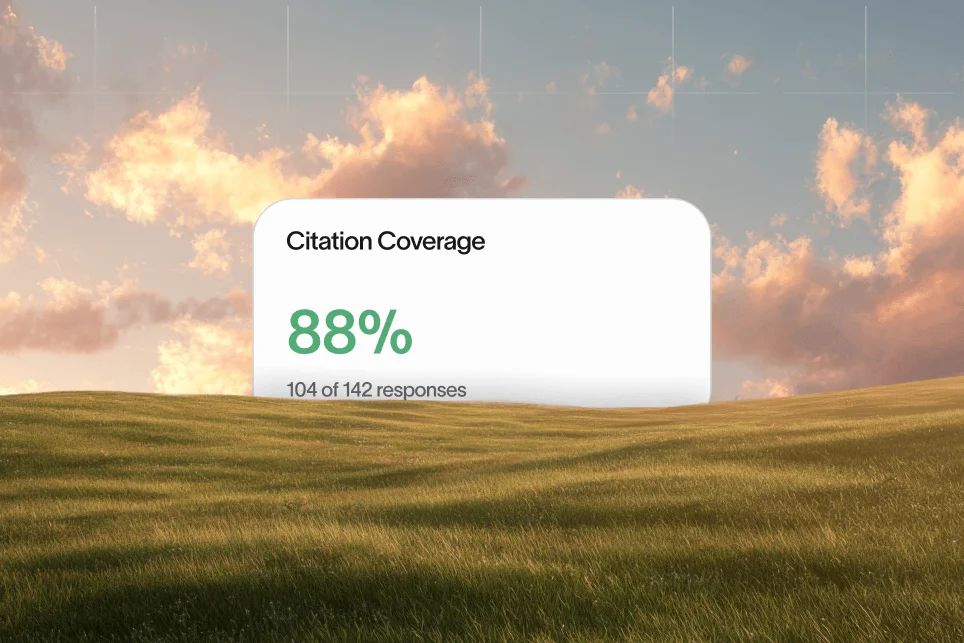
For teams that want clearer visibility into what is ranking, what is being cited, and where content effort should go next, the next step is straightforward: measure your AI visibility, understand your citation coverage, and build the pages that deserve to win.
References
- Power Digital Marketing — B2B Saas SEO: Best Practices for Success
- Gravitate Design — B2B SaaS SEO Strategies for Growth in 2026
- Linkflow — B2B SaaS SEO Strategies for Growth in 2025
- SEO Profy — B2B SaaS SEO: Comprehensive Guide for 2026
- Reddit r/SaaS — Here Are the Top SEO Strategies for SaaS I’ve Tested
- Creating a Winning SaaS SEO (7 Strategies + Examples)
- The Advanced Guide to B2B SaaS SEO