
TL;DR
AI share of voice helps SaaS founders measure how often their brand appears, gets recommended, and gets cited across AI platforms like ChatGPT, Gemini, and Perplexity. The most reliable approach uses a fixed prompt set, stable competitor group, and monthly reporting tied to content and authority actions.
AI share of voice is becoming a leadership metric, not just a search experiment. For SaaS teams, the question is no longer whether AI assistants mention the brand, but how often, in what context, and against which competitors.
AI share of voice is the percentage of relevant AI-generated answers in which a brand is mentioned, recommended, or cited compared with competing brands. That makes it useful for founders who need a clearer view of market visibility beyond rankings, traffic, and branded search.
Why founders need a different visibility metric in 2026
Traditional SEO reporting was built around rankings, clicks, and sessions. Those still matter. But they do not fully explain what happens when a buyer asks ChatGPT, Gemini, or Perplexity for product recommendations, vendor comparisons, category definitions, or implementation advice.
A SaaS company can lose visibility before it loses traffic. If AI platforms summarize a category without mentioning the brand, that brand is already missing from early-stage consideration.
This is why AI share of voice matters at the leadership level. According to Waikay.io, AI share of voice measures the percentage of all brand mentions in AI-generated responses that belong to a specific brand. That framing is useful because it turns a vague concern about “AI visibility” into a measurable competitive metric.
For founders, the business case is simple:
- It shows whether the market associates the brand with its category.
- It reveals whether AI systems recommend competitors more often.
- It creates a reporting layer between top-of-funnel discovery and pipeline generation.
- It helps explain traffic volatility when AI answers absorb more of the click.
- It exposes authority gaps that rankings alone can miss.
The deeper point is strategic. In evolving categories, AI share of voice can separate category leaders from peripheral players because it reflects which brands AI systems consistently recognize and retrieve as credible sources. That dynamic is described clearly by LLMPulse, which positions the metric as a signal of market recognition, not just content output.
That is why AI share of voice should not be treated as a vanity number. It is better viewed as a leadership visibility metric that sits alongside search demand, qualified traffic, and conversion efficiency.
What AI share of voice actually measures across ChatGPT, Gemini, and Perplexity
The term gets used loosely, which creates bad reporting. Founders need a stricter definition.
AI share of voice does not simply mean “how often the company appears in AI.” It measures brand presence within a controlled prompt set, across selected AI platforms, against a defined competitor group, over a fixed period.
A useful reporting model tracks four things at once:
1. Mention frequency
How often does the brand appear at all?
This is the base layer. If 100 prompts are tested and the brand appears in 28 answers, raw mention frequency is 28% for that dataset.
2. Recommendation rate
Being mentioned is weaker than being recommended. In many B2B categories, AI tools list several vendors, but only a few are framed as strong fits.
As noted by Alex Birkett, AI visibility measurement should account for more than simple mentions. Recommendation patterns and source use matter because they reflect stronger commercial positioning.
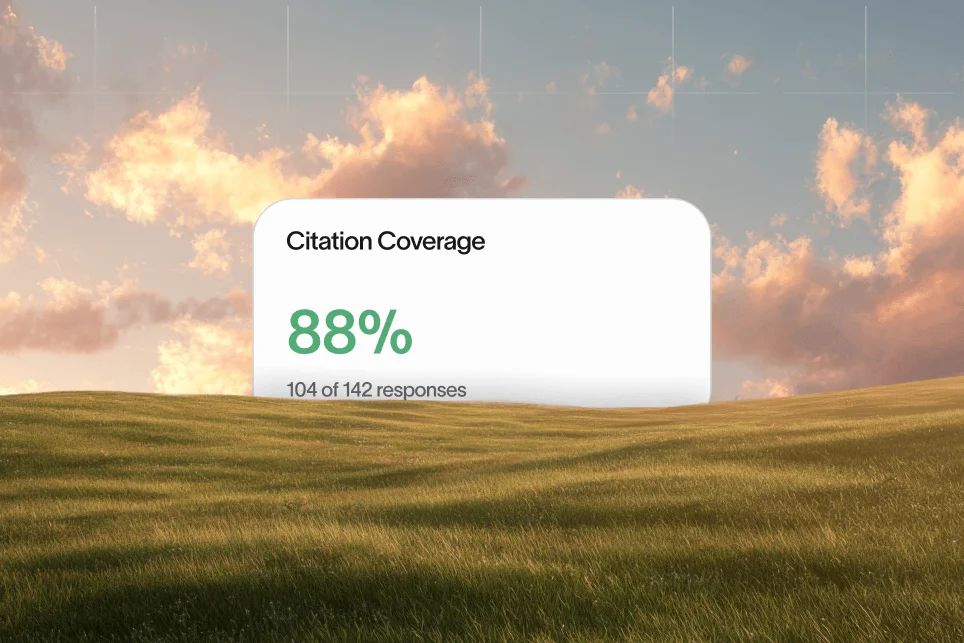
3. Citation coverage
If a platform provides source links or named references, how often is the brand’s site or content cited directly?
This is where the AI-answer world changes the game. Brand is now a citation engine. The companies that publish clear, trustworthy, non-generic material are easier for AI systems to reference.
4. Competitor distribution
How is visibility split across the comparison set?
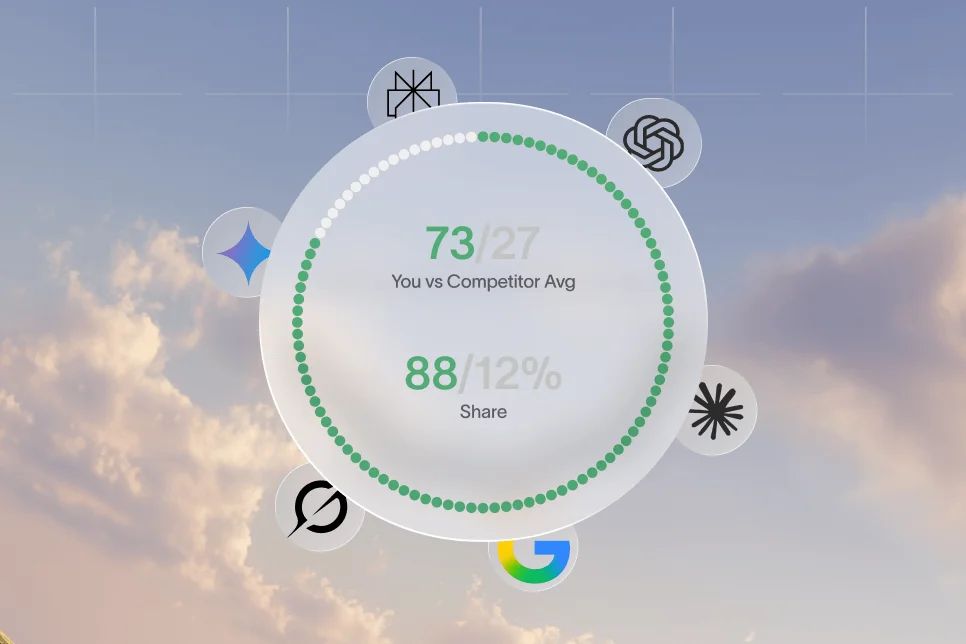
Share of voice is relative by definition. A 20% presence may look solid in isolation, but weak if one competitor owns 45% of category prompts.
This creates a more useful reporting view than traffic-only dashboards. It also aligns with how Conductor frames competitive AI share of voice: how often a brand is cited compared with direct rivals in AI search environments.
The five-part measurement model leaders can actually use
Most teams fail because they start collecting prompts before they define what the metric is for. Founders need a stable model that can be repeated every month.
A practical way to run AI share of voice reporting is the category-to-citation model:
- Define the market questions that matter to pipeline.
- Group prompts by buyer intent instead of by keyword alone.
- Track brand mentions, recommendations, and citations across platforms.
- Compare against the same competitor set each cycle.
- Tie the findings to authority gaps and content actions.
This is not a fancy naming exercise. It is a reporting discipline. The model works because it forces teams to move from anecdotal screenshots to consistent measurement.
Start with prompt classes, not random queries
Founders do not need hundreds of prompts on day one. They need the right prompt classes.
A clean starting set usually includes:
- Category discovery prompts: “best B2B billing software”
- Comparison prompts: “Stripe vs Chargebee for SaaS subscriptions”
- Use-case prompts: “best CRM for small SaaS sales teams”
- Problem-aware prompts: “how to reduce churn in product-led SaaS”
- Educational prompts: “what is usage-based billing software”
- Alternative prompts: “tools like HubSpot for startups”
This matters because AI share of voice varies by intent. A company may dominate branded and comparison prompts but disappear from educational prompts that shape first exposure.
Track platforms separately before rolling them up
ChatGPT, Gemini, and Perplexity do not behave the same way. They differ in answer style, source visibility, and retrieval behavior.
A founder-level dashboard should first show platform-specific results, then a blended summary. Otherwise the team can hide platform weakness inside an average.
For example:
- ChatGPT may mention the brand often but provide fewer visible citations.
- Gemini may surface stronger web-linked answers tied to category pages.
- Perplexity may expose source coverage more directly, making citation analysis easier.
A rolled-up score has value, but only after the underlying platform variance is visible.
Use a stable competitor set for at least one quarter
One of the fastest ways to ruin AI share of voice reporting is to keep changing the peer group.
The comparison set should usually include:
- Direct product competitors
- Two or three adjacent category alternatives
- One established market leader if the category is crowded
This is also where tool-driven benchmarking can help. HubSpot’s AI Share of Voice Tool positions the metric around citation frequency versus industry rivals and frames it as a way to uncover competitive blind spots. That is the right executive use case.
Turn observations into a monthly reporting table
A leadership-ready table does not need to be complex. It should answer four questions:
- Where is the brand visible?
- Where is it absent?
- Which competitors are winning the category narrative?
- What content or authority work should change next?
A simple table might include:
| Prompt cluster | Platform | Brand mentions | Recommendations | Citations | Top competitor | Notes |
|---|---|---|---|---|---|---|
| Category discovery | ChatGPT | 6/20 | 3/20 | 0/20 | Competitor A | Weak educational visibility |
| Category discovery | Gemini | 8/20 | 4/20 | 2/20 | Competitor A | More category page exposure |
| Comparison prompts | Perplexity | 12/20 | 9/20 | 7/20 | Competitor B | Strong bottom-funnel presence |
This is enough for a founder to understand the market position without reading an SEO deck.
What good reporting looks like inside a SaaS leadership team
Founders should expect AI share of voice reporting to sit between brand reporting and search reporting. It is not a replacement for pipeline metrics. It is an early visibility layer.
The best internal use cases are practical.
Board and leadership updates
AI share of voice helps explain whether the brand is being recognized as part of the category conversation. That is especially relevant in emerging markets where demand is still being shaped.
The value here is not precision to the decimal point. The value is directional truth.
If a company is absent from recommendation prompts across three major AI platforms for two quarters, that is a strategic signal. It suggests the brand has not yet built enough topical authority, market association, or citation-worthy content to earn inclusion.
Forecasting brand discoverability before traffic changes
This is where the metric becomes useful for executive reporting. Some teams only notice an issue after organic traffic drops. AI share of voice can expose erosion earlier.
A company can still rank for high-intent terms while losing share in AI-generated summaries and comparisons. That creates a gap between visible rankings and actual category presence.
This is one reason the metric is gaining attention. In a LinkedIn article by Maritz, AI share of voice is described as harder to fake than traditional metrics because it requires genuine brand association. That claim resonates with leadership teams because it points to substance over dashboard cosmetics.
Connecting the metric to commercial outcomes
A useful founder report should connect AI share of voice to downstream signals, even if the causality is not perfect.
The strongest supporting metrics are:
- Branded search demand
- Direct traffic trend
- Assisted conversions from organic
- Demo requests from educational content
- Conversion rate on cited pages
- Share of non-brand category traffic
This is where design and conversion implications matter. If AI platforms start citing a company’s category page or educational content more often, the click path shifts. The page must immediately validate credibility, intent fit, and next action.
That means cited pages need:
- Clear category positioning above the fold
- Fast comprehension of who the product is for
- Proof points that support the AI-framed claim
- Strong internal links to use-case and comparison pages
- A conversion path that matches informational visitors
The funnel has changed: impression -> AI answer inclusion -> citation -> click -> conversion.
A practical 30-day process for building the first baseline
Most teams do not need a perfect system. They need a credible baseline they can repeat. The first 30 days should focus on consistency.
Week 1: build the prompt set and scoring rules
Start with 40 to 60 prompts. That is enough to reveal patterns without creating reporting chaos.
Score each answer using a shared rubric:
- 0 = no mention
- 1 = mentioned
- 2 = recommended
- 3 = cited directly
This is intentionally simple. Overcomplicated taxonomies slow adoption and create internal disagreement.
Week 2: collect snapshots across platforms
Run the same prompt set on ChatGPT, Gemini, and Perplexity. Capture outputs in a consistent format.
The team should log:
- Date and time
- Platform used
- Prompt used
- Brand appearance status
- Competitor mentions
- Source links, if shown
- Answer framing notes
The goal is not forensic perfection. It is comparability.
Week 3: group the results by intent and page type
Once the raw results exist, sort them into buyer-intent clusters.
This is usually where useful patterns emerge. Many SaaS brands discover they are visible in comparison prompts but not in educational prompts. Others find the reverse: broad educational presence with weak commercial recommendation rates.
Those patterns matter because they point to different fixes.
- Weak educational visibility usually means the brand lacks foundational category authority.
- Weak recommendation rates often signal thin differentiation or generic messaging.
- Weak citation coverage usually means the content is not distinctive or trustworthy enough to reference.
Teams working on this problem often also need stronger editorial controls. Generic AI-written pages rarely earn durable trust. That is why cleaning up low-value content matters, and our guide to avoiding AI slop is directly relevant when the goal is citation-worthy output.
Week 4: publish the first leadership report and assign actions
The first report should not be a giant dashboard. It should be a short memo with three parts:
- Current AI share of voice by platform and prompt class
- Competitors gaining disproportionate AI visibility
- Specific content and authority actions for the next cycle
This is also the right moment to decide whether a manual process is still enough. As prompt sets expand, many teams move toward platforms that help measure how often they appear in AI answers and connect that visibility to execution. Skayle fits in that category by helping SaaS teams improve ranking performance and AI answer presence without treating content as an isolated production task.
The mistakes that make AI share of voice reporting unreliable
The metric is useful, but only if the method is disciplined. Most bad reports fail in familiar ways.
Mistake 1: using vanity prompts
Teams often choose prompts they already know they win. That creates a flattering report and a useless one.
The prompt set should reflect real buyer questions, not internal positioning language.
Mistake 2: mixing audience segments together
If enterprise prompts, SMB prompts, and agency prompts are all thrown into one bucket, the result becomes hard to interpret.
Prompt clusters should map to the company’s actual go-to-market segments.
Mistake 3: treating every mention as equal
A passing mention inside a vendor list is not equivalent to a direct recommendation with source support.
This is a core reason to separate mentions, recommendations, and citations.
Mistake 4: reporting one blended score with no context
A single AI share of voice number is attractive in a board slide. It is weak as an operating metric.
Leaders need the roll-up score, but they also need the split by platform, intent, and competitor group.
Mistake 5: failing to connect findings to page-level action
Reporting without execution becomes theatre.
If the brand is absent from “best X software” prompts, the team should review:
- Category pages
- Comparison pages
- Supporting evidence content
- Customer proof and use-case pages
- Structured page clarity and internal linking
This is also why AI share of voice should not be isolated from broader search work. Teams still need a real SEO foundation, and our founder’s guide to SEO gives the broader context for how ranking and AI visibility now reinforce each other.
The content changes that usually move the metric
There is no single fix. But the teams that improve AI share of voice usually do a few things consistently.
Build pages that are easy to cite, not just easy to publish
AI systems tend to favor content that is clear, specific, and anchored in recognizable expertise.
That means pages should include:
- Direct definitions
- Clear category framing
- Decision criteria
- Concrete tradeoffs
- Unique examples
- Credible source support
The opposite is also true. Thin listicles, generic feature pages, and repetitive AI copy may index, but they are less likely to become trusted source material.
Strengthen entity association across the site
Founders often think in terms of keywords. AI visibility often rewards stronger category association.
If the company wants to appear for prompts about a category, the site needs repeated, coherent evidence that it belongs in that category. That means:
- Consistent terminology across pages
- Use-case coverage tied to audience segments
- Comparison pages against real alternatives
- Category definitions and educational explainers
- Customer proof linked to the problem the product solves
Refresh pages that have already earned search trust
For many SaaS teams, improving AI share of voice is less about creating net-new content and more about refreshing pages that already have authority.
That includes adding better definitions, stronger examples, updated competitor framing, and tighter internal linking. Teams focused on recovering visibility from changing search experiences often use this AI Overviews recovery playbook as a parallel approach because citation-focused refreshes help in both environments.
A realistic proof block for leadership teams
Because hard benchmark numbers vary by category and prompt set, the most honest proof format is operational, not sensational.
A credible mini case study for a SaaS team would look like this:
Baseline: the company appears inconsistently in educational prompts across ChatGPT, Gemini, and Perplexity, but performs better in bottom-funnel comparisons.
Intervention: the team rewrites category pages, adds comparison content, sharpens above-the-fold messaging, improves internal links between category and use-case pages, and refreshes older articles with direct definitions and decision criteria.
Expected outcome: recommendation rates rise first, citation coverage follows, and blended AI share of voice improves in the next 30 to 90 days if authority signals strengthen.
Timeframe: initial movement can be reviewed monthly, but category-level change should be judged over a quarter, not a week.
That is the right level of discipline. It avoids fake precision while still creating accountability.
Is AI share of voice the next big brand metric or just another dashboard fad?
The answer depends on how it is used.
AI share of voice is not useful if it becomes a screenshot contest. It is useful if it helps leadership understand whether the brand is entering, holding, or losing its place inside AI-mediated category discovery.
That is why the strongest position is slightly contrarian: do not report AI share of voice as a standalone win metric; report it as a visibility integrity metric tied to category authority.
That framing avoids two common errors.
First, it avoids treating AI mention counts as pipeline. They are not.
Second, it avoids dismissing the metric because attribution is imperfect. Attribution has always been imperfect at the category-awareness layer. That does not make the signal useless.
As Vazoola notes, share of voice is fundamentally about how much attention a brand earns within a market or industry. In AI search environments, that attention is increasingly mediated by generated answers, not just blue links.
For SaaS founders, that makes the metric important enough to monitor and narrow enough to operationalize.
FAQ: the questions leadership teams usually ask
How often should a SaaS company measure AI share of voice?
Monthly is usually the right cadence for operating review. Weekly checks create noise because AI outputs fluctuate, while quarterly-only reviews are too slow to catch visibility loss early.
Should AI share of voice replace SEO reporting?
No. It should sit next to rankings, traffic, conversions, and branded demand. AI share of voice shows presence inside generated answers, while SEO reporting still shows search performance on the site and in the SERP.
What is a good AI share of voice benchmark?
There is no universal benchmark because results depend on category size, prompt set, and competitor mix. A more useful benchmark is relative movement over time against the same prompt library and the same comparison set.
Why can a brand rank well in Google but have weak AI share of voice?
Because ranking and recommendation are related but not identical. A site may rank for target terms yet still lack the clarity, authority, or citation-worthiness that makes AI systems mention it consistently.
Which matters more: mentions, recommendations, or citations?
Citations and recommendations are stronger than simple mentions because they indicate trust and commercial relevance. The best reporting tracks all three, but leaders should pay closest attention to recommendation rate and citation coverage.
If a SaaS team wants to move from ad hoc AI visibility checks to a more structured operating model, the next step is to measure where the brand appears, where competitors dominate, and which pages need to earn trust. Skayle helps teams do that by connecting ranking work, content updates, and AI answer visibility in one system.
References
- Waikay.io — What Is AI Share of Voice?
- LLMPulse — Share-of-Voice: what it is, measurement and benchmarks
- Alex Birkett — How to Measure AI Share of Voice (+ 3 Tools)
- Conductor — AI Competitive Market Share & SOV Analysis
- HubSpot — AI Share of Voice Tool
- LinkedIn (Maritz) — Why AI Share of Voice is now my primary metric
- Vazoola — Is AI Share of Voice The Next Big Brand Strategy?
- AI Share of Voice (AI SoV)