
TL;DR
AI answers punish inconsistent and stale pages by dropping citations before rankings fall. Treat content governance like SaaS governance: rules, gates, monitoring, and refresh SLAs so citation coverage becomes measurable and maintainable.
I’ve watched teams do everything “right” in SEO—then quietly lose AI answer visibility because their content got inconsistent, stale, or impossible for models to extract.
The painful part is it’s rarely a single page problem. It’s a governance problem.
Content governance is the set of enforced rules that keep every page accurate, on-brand, and extractable by search engines and LLMs.
Why AI answers punish sloppy content governance
Classic SEO decay is slow. A page slips a few positions, traffic drops, you notice later.
AI answer decay is faster and less obvious. You can still rank, but stop getting cited.
If you care about GEO (Generative Engine Optimization), this matters because the funnel changed:
Impression (AI overview / chat answer appears)
Inclusion (your brand is mentioned)
Citation (your page is linked)
Click (someone actually visits)
Conversion (demo, trial, sign-up)
Governance sits underneath all five steps.
When governance breaks, you get the worst combination: the AI answer still covers your topic, but it uses someone else’s definitions, screenshots, and examples. Your rankings can look “fine,” while your influence disappears.
The new decay pattern: citations fade before rankings
In practice, we see citation losses happen when:
The page is technically indexable, but the key answer block moved below the fold.
The definition section is outdated, so the model prefers a newer source.
The brand is mentioned, but the page doesn’t clearly support the claim with structure.
The page has “helpful” fluff, so the extractable answer gets diluted.
This is why I’m bearish on governance-as-a-Google-Doc. It’s not enforceable.
The closest analogy isn’t editorial style guides. It’s SaaS governance.
SaaS governance, done well, turns policy into automated workflows and controls across the lifecycle—so it doesn’t rely on everyone remembering the rules. That’s the core point in Torii’s explanation of governance as a living system with automated enforcement across the app lifecycle (Torii).
That mental model transfers cleanly to content.
Point of view (the stance I’d bet on)
Don’t try to “govern” content with meetings and manual review checklists.
Turn governance into defaults + gates + scheduled refreshes so your content stays citation-ready even when your team is busy.
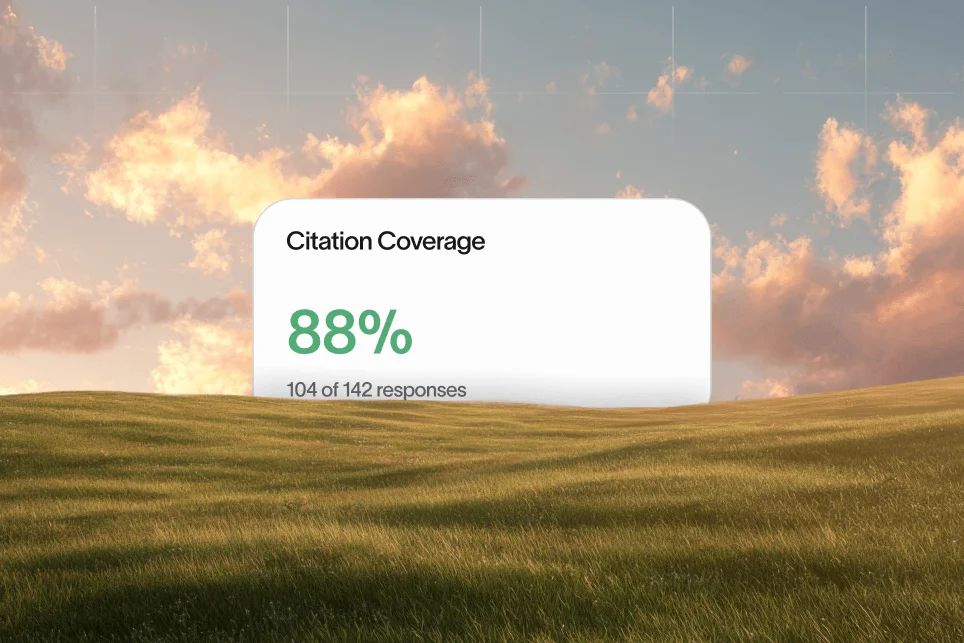
If you want a deeper look at how AI visibility becomes measurable (instead of vibes), our write-up on finding your citation coverage gap is a good companion to this.
Content governance in 2026: policies that become controls
Most SaaS teams already have a content process. It usually looks like:
Someone finds keywords.
Someone writes.
Someone edits.
Someone publishes.
Nobody owns what happens six months later.
That’s not governance. That’s production.
Governance answers different questions:
Who owns accuracy on this page?
What must be true before we publish?
What changes trigger a review?
How do we know we’re losing citations?
What’s the refresh SLA for pages that matter?
A useful way to define it is by borrowing from how Flexera talks about governance policy: gather what exists, address key concerns, and keep it short enough that it gets adopted (Flexera). For content, “adopted” means “built into workflows.”
Borrow the SaaS governance idea: rules mapped to automation
Torii’s framing is the part most content teams miss: governance policies can be translated into enforceable rules and automated without constant manual work (Torii).
In content terms, that becomes:
Rules (what “good” looks like)
Checks (how you detect violations)
Gates (what blocks publishing)
Ownership (who approves exceptions)
Cadence (when you re-check after publishing)
If you’ve ever had two blog posts contradict each other—or a feature page claim a capability you shipped two quarters ago—you already understand the need.
The business case: governance protects compounding traffic
Riseopp calls out a specific refresh benchmark: updating top-performing content every 6–12 months can be more effective than constantly creating new posts (Riseopp).
That’s not just an SEO point. It’s a governance mandate.
If you accept “6–12 months” as your refresh window, you can’t run governance as a heroic, last-minute scramble. You need an inventory and a schedule that doesn’t depend on memory.
This is where a practical refresh system matters: governance isn’t separate from refreshing; governance is how refreshing becomes inevitable.
Manual vs automated governance: which model fits your team?
You’re not really choosing between “governance” and “no governance.”
You’re choosing between:
Manual governance (people remember rules and apply them)
Automated governance (systems apply rules and people handle exceptions)
Here’s the comparison I use when I’m advising teams.
Option A vs Option B: what actually changes
Dimension | Manual governance (docs + reviews) | Automated governance (rules + workflows) |
|---|---|---|
Quality control | Inconsistent; depends on reviewer | Consistent; enforced gates + templates |
Speed to publish | Slower under load | Predictable once set up |
Risk | High: drift, contradictions, stale claims | Lower: violations are detectable |
Scalability | Breaks at 30–50 pages/month | Designed for 100s–1000s pages |
AI citation readiness | Depends on writer skill | Defaults create extractable answers |
Measuring impact | Hard; reporting disconnected | Built around measurable checks |
Automated governance doesn’t mean “no humans.” It means humans stop doing repetitive policing.
BlogHunter’s 2026 SaaS marketing guidance explicitly calls out using AI tools across creation, optimization, distribution, and analytics (BlogHunter). The important nuance: the value is in the system, not the tool list.
Decision criteria: speed, risk, and measurable visibility
If you’re deciding where to start, use these criteria.
If you publish fewer than 10 pages/month and have one editor who touches everything, manual governance can work.
If you publish across multiple writers, products, or languages, manual governance will drift.
If you do programmatic SEO, manual governance is basically impossible.
And the AI visibility angle is the tie-breaker:
If you can’t answer “where do we get cited today, and where did we lose it this month?” you don’t have governance.
That’s why we push teams to connect monitoring to action. The difference between dashboards and execution is the whole point of having an operating system, not another report. (If you want the measurement layer itself, our guide on AI search visibility tools maps out what to track and what to fix.)
Pros and cons (no marketing fluff)
Manual governance pros:
Quick to start
Low tooling requirements
Manual governance cons:
Doesn’t survive team growth
Doesn’t survive content volume
Doesn’t survive AI answer volatility
Automated governance pros:
Predictable output quality
Easier to audit and improve
Easier to measure citation coverage
Automated governance cons:
Requires up-front decisions (definitions, templates, rules)
Can feel restrictive if your team isn’t aligned on standards
The Governance-to-Citation Pipeline: a 4-part operating model
If you want something you can copy, use this:
The Governance-to-Citation Pipeline is: define rules → enforce at publish time → monitor citation coverage → refresh on a schedule.
That’s it. Four parts. No mythology.
1) Define non-negotiables as page rules (not writing advice)
This is where most teams waste time.
They write a style guide that says “be clear” and “use short paragraphs.” Nice, but unenforceable.
Write rules you can actually check:
Every page must have a 40–80 word definition block near the top.
Every page must list the primary entity (product/category) explicitly.
Every page must include at least one comparison table if the intent is evaluative.
Every page must include an FAQ block with 5 questions.
Every page must have a last-reviewed date and an owner.
If your content team can’t agree on non-negotiables, you don’t have a governance problem. You have an alignment problem.
2) Enforce rules at publish time with gates and templates
Here’s the contrarian bit:
Don’t use a checklist that lives in Notion. Use a publishing gate that blocks bad pages.
People will always ship content under pressure. Governance has to be stronger than pressure.
In practice, enforcement looks like:
CMS templates that require certain sections
Structured fields (owner, product area, intent)
Pre-publish checks (missing FAQ, missing definition, missing schema)
This is also where you fix the classic fragmented workflow problem—writers in one tool, editors in another, SEO in spreadsheets, publishing in a CMS nobody understands. If you’re feeling that pain, we broke down what it takes to fix fragmented workflows without hiring a small army.
3) Monitor citation coverage like you monitor production systems
BetterCloud’s SaaS management best practices emphasize centralized management with distributed ownership and automation for “zero-touch” operations (BetterCloud). That pattern maps well here.
You want:
Central visibility into what’s drifting
Distributed owners who fix their areas
Automation that detects issues early
Instead of uptime, your core “system health” metrics become:
Citation presence for target prompts
Brand mention accuracy (names, capabilities, positioning)
Extractability (is the answer block clear?)
Freshness SLA adherence
If you’re new to the idea of citation monitoring, it helps to start with a simple gap scan—what prompts cite competitors but not you—and then operationalize fixes.
4) Refresh on a cadence, not a panic
This is where Riseopp’s 6–12 month refresh recommendation becomes operational, not inspirational (Riseopp).
Set refresh SLAs by page type:
Money pages (pricing, alternatives, integrations): every 90 days
Product-led tutorials: every 6 months
Glossary / definitions: every 12 months, unless the category shifts
If that sounds like a lot, good. It is.
The only way it works is with automation and a clear backlog, similar to treating content like a product backlog with prioritization and post-mortems (Riseopp).
A numbered action checklist you can run this week
If you want to move from “we should govern content” to actual controls, do this in order:
Inventory your money pages (pricing, comparison, integration, demo pages) and assign a single owner per page.
Define three publish gates you’ll enforce immediately: definition block, FAQ block, and last-reviewed metadata.
Add a refresh SLA per page type (start with 90/180/365 days).
Pick one monitoring signal for GEO: “Where are we cited today?” and track it monthly.
Write an exception rule: who can bypass gates, and for how long before it must be fixed.
Schedule a monthly change-control review, similar to the “ongoing maintenance” cadence used in SaaS governance programs (Torii).
That checklist is intentionally boring. Boring is what scales.
Proof block (baseline → intervention → expected outcome → timeframe)
Here’s a pattern that’s been repeatable when we’ve helped SaaS teams clean up governance for GEO.
Baseline: content standards exist, but only as guidelines; refreshes happen ad hoc; nobody can confidently say which pages are stale or contradicted.
Intervention: enforce 3 publish gates (definition, FAQ, owner + last reviewed), set refresh SLAs, and run a monthly change-control review.
Expected outcome: fewer contradictions, faster refresh throughput, and clearer extraction blocks—so citation coverage becomes something you can improve systematically instead of guessing.
Timeframe: noticeable operational stability within a month; meaningful refresh impact typically aligns with a 6–12 month cadence for top performers (Riseopp).
If you want to make this measurable, define a baseline this week: % of priority pages with an owner, a refresh date, a definition block, and valid schema. Then track that monthly.
Governance that improves citations and conversions
Most teams treat governance like risk management.
That’s backwards for GEO. Governance is also conversion design.
If your page is structured so an AI system can extract the answer, a human can scan it faster too. That’s usually a conversion lift, not a tradeoff.
Design for impression → citation → click → conversion
A page that earns citations tends to have:
A direct definition near the top
A short “what to do next” path for humans
Scannable comparisons (tables beat paragraphs)
Specific constraints (who it’s for / not for)
Clear internal links that deepen the topic
That’s why we like topic clusters and hubs. They give the model context and give the reader depth.
If you’re building those systems, the two levers that compound are:
Hub/spoke architecture (so pages reinforce each other)
Internal linking rules (so authority flows intentionally)
We’ve gone deep on topic cluster architecture and how to build hubs that both rank and get cited, because it’s one of the cleanest ways to turn governance into compounding authority.
Technical guardrails: schema, crawlability, and extractability
If you want AI answers to cite you, you need two things simultaneously:
The page must be accessible and understandable to crawlers.
The page must be easy to extract into a short answer.
Governance should include technical checks like:
Canonicals and indexation are correct
The primary answer block is not hidden behind tabs or heavy client-side rendering
Structured data exists where it’s relevant (FAQ, product, organization, how-to)
If you’re doing this at scale, you’ll eventually need structured data rules that are consistent across templates. Our structured data blueprint is useful when you’re ready to stop treating schema as a one-off dev ticket.
And if you suspect you’re failing the basics (rendering, extraction, crawl waste), fix those first. Governance can’t compensate for broken foundations. This is why technical checks for extraction and crawling belong in the same workstream as governance—see our technical SEO fixes if you need a punch list.
Common ways teams break governance (and how to avoid it)
They govern writing, not facts.
You don’t lose citations because a sentence was too long. You lose citations because the definition was vague, the claim was unsupported, or the page contradicted another page.
Fix: govern page primitives—definitions, entities, comparisons, FAQs, and freshness.
They refresh everything on the same schedule.
That’s how you burn time and still miss the pages that drive pipeline.
Fix: set SLAs by page type (money pages refresh more often).
They ignore ownership.
A page without an owner is a page that will drift.
Fix: one owner per page. Not “marketing.” A person.
They measure traffic but not citations.
Traffic tells you what happened. Citation coverage tells you what’s about to happen.
Fix: build a monthly citation coverage review, modeled after governance programs that do periodic change control to keep systems aligned (Torii).
They overproduce TOFU and underinvest in BOFU structure.
Pritcentrago’s 2026 SaaS strategy advice leans into product-led content, long-tail, and prioritizing BOFU where it matters (Pritcentrago). That matters for governance because BOFU pages carry higher risk: wrong claims and stale comparisons directly hurt revenue.
Fix: put the strictest gates on BOFU pages first.
A simple decision matrix (how I’d choose priorities)
If you’re short on time, prioritize governance in this order:
First: pages that influence buying decisions (pricing, comparisons, alternatives)
Second: pages that define the category (glossary, “what is” pages)
Third: programmatic templates (because drift multiplies)
Last: top-of-funnel thought pieces
If you’re looking for broader SaaS SEO context, First Page Sage’s 2026 best practices overview is a reasonable high-level backdrop for why sustained organic systems beat one-off campaigns (First Page Sage). Just don’t confuse “best practices” with enforceable governance.
FAQ: content governance for GEO
What is content governance for SaaS SEO?
Content governance is a set of enforced rules and owners that keep SaaS pages accurate, consistent, and up to date. For SEO and GEO, it specifically ensures pages remain extractable and trustworthy so they keep earning rankings and AI citations.
How do I automate content governance without slowing publishing?
Automate the repetitive parts: templates, required sections, pre-publish checks, and refresh scheduling. Humans should handle judgment calls and exceptions, not policing whether a page forgot an FAQ or an owner field.
How often should SaaS content be refreshed in 2026?
A practical starting point is refreshing top-performing content every 6–12 months, which Riseopp highlights as a way to climb rankings more efficiently than only publishing net-new posts (Riseopp). Money pages often need a shorter cadence, like quarterly, because product and competitive claims change faster.
What’s the minimum governance system that actually works?
Three publish gates (definition block, FAQ block, owner + last reviewed) plus a monthly change-control review. That combination prevents drift, makes accountability real, and creates a repeatable refresh backlog.
How do I connect governance to AI citations (not just rankings)?
Track citation coverage for a set of prompts that map to your product and category, then tie losses to specific pages and fixes. Governance becomes the mechanism that ensures those fixes stick—via enforced structure, consistent schema, and scheduled refreshes.
How do we keep governance lightweight enough that the team follows it?
Keep the policy short, focus on the highest-risk pages first, and build rules into the workflow so nobody has to remember them. This mirrors Flexera’s advice to keep governance policies concise so they actually get adopted (Flexera).
If you want, we can help you map your current workflow to the smallest set of publish gates and monitoring signals that will protect citation coverage. Start by measuring where you show up in AI answers today, then decide which page types need strict governance first—does that feel like your bottleneck right now?