
TL;DR
A content refresh strategy works when you tie updates to measurable triggers: rank drops, traffic/CTR decay, engagement and conversion dips, backlink changes, and SERP shifts. Use the SIFT loop (Signal → Investigate → Fix → Track) plus a simple scoring model to prioritize updates and protect both rankings and AI citations.
I’ve watched too many SaaS teams treat content decay like a surprise, then scramble when the pipeline graph dips.
The painful part isn’t the dip itself. It’s realizing the signals were there for weeks, sitting quietly in GA4, Search Console, and your rank tracker.
A content refresh strategy is a repeatable system for detecting when an asset is losing rankings, clicks, trust, or conversions—and updating it before that loss becomes your new baseline.
Why content decay hits harder in high-growth SaaS (and why 2026 makes it worse)
Fast-growing SaaS companies don’t just need more traffic. You need traffic that shows up for the right problems, earns trust fast, and converts.
When an important page decays, the damage is usually asymmetric:
You don’t lose “some traffic.”
You lose the traffic that already proved it can turn into demos.
If you’re scaling headcount, paid spend, or outbound, that’s brutal timing.
And 2026 adds a second failure mode: AI answers.
You can still “rank” and still lose mindshare if AI Overviews and LLMs stop citing you, summarize competitors instead, or frame your category in a way that pushes your product down the consideration stack. If you’re building toward that impression → citation → click path, decayed pages don’t just leak traffic—they leak citation eligibility.
A quick benchmark that’s useful for alert thresholds: Series X Marketing cites that slipping from position #1 to #2 can mean roughly a 50% traffic drop, and dropping to around #6 can mean close to 90% loss (Series X Marketing). You don’t need to believe the exact number to act on the point: small rank shifts can cause outsized business impact.
Point of view (the contrarian bit)
If your site is older than 12 months, don’t default to net-new content.
Run your refresh backlog first. Refreshing protects existing authority, improves extractability, and usually ships faster than creating something from zero.
If you want the deeper system version of this (including how to keep updates compounding), we’ve laid out a full refresh approach that ties updates to measurable ranking and AI citation outcomes.
The business case you can defend to finance
Refreshing isn’t “updating old blog posts.” It’s an efficiency move.
SEMrush reports that after content audits, 53% of teams saw engagement improvements and 49% saw boosts in traffic and rankings (SEMrush). That’s not a promise. It’s evidence that refresh work often produces measurable lift when you treat it like an operational loop, not a one-off cleanup.
And if you’re trying to keep pace with category growth, Benchmarkit’s 2025 benchmarks put median SaaS growth at 26%, with top quartile at 50% (Benchmarkit). Whether you’re above or below that curve, the implication is the same: you can’t afford to let your highest-intent pages quietly rot.
The SIFT Refresh Loop (the framework that stops “random updates”)
Most refresh programs fail because they’re vibes-based:
“This post feels old.”
“Competitors published something new.”
“Let’s add a few paragraphs.”
That’s not a content refresh strategy. That’s busywork.
Here’s the framework I use because it’s easy to explain, easy to automate, and hard to argue with.
SIFT Refresh Loop = Signal → Investigate → Fix → Track.
Signal: detect decay using thresholds (rank, traffic, CTR, conversions, links).
Investigate: identify the cause (SERP changes, intent shift, cannibalization, UX friction, outdated claims).
Fix: update what matters (content, internal links, schema, conversion paths).
Track: measure lift, and feed wins into the next refresh cycle.
If you want to build this into a broader operating system (planning → creation → publishing → visibility), that’s the exact gap Skayle is designed to close. The important bit for you right now is the loop: signals drive work.
What “good” looks like for AI answers
AI systems cite pages that are:
specific (clear definitions, crisp subheadings)
structured (predictable sections, lists, tables)
trustworthy (consistent claims, updated references, stable internal linking)
easy to extract (clean HTML, clear entity language)
If you’re actively optimizing for citations, it’s worth understanding how GEO differs from classic SEO; our breakdown of GEO vs SEO helps you decide what to refresh first.
The 7 content refresh triggers I watch like a hawk
You don’t need 40 metrics. You need a small set of triggers that are (1) measurable, (2) actionable, and (3) connected to rankings or revenue.
I’m going to give you seven. These are the ones I’d automate alerts for.
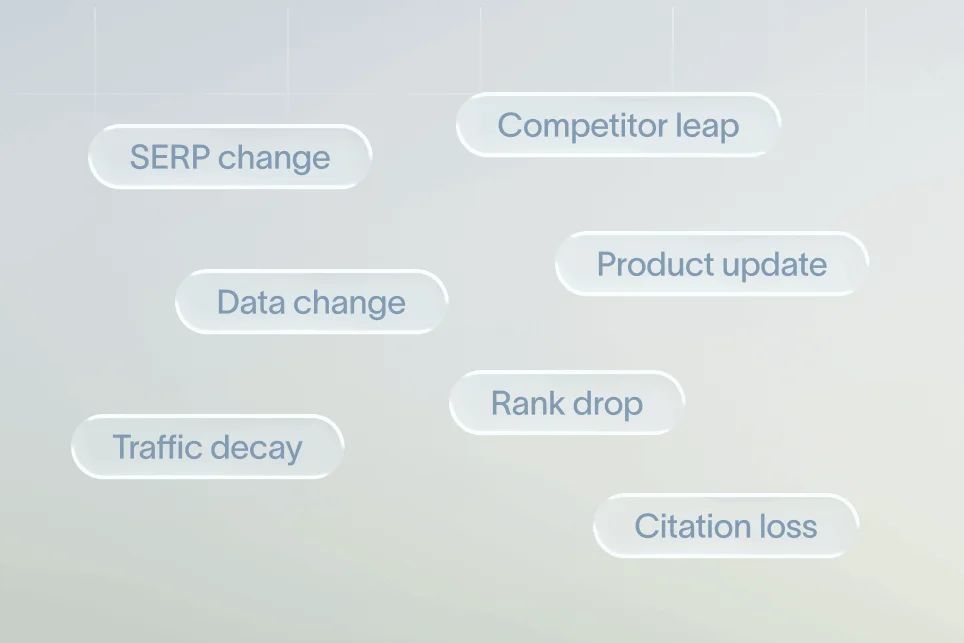
Trigger 1: Ranking drop on a keyword that pays your bills
This is the cleanest trigger because it’s closest to revenue.
If a page is responsible for demo starts, trial signups, or high-intent assisted conversions, a rank drop is an emergency—not a quarterly task.
Series X Marketing highlights how steep the traffic cliff can be with small position changes (Series X Marketing). Use that idea to define thresholds:
Alert if your top 20 “money keywords” drop by 2+ positions week-over-week.
Escalate if they drop by 5+ positions or fall off page one.
What I look for during investigation:
Did the SERP layout change (AI Overviews, more ads, more video, more forums)?
Did competitors add a better comparison, template, or tool?
Did you accidentally cannibalize with a new page?
Fixes that usually work:
tighten the page’s “answer block” near the top (definition + steps)
add missing sections competitors now cover
update internal links from relevant hubs
Trigger 2: Organic sessions down over 28–90 days (even if rankings look “fine”)
Rankings can lie because:
SERP features steal clicks
your snippet got worse
intent shifted and your page no longer matches the click
Hashmeta suggests layering 90-day traffic change into prioritization (Hashmeta). I like 28 days for fast feedback and 90 days for trend confidence.
A practical threshold:
–20% organic sessions over 28 days = investigate
–30% over 90 days = schedule refresh
Example pattern (not a promise, just what it looks like):
Baseline: 2,400 organic sessions/month
Now: 1,650 sessions/month (–31%)
Intervention: update intent sections + refresh internal links + improve title/snippet alignment
Measurement plan: track sessions, CTR, and demo assists for 6 weeks
Trigger 3: CTR drop in Search Console (your snippet is losing the click)
CTR decay is one of the most underrated refresh triggers.
You can be “ranking” and still lose half the clicks because:
competitors added “2026” style freshness signals
AI Overviews push you down
your title/description no longer matches what the query implies
This is where refresh work is often surgical:
rewrite title for intent match, not keyword stuffing
add a sharper “what you’ll learn” line in the meta description
rework the first 80–120 words to answer the query directly
This is also where AI extraction starts. If your first screen is fluff, AI systems have nothing clean to cite.
If you’re actively monitoring AI answer behavior, pair CTR work with AI Overviews optimization so you’re not only chasing blue links.
Trigger 4: Engagement drop (people land, then bail)
Engagement isn’t vanity when it correlates with “this page satisfied the query.”
Factors.ai lists core SaaS content KPIs like bounce rate, time on page, and scroll behavior (Factors.ai). You don’t need to overcomplicate it—just track changes.
Common engagement decay causes I see:
the intro got bloated over time
the page lost its structure (too many random H2s)
the content is accurate but not actionable
it answers “what” but not “how”
Refresh fixes that tend to lift engagement:
add a numbered process
add a “common mistakes” section
move the definition and checklist above the fold
add internal jump links (especially on long pages)
Trigger 5: Conversion rate dip on high-intent pages
This one is where most SEO teams hesitate, because it feels like “CRO territory.”
But if SEO is bringing qualified visitors and conversion drops, it’s your problem too.
What changes over time:
the product UI evolves but screenshots (or descriptions) don’t
the positioning shifts but the page still sells the old story
competitor comparisons show up in AI answers and your page doesn’t defend differentiation
How I investigate:
segment by landing page + source/medium
compare conversion rate over the last 28 days vs previous 28
check whether the query mix changed (more problem-aware vs solution-aware traffic)
Refresh fixes that protect conversions:
add a “who this is for” block
add proof elements (logos, outcomes, constraints)
tighten CTA language (less “book a demo,” more “see how it works for X use case”)
If you’re trying to turn AI citations into clicks, this is the part that matters: citations without conversion-ready pages just create expensive awareness.
Trigger 6: Backlink decline or link growth stagnation
Links are both authority and a proxy for whether the web still finds your asset reference-worthy.
Ahrefs describes using backlink and traffic data to spot underperformers worth updating (Ahrefs). Even if you’re not deep in link building, you can still use link signals.
Two practical alerts:
pages that lost links month-over-month
pages with stable rankings but no new links for 6–12 months (often a “stale” signal)
Refresh moves that help:
add a unique artifact worth citing (a framework, a checklist, a template)
tighten definitions and “quotable” sections
add internal links from your most linked-to pages (home, flagship guides)
This is also where structured internal linking matters. If your site architecture is messy, refreshes don’t compound. We’ve covered how to build topic cluster architecture so refreshed pages actually receive and redistribute authority.
Trigger 7: The SERP changes and your page stops being the best match
Sometimes nothing “went wrong” on your page. The world moved.
Common shifts in SaaS:
intent becomes more comparison-heavy (“X vs Y”, “best for…”)
the SERP starts rewarding templates/tools instead of essays
AI Overviews summarize the category and users click fewer results
This is the trigger where refresh work becomes repositioning, not editing.
Series X Marketing also argues refreshing can reduce production costs dramatically compared to net-new (Series X Marketing). I treat that as a prompt, not a guarantee: when SERPs shift, you can often win by reshaping an existing asset instead of rebuilding from scratch.
Build a refresh radar: scoring + alerts + a weekly habit
If you only take one thing from this post, take this: refreshing is an ops problem, not a writing problem.
Your job is to make it easy to answer:
What is decaying?
How bad is it?
What should we do this week?
Start with a content inventory that isn’t a mess
Flow Agency recommends building an inventory with metrics like organic sessions, backlinks, word count, internal links, and crawl date, pulling from analytics and SEO tools (Flow Agency).
That sounds obvious, but most teams don’t do it well.
My inventory columns (minimum viable):
URL
content type (blog, landing page, integration page, programmatic page)
primary query/topic
organic sessions (28d + 90d change)
impressions + CTR
avg position for primary query
conversions (whatever matters: demo starts, trial starts, lead submits)
referring domains (or link count)
last updated date
notes (cannibalization risk, product changes, legal/compliance constraints)
Use a simple scoring model (don’t overthink it)
Hashmeta suggests prioritization scoring using layered metrics like traffic trend and ranking positions (Hashmeta).
Here’s a scoring model you can copy.
Score each page 0–3 on four dimensions:
Business value (conversion impact)
Decay severity (rank/traffic/CTR drop)
Fixability (how likely a refresh can win)
AI visibility upside (is this a “definition” or “comparison” page likely to be cited?)
Total score 0–12.
Rules of thumb:
9–12: refresh now
6–8: queue for this month
0–5: monitor, don’t touch
Action checklist: set up your refresh system in 7 days
This is the “you can actually do it” part.
Export your top 200–500 organic landing pages.
Add 28d and 90d deltas for sessions, impressions, CTR, conversions.
Tag the top 20 pages by conversion impact (your “money pages”).
Add rank movement for your top keyword per page.
Add link data (even a simple referring domains count).
Define alert thresholds (rank drop, traffic drop, CTR drop, conversion drop).
Build a weekly 30-minute review: sort by biggest negative deltas.
Score the top 30 “at risk” pages using the 0–12 model.
Pick 5 pages to refresh this week (not 50).
For each refresh, write down: hypothesis → changes → metrics → check-in date.
Thruuu recommends ongoing monitoring via custom reporting (often via Looker Studio) to track rankings, traffic, engagement, and conversions (Thruuu). Whether you use dashboards or spreadsheets, the habit matters: refresh review is a recurring meeting, not a panic response.
Cadence: monthly, quarterly, and “when something breaks”
Sitebulb suggests a pragmatic cycle: review top traffic drivers monthly, audit evergreen content quarterly, and revisit low-traffic/high-potential content bi-annually (Sitebulb).
I like that structure because it keeps you honest:
monthly = protect your biggest assets
quarterly = keep evergreen pages aligned with the market
bi-annual = find sleeper pages worth expanding
If you’re scaling content volume (especially programmatic), cadence and crawl/index control become infrastructure problems. This is where a platform mindset matters; see our breakdown on content infrastructure if your refreshes aren’t sticking.
What to change during a refresh (so rankings and citations actually come back)
A refresh isn’t “add a few new paragraphs.”
It’s a targeted set of changes tied to the trigger.
Fix the part that matches intent (not the part that’s easy to edit)
If rankings dropped, your page likely lost intent fit.
Common intent fixes:
Add a clearer definition block.
Add step-by-step instructions.
Add a comparison section (“X vs Y”, “best for”, “alternatives”).
Add implementation constraints (time, cost, team size).
If you want your page to be cited, build short, extractable sections:
40–80 word answer paragraphs
numbered steps
lists of decision criteria
This is also how you keep your content usable for humans. People skim. AI systems extract. Structure helps both.
Update internal links like you mean it
Refreshing content without adjusting internal linking is like repainting a house while leaving the foundation cracked.
When you refresh, do three internal link passes:
Inbound links: add links to the refreshed page from relevant high-authority pages.
Outbound links: ensure the refreshed page links to the next step (product page, integration, demo path, deeper guide).
Cluster alignment: confirm it sits correctly in your hub/spoke model.
If you’re building clusters intentionally, our guide to internal linking goes deeper on how to make those links measurable.
Make the page “AI-citable” without turning it into a robot essay
For AI answers, you want clean extraction:
definitional sentences
consistent terminology
explicit pros/cons
clear “best for” qualifiers
Do not bury the lede.
A simple pattern that works:
First 120 words: definition + who it’s for
Next: steps/process
Next: pitfalls + troubleshooting
Next: tools/templates (if relevant)
End: conversion path
Refresh conversion elements (quietly, but intentionally)
This is where I see teams miss easy wins.
If a page gets high-intent traffic, treat it like a landing page:
tighten CTA placement (one above fold, one mid-page, one near end)
add social proof that matches the query (not generic logos)
update positioning to match the current product
You don’t need a big redesign. You need fewer dead ends.
Common mistakes that waste refresh cycles
I’ve made these mistakes. They’re expensive.
Refreshing without a trigger. You’ll “update” pages that weren’t the bottleneck.
Changing too much at once. You won’t know what caused the lift (or the drop).
Ignoring cannibalization. Two pages target the same query, and both weaken.
Only updating words. Snippet, internal links, and conversion path stay broken.
Not measuring AI visibility. You fix rankings, but your brand still disappears from citations.
If you’re serious about that last one, the most practical next step is to start measuring where you do and don’t appear in AI answers. That’s what our AI search visibility workflows are built for.
What outcomes are realistic (and how to forecast them)
You shouldn’t promise lifts. You should forecast and measure.
Two externally cited ranges you can use as sanity checks:
Hashmeta notes companies can see 20–40% traffic increases on updated posts within 60–90 days (Hashmeta).
Libril reports refreshed content can show 20–50% traffic growth and 15–30% engagement improvement in roughly 90 days (Libril).
Use those as guardrails, not guarantees.
My preferred measurement plan per refresh:
Baseline: last 28 days (sessions, CTR, conversions)
Target: +10–20% sessions or +0.3–0.8pp CTR, depending on trigger
Timeframe: 6 weeks for leading indicators, 90 days for stabilized impact
FAQ: content refresh strategy for SaaS teams
How do I choose between refreshing and writing a new page?
If the existing page has backlinks, rankings history, and some conversions, refresh first. Net-new makes sense when the intent is genuinely different (new category page, new use case, new comparison query). When in doubt, refresh to reclaim relevance, then split into a new page only if cannibalization or intent mismatch persists.
What’s the fastest refresh that still moves rankings?
Fixing CTR and intent alignment tends to move first: rewrite title/meta for the actual query, tighten the top-of-page answer, and add missing sections competitors cover. Then update internal links so the page actually receives authority. You can often ship this in a day and measure leading indicators within 2–4 weeks.
How often should SaaS teams refresh content in 2026?
Use a tiered cadence: monthly reviews for top traffic and conversion drivers, quarterly audits for evergreen pages, and bi-annual sweeps for low-traffic/high-potential pages. That cadence lines up with Sitebulb’s recommended cycles for maintaining search and AI visibility (Sitebulb).
What metrics matter most for a content refresh strategy?
Rank position, organic sessions, impressions and CTR, conversions (demo/trial/lead), and engagement (bounce/time/scroll) are the core set. Factors.ai outlines many of these content KPIs for SaaS teams (Factors.ai). Add backlinks as an authority indicator if you have reliable link data.
Can content refreshes improve AI citations, not just Google rankings?
Yes, if the refresh makes the page easier to extract and trust. Add crisp definitions, structured steps, explicit comparisons, and clear qualifiers (“best for X, not for Y”). Then monitor where your brand is and isn’t cited, and refresh the pages that should be the source of truth for your category.
What’s the biggest refresh mistake teams make?
Treating refresh as editing instead of diagnosis. If you don’t tie work to a trigger (rank drop, CTR drop, conversion drop, SERP shift), you’ll ship updates that feel productive but don’t change outcomes. Use the SIFT loop so every refresh has a measurable reason to exist.
If you want, we can help you turn this into an operating cadence: detect decay automatically, prioritize by business value, and track whether refreshed pages show up in AI answers. Start by checking your current citation footprint, then decide what deserves a refresh first—our AI visibility guides are a good place to calibrate what “measurable” should look like.
What’s the one page on your site that would hurt the most if it dropped from #2 to #7 next month?
References
Flow Agency — Content Refreshing: Maximizing SaaS Traffic and Conversions
Series X Marketing — The Ultimate SaaS Content Refreshing Playbook: When + How
Factors.ai — 12 Content Marketing Metrics & KPIs For SaaS Companies
Hashmeta — Content Refresh Strategy: When and How to Update Old Posts for Maximum SEO Impact
Libril — Evergreen Content Refresh Strategy: Updating & Optimizing Legacy Content
Thruuu — Content Refresh 101: How to Improve Search and LLM Visibility
Sitebulb — Content Refresh Guide: How to Improve Your Search & AI Visibility
SEMrush — Content Refresh: How to Update Old Posts and Boost Traffic
Ahrefs — Content Refresh: How to Rejuvenate Your Old Content