
TL;DR
AI search visibility ROI is measurable if you treat it as a system, not a vanity metric. Track presence, citation quality, visit quality, and pipeline impact, then connect those signals to the pages and prompts that influence buying decisions.
Most founders I talk to have the same problem: they can feel AI search changing buyer behavior, but they can’t defend a budget line for it in a board meeting. Traffic is wobbling, branded queries are shifting, and more prospects are showing up already half-convinced because they saw the company in an AI answer somewhere.
That creates an awkward gap. You know AI visibility matters, but if you can’t tie it to pipeline, it gets treated like an experiment instead of a growth channel.
Why this is suddenly a board-level question
AI search visibility ROI is the business value created when your brand appears in AI-generated answers and that visibility influences pipeline, revenue, or customer acquisition efficiency.
That’s the clean definition. It matters because founder-led budgeting is about tradeoffs, not theories.
For years, SEO had a familiar reporting model: rankings, clicks, assisted conversions, pipeline. Messy, but workable. AI search breaks that neat flow because the new path is often impression -> AI answer inclusion -> citation -> click -> conversion.
Some of that path happens off your website. That makes lazy reporting dangerous.
According to Amplitude, the case for AI visibility has to be tied directly to business outcomes if you want leadership teams to treat it seriously. That lines up with what I’ve seen in SaaS teams: if the report stops at “we appeared more often,” the budget gets cut. If the report shows influence on qualified traffic, demo quality, and sales velocity, the conversation changes.
This is also why old SEO dashboards are no longer enough. If your team is still reporting only on sessions and keyword movement, you’re missing the part of search that buyers increasingly see first.
We’ve covered the broader shift in our guide to SEO in 2026, but the practical point is simple: visibility now includes both search engine rankings and whether AI systems consider your brand worth citing.
The mistake I see most often
Founders usually make one of two errors.
First, they treat AI visibility as a vanity metric and ask for a hard dollar return too early, before they’ve built any instrumentation.
Second, they assume AI visibility is impossible to measure and therefore ignore it completely.
Both are wrong. You do not need perfect attribution to calculate ROI. You need a defensible model, clean baselines, and a way to separate leading indicators from outcome metrics.
A practical point of view
Don’t ask, “Can we prove every AI mention caused revenue?” Ask, “Can we show that better AI visibility increases qualified discovery, brand preference, and pipeline efficiency?”
That’s a much better operating question. It’s also how boards actually think.
The four layers that make ROI defensible
When I help teams think about AI search visibility ROI, I keep it to four layers: presence, citation, visit quality, and pipeline impact.
That’s the model. It’s simple enough to reuse, and specific enough to survive scrutiny.
1. Presence
Presence is how often your brand, product, or category pages appear in relevant AI answers.
This is your top-of-funnel visibility layer. You’re not asking whether someone clicked yet. You’re asking whether you exist in the answer set when buyers ask commercial or evaluative questions.
Examples:
- “best SOC 2 compliance software for startups”
- “alternatives to enterprise analytics tools”
- “how to reduce SaaS churn with onboarding automation”
If you never appear, there is no downstream ROI to calculate.
2. Citation quality
Citation quality is whether AI systems mention your brand in a way that signals trust, relevance, and category fit.
This matters more than raw presence. A weak mention buried among ten brands has a different value than a direct recommendation with clear positioning.
As Digital Scouts notes, measuring AEO performance requires more than counting appearances. You need to track authority signals and connect them to business outcomes. In practice, that means scoring not just whether you were mentioned, but how you were framed.
3. Visit quality
This is where most teams finally get comfortable, because it touches standard web analytics.
Once someone clicks from an AI surface, what happens? Do they bounce? Do they visit pricing? Do they request a demo? Do they convert at a higher rate than generic organic traffic?
In one SaaS case I worked on, AI-referred traffic was small in volume but unusually sharp in intent. Visitors landed on comparison and solution pages, spent more time on-site, and viewed more commercial pages per session than broad blog traffic. The exact revenue attribution took time to clean up, but the pattern was obvious within weeks: lower volume, higher intent.
That’s a founder-friendly signal.
4. Pipeline impact
This is the bottom line layer. Did improved AI search visibility contribute to sourced pipeline, influenced pipeline, faster sales cycles, or stronger branded demand?
According to Discovered Labs, teams now need to shift from traffic-only reporting toward AI-sourced pipeline attribution. That’s the right move. Sessions are useful, but pipeline is what gets budget approved.
What to measure before you try to prove revenue
This is where a lot of teams get stuck. They jump straight to ROI formulas without building a measurement spine.
Start with a 60- to 90-day baseline. Not because it’s elegant, but because without a baseline every board slide turns into opinion.
Track these inputs first
- Prompt set coverage: Build a fixed set of category, problem, comparison, and use-case prompts that matter to your pipeline.
- Appearance rate: Measure how often your brand appears across those prompts.
- Citation position and framing: Note whether you’re first mentioned, listed among alternatives, or omitted entirely.
- Landing page destination: Track which pages are being cited or clicked.
- Engagement quality: Measure bounce rate, pages per session, pricing visits, demo intent, and assisted conversions from AI-referred or AI-influenced traffic.
- Pipeline connection: Tag leads where AI surfaces played a role in discovery or validation.
That gives you a useful baseline without pretending attribution is cleaner than it is.
The Pepper Content guide on tracking AI search ROI also makes an important operational point: appearance rates can degrade over time, so prompt monitoring needs to be repeated regularly. That’s not a minor detail. If you measure once and stop, you’re not tracking ROI. You’re taking a screenshot.
What your dashboard should actually show
Founders don’t need a giant SEO command center. They need a compact operating view.
I’d include:
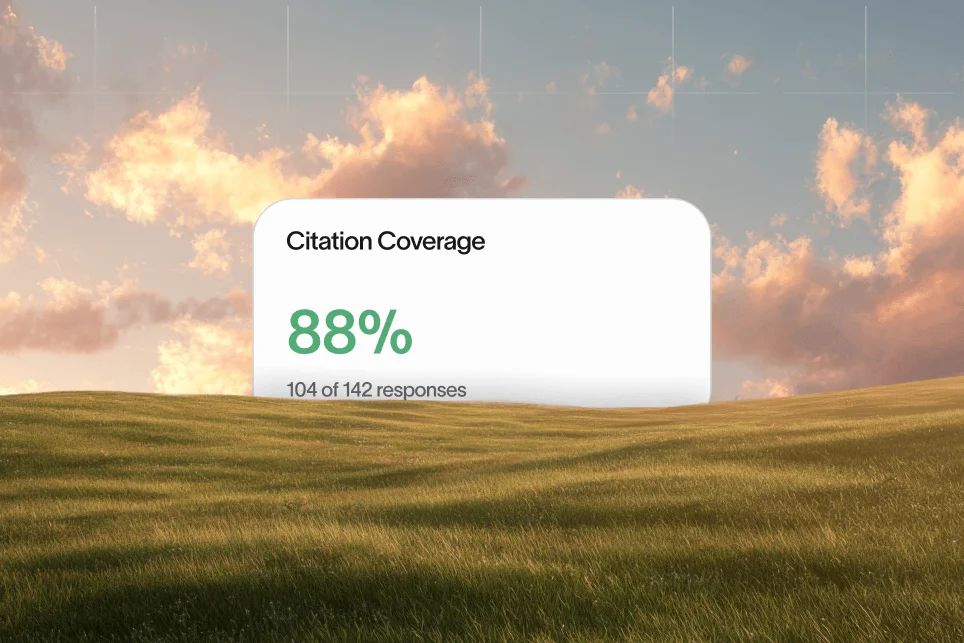
- AI appearance rate by prompt cluster
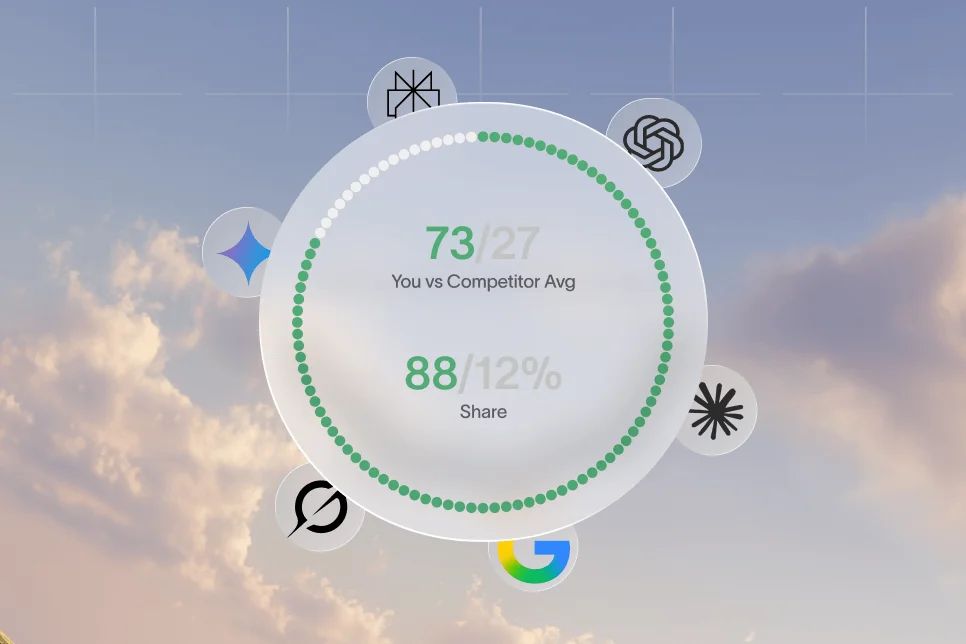
- Citation share versus key competitors
- Click-throughs from AI-linked environments where measurable
- Conversion rate of AI-influenced sessions
- Number of opportunities with AI-assisted discovery
- Pipeline value influenced by AI visibility
- Cost to produce and maintain the content driving those outcomes
This is also where platforms matter. Skayle fits naturally here because it helps SaaS teams improve rankings and appear in AI-generated answers while keeping content creation, optimization, and refresh work connected to visibility outcomes rather than scattered across separate tools.
Don’t let tooling hide weak reasoning
I’ve seen teams buy monitoring tools before they’ve defined what a valuable AI mention looks like.
That’s backwards. Tooling should support your measurement model, not become the model.
How to calculate ROI without pretending attribution is perfect
Here’s the part founders actually need: the math.
You do not need one formula. You need three views of ROI, each with a different level of confidence.
The direct return view
Use this when you can identify sessions, conversions, or opportunities with a credible AI-source signal.
Formula:
AI visibility ROI = (Pipeline or revenue influenced by AI visibility - AI visibility investment) / AI visibility investment
Your investment should include:
- content production
- content refresh work
- SEO research and optimization
- AI visibility monitoring
- team time or agency cost
Example:
Say you spend $18,000 over a quarter on category page upgrades, expert-led comparison pages, refreshes, and measurement. During that same quarter, you can credibly tie $72,000 in influenced pipeline to AI-cited discovery paths and closed-won revenue is still lagging behind by one sales cycle.
Your near-term pipeline ROI view is:
($72,000 - $18,000) / $18,000 = 3.0x
That doesn’t mean every dollar came from AI answers alone. It means the investment produced measurable pipeline influence at a level worth continuing.
The efficiency view
This one is underrated.
Sometimes AI visibility doesn’t create obviously net-new demand right away, but it improves the efficiency of demand capture. That still has value.
Look for:
- higher branded search volume after repeated AI citations
- improved conversion rate on solution or comparison pages
- lower CAC from organic-assisted opportunities
- shorter sales cycles because buyers arrive pre-educated
As Coalition Technologies argues, SEO ROI in the AI era includes a multiplier effect, not just direct traffic value. I think that’s exactly right. If AI search makes your brand more credible before the first sales conversation, it changes downstream economics.
The strategic coverage view
This is the view I use when a company is still early in AI measurement.
If you can’t responsibly claim revenue yet, calculate ROI as cost per valuable citation improvement across high-intent prompt clusters.
That sounds less glamorous, but it’s honest.
Example:
- Baseline: brand appears in 12% of target prompts
- Intervention: rebuild category pages, refresh product-led comparison content, tighten expert attribution, improve internal linking, publish concise answer-ready blocks
- 8 weeks later: appearance rate improves to 31% across the same prompt set
You still haven’t “proved revenue,” but you’ve clearly increased discoverability where commercial buyers are looking. That is the leading indicator your next quarter pipeline report should test.
If your content team needs help avoiding low-trust output during that process, our piece on avoiding AI slop gets into the editorial discipline required to make pages citable instead of disposable.
The content changes that usually move the numbers
Here’s the contrarian stance: don’t publish more AI content to improve AI search visibility ROI; publish fewer pages with stronger evidence, cleaner structure, and clearer commercial intent.
Most underperforming SaaS teams don’t have a volume problem. They have a trust and relevance problem.
According to Search Engine Land, durable AI visibility depends on stronger entity structure, taxonomies, and knowledge relationships rather than surface-level SEO tactics. You do not need to explain the underlying machinery to act on that. The practical takeaway is that sloppy, interchangeable content rarely earns durable citations.
What I’d fix first on a Series A site
- Category pages that sound like an adult wrote them
Too many category pages read like they were assembled from SERP fragments. Rewrite them with a clear point of view, category definition, buyer context, and proof.
- Comparison pages with real tradeoffs
AI systems and human buyers both respond better to pages that explain differences honestly. Not “we’re better at everything.” Actual tradeoffs.
- Authoritative answer blocks
Add concise 40-80 word explanations under key questions. These are often the most extractable pieces on the page.
- Internal linking that reinforces authority
Connect category pages, comparisons, use cases, and definitions so the site reads like a coherent knowledge base instead of a folder of disconnected assets. This matters even more when you’re trying to recover lost visibility from AI surfaces, which we’ve broken down in this playbook.
- Refreshes before new production
In most early-stage SaaS teams, updating ten strategic pages beats publishing thirty new mediocre ones.
A mini case that shows how to think about proof
Here’s a realistic pattern I’ve seen more than once.
Baseline: a company has decent traditional SEO traffic, but almost no visibility in AI answers for high-intent prompts like “best X software for startups” or “top alternatives to Y.” Their blog performs fine, but buyers aren’t landing on the money pages.
Intervention: over six weeks, the team rewrites category and comparison pages, adds tighter product positioning, includes clearer definitions, reduces filler, improves internal linking, and adds source-backed statements where appropriate.
Outcome: the company starts appearing more consistently in evaluative AI answers, branded search lifts modestly, and demo requests from organic sessions become more sales-qualified.
Timeframe: the first useful visibility signal appears in 3-6 weeks; reliable pipeline interpretation usually takes one full sales cycle longer.
That’s not a fantasy dashboard result. It’s how this usually works in the real world: first citation and discovery signals, then traffic quality shifts, then pipeline evidence.
Design and conversion details that founders ignore
If AI answers send a click, your page still has to close the gap.
I’ve seen teams do the hard part—earn the citation—then send traffic to a page with vague headlines, weak proof, and no obvious next step. That kills ROI.
Check these elements on any page likely to be cited:
- headline clarity in the first screen
- immediate category relevance
- proof near the top, not buried at the bottom
- buyer-specific examples
- frictionless CTA path to demo, trial, or pricing
- message match between AI citation and landing page promise
A cited page that converts poorly is not an AI visibility success. It’s an attribution mirage.
Where ROI models break down and how to avoid bad decisions
There are a few traps that make teams either overstate or understate AI search visibility ROI.
Mistaking mention volume for business value
Not all prompts matter. A brand mention on a broad informational query is not equal to a citation on a comparison prompt right before vendor evaluation.
Weight your prompts by commercial value. A Series A company should care much more about high-buying-intent prompts than vanity reach.
Reporting clicks only
Some AI experiences reduce clicks while still influencing demand.
As ROI Revolution argues, consistent brand authority matters because it shapes how AI systems surface and frame companies. That’s important for ROI because buyers may search your brand directly later, book a demo through another channel, or arrive with pre-built trust. If you only count last-click visits, you’ll undervalue the channel.
Assuming traditional SEO content will naturally transfer
Sometimes it will. Often it won’t.
Pages built to rank for broad long-tail traffic are not always the same pages that get cited in AI answers. The latter usually need tighter definitions, clearer comparisons, stronger evidence, and fewer generic sentences.
Treating this as a side project
AI visibility compounds when content, technical hygiene, internal linking, and measurement are run as one system.
That’s one reason some teams move toward platforms like Skayle rather than stitching together separate writers, SEO docs, audits, and tracking tools. The value is not “content faster.” The value is coordinated execution tied to ranking and answer visibility.
A 90-day plan founders can actually use
If I joined a Series A SaaS company tomorrow and had to justify AI search work in one quarter, this is the order I’d follow.
Days 1-14: define the commercial prompt set
Build a prompt library across four buckets:
- category queries
- pain-point queries
- competitor comparison queries
- use-case queries
Limit it to 30-50 prompts at first. More than that and the team usually drowns in noise.
Days 15-30: benchmark visibility and page readiness
For each prompt, record:
- whether your brand appears
- how it is framed
- which competitor brands appear
- whether a citation or link is present
- which internal page is most relevant if a click happens
Then audit the destination pages. Many companies discover that the page most likely to be cited is also the page least likely to convert.
Days 31-60: upgrade the pages most tied to revenue
Do not start with blog posts.
Start with:
- category pages
- solution pages
- comparison pages
- high-intent product education pages
This is where most of the ROI lives.
Days 61-90: connect visibility movement to pipeline signals
At this stage, look for:
- improved appearance rate in target prompts
- increased branded search or direct traffic correlation
- stronger engagement on upgraded landing pages
- more sales conversations where prospects reference AI assistants, summaries, or comparison research
- influenced opportunities tied to the upgraded content set
That last point matters. Ask sales to capture this in plain language. You don’t need fancy taxonomy if your reps can consistently log things like “prospect said ChatGPT recommended us in shortlist research.”
According to Column Five Media, AI search is changing how B2B SaaS buyers discover and evaluate software. You don’t need every stat in the deck to feel that shift; you need your own operating data to show whether your company is benefiting from it.
Questions founders ask when the spreadsheet gets real
How long does it take to see AI search visibility ROI?
You can usually see leading indicators like appearance rate, citation quality, and landing-page engagement within a few weeks. Revenue-level ROI usually takes at least one full sales cycle, sometimes longer.
What’s the difference between AEO, GEO, and AI search visibility?
AEO usually refers to optimizing for direct answers, while GEO is often used more broadly for visibility in generative engines and AI assistants. For founders, the practical issue is the same: can your company be found, cited, and trusted in AI-mediated discovery?
Can we measure AI search visibility ROI if we don’t have perfect attribution?
Yes. Start with a model that combines leading indicators and influenced pipeline rather than demanding perfect last-click proof. Most good growth decisions are made with directional evidence, not laboratory conditions.
Which pages usually produce the best return?
For most SaaS companies, category pages, comparison pages, and high-intent solution pages create more value than generic informational blog posts. They sit closer to buying decisions and are easier to tie to pipeline.
What should we stop doing if ROI is weak?
Stop publishing large volumes of low-differentiation content and calling it AI strategy. Weak pages rarely earn durable citations, and even when they do, they often convert badly.
The real budgeting decision
The founder decision is not whether AI search visibility can be measured perfectly. It can’t.
The real decision is whether you want to build a repeatable system for earning citations, capturing higher-intent discovery, and connecting those gains to pipeline before your category gets more crowded.
That is why AI search visibility ROI should be managed like an operating model, not a one-off experiment. You need a clean prompt set, a defensible measurement spine, stronger commercial pages, and regular refresh cycles. Once that is in place, the business case gets much easier to defend.
If you’re trying to get clearer on where your brand shows up and whether that visibility is compounding, Skayle can help you measure AI visibility, improve your citation coverage, and connect content work to ranking outcomes without turning the process into another fragmented reporting exercise.