
TL;DR
In skayle vs profound, the core difference is what happens after AI visibility insights. Profound is strongest as large-scale AI telemetry, while Skayle is built to turn gaps into shipped, maintained pages that earn citations, clicks, and conversions.
SaaS teams are spending more time inside AI answers and less time inside classic SERP reports. The hard part is no longer “seeing” what the engines say—it’s turning that visibility into pages that get cited, clicked, and converted.
AI visibility without execution is just expensive telemetry.
The real buyer journey: impression → AI answer → citation → click → conversion
AI search changed the funnel shape. A buyer can ask ChatGPT, Perplexity, or Google AI Overviews a question, get a synthesized answer, and only click a citation when something feels credible, specific, and immediately useful.
That means “ranking” is now two intertwined problems:
Search rankings (classic SEO outcomes).
Answer inclusion and citations (AEO/GEO outcomes).
A practical definition that’s easy to operationalize:
AI search visibility: whether a brand is mentioned, compared, and cited across major answer engines for a defined prompt set.
Citation coverage: the share of tracked prompts where the brand earns a clickable citation (not just a mention).
Execution layer: the workflow that turns prompt insights into updated pages, internal links, schema, and conversion paths.
Two tools can both “track prompts” and still create very different business outcomes. The core question in skayle vs profound is whether the platform stops at reporting—or connects reporting to repeatable publishing and maintenance.
A clear point of view for SaaS teams
A SaaS team should treat AI visibility as an input signal, not a deliverable. The winning stack is the one that reduces the time between “we found a gap” and “the fix is live, indexable, and converting.”
Why this matters now (2026)
AI answers compress the evaluation cycle. When an engine answers “best tool for X” and cites three sources, those three sources get the next set of clicks, brand recall, and sales conversations.
The teams that win are the teams that can:
Identify the prompts that matter.
Publish answer-ready pages with extraction-friendly structure.
Maintain those pages as competitors ship and engines change.
If a platform only solves step 1, the team is buying a dashboard and then rebuilding the real system manually.
Profound in plain terms: strong telemetry for AI answers
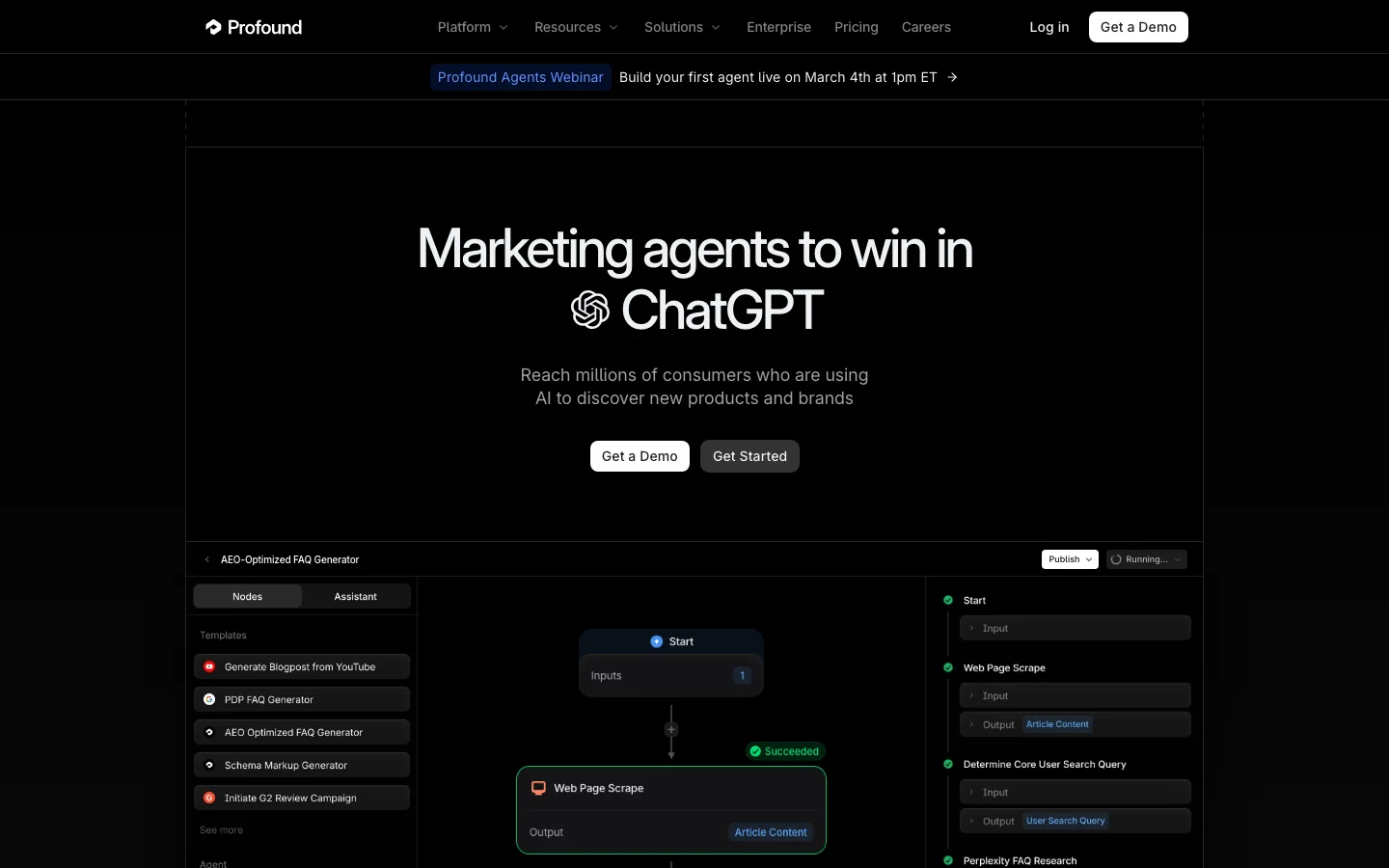
Profound is positioned as a platform for understanding brand presence in AI-generated conversations. Its core value is depth of AI visibility analytics—the kind that helps large teams monitor enormous prompt sets and multiple engines.
As a baseline reference, Profound presents itself as a “full stack” marketing platform on its official site at Profound. But in most buying evaluations, the difference comes down to what happens after the insight appears.
Where Profound is genuinely strong
Several third-party comparisons emphasize Profound’s enterprise-grade monitoring and data scale.
Prompt scale and retention: Relixir’s comparison describes Profound as capable of analyzing up to 200,000 unique prompts daily per customer with unlimited data retention, and also notes SOC 2 Type II compliance positioning for enterprise security needs in Relixir’s GEO platform comparison.
Multi-engine coverage: Nick Lafferty’s discussion highlights monitoring across multiple AI engines (including major systems like ChatGPT-class assistants and other answer engines), framing Profound as broad in visibility coverage in Nick Lafferty’s Profound vs Scrunch analysis.
Operationally, this is what Profound is good for:
Monitoring brand mentions and citations across engines.
Detecting prompt categories where competitors dominate.
Producing conversation intelligence that’s useful for comms, brand, and market insights.
For enterprises where the primary risk is “the company has no idea how it appears in AI answers,” this is a real gap Profound can help close.
Where Profound stops (and why that becomes expensive)
The common failure pattern with analytics-first visibility tools is predictable: the team gets a flood of insights and then a backlog of manual work.
Relixir explicitly frames this as an “analytics-only trap,” describing a gap between diagnostic strength and the ability to act through native content workflows in Relixir’s GEO platform comparison.
The execution friction shows up in a few places:
Content output limits: GetMint’s comparison notes that Profound’s Growth plan limits content generation to 3 articles per month and indicates zero on the Starter plan, reinforcing the idea that content production is not the system’s center of gravity in GetMint’s Profound vs Hall AI piece.
Manual optimization reality: Nick Lafferty’s analysis describes strong visibility outcomes (including a cited 47.1% AI visibility figure) while also emphasizing that optimization of existing content is typically a manual process rather than an automated refresh engine in Nick Lafferty’s Profound vs Scrunch analysis.
What about pricing and plan shape?
Exact pricing changes, so teams should validate current tiers directly with the vendor. That said, multiple industry sources describe Profound’s entry pricing and tier constraints:
NudgeNow describes a Starter entry point at $99/month with AI visibility tracking emphasis in NudgeNow’s AI visibility tools overview.
SocialChamps describes a Starter plan limitation of 50 prompts and a single AI engine, which can be enough for lightweight reporting but constraining for multi-engine journey analysis in SocialChamps’ GoVISIBLE vs Profound comparison.
Relixir references a higher minimum price point (including $499/month language) tied to deeper capabilities in Relixir’s GEO platform comparison.
The practical takeaway is not “Profound is expensive” or “Profound is cheap.” The takeaway is: if the platform doesn’t reduce execution cost, the team pays that cost elsewhere—in headcount, contractors, or stalled backlog.
Skayle’s approach: a system that connects visibility to publishing
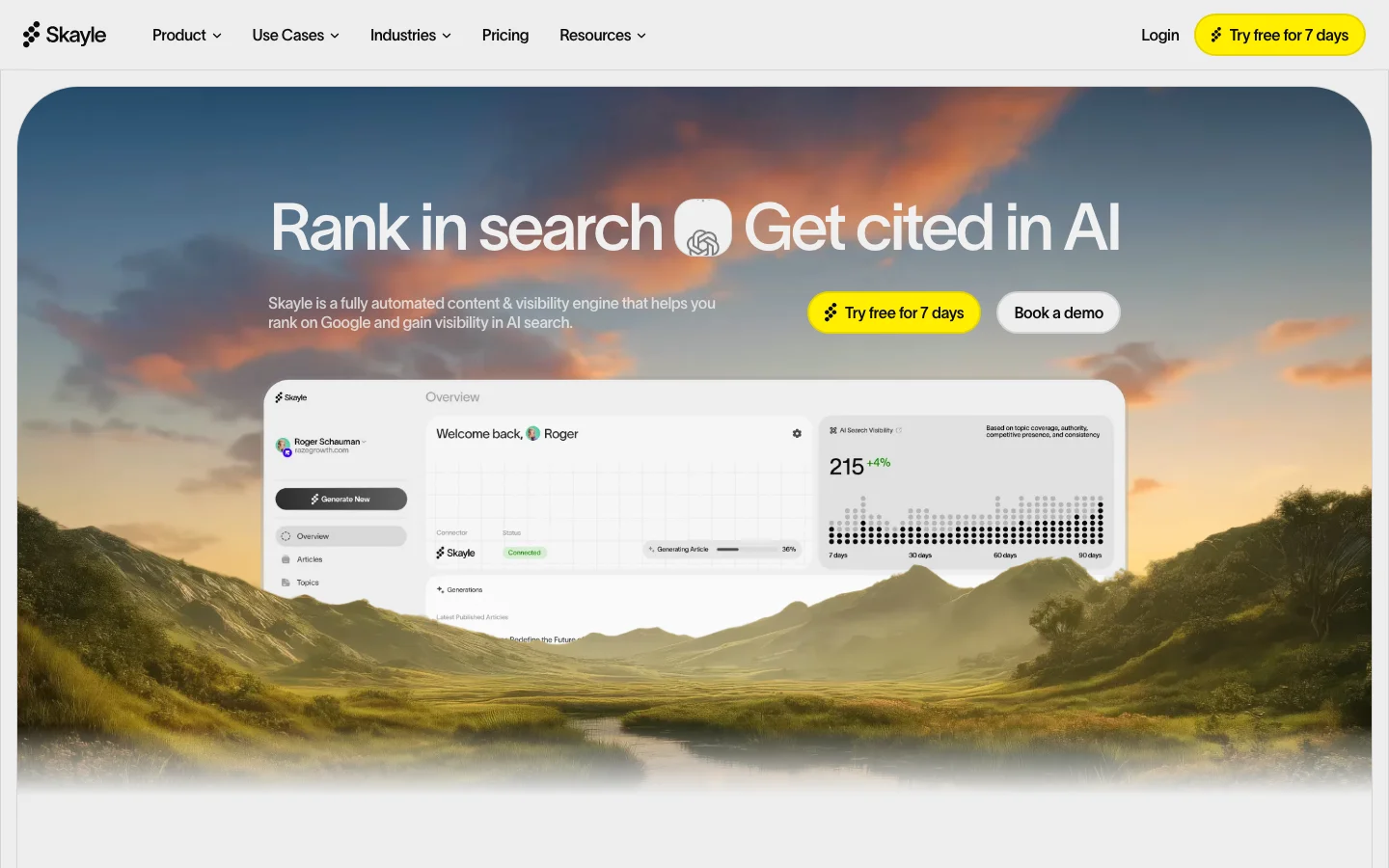
Skayle is built as a ranking and visibility platform for SaaS teams. The center of the product is not a dashboard; it’s the workflow from planning to publishing to maintenance.
A useful mental model is: Profound optimizes for insight depth. Skayle optimizes for time-to-live fixes.
Skayle’s product positioning is explicit about connecting planning, creation, publishing, and AI search visibility in Skayle’s platform overview. That matters because the bottleneck for most SaaS teams is not “what should be done,” it’s “how fast can it ship without quality collapsing.”
The core difference: execution is treated as infrastructure
Execution isn’t a one-time content sprint. It’s infrastructure:
Content structure that stays consistent.
Governance so pages don’t drift.
Publishing and updating workflows that don’t rely on heroics.
Measurement that links citations to pages and pages to conversions.
Skayle leans into that via a few connected pieces:
A centralized context layer so writing and optimization stay consistent across teams, described in the context library.
Content workflows designed for SEO and AI answer eligibility, described in content creation.
AI visibility monitoring that is meant to drive what gets updated next, described in AI search visibility.
A structured CMS that supports reusable objects and governed publishing in the Skayle CMS.
None of these matter alone. The value is in the connected workflow: visibility signals → content decisions → production → publishing → measurement → refresh.
What “execution” actually looks like on a SaaS site
Execution is not “write more blogs.” It’s making sure the pages that answer high-intent prompts have:
A clear, quotable definition.
Extractable sections (40–80 word blocks that LLMs can lift cleanly).
A consistent entity story (product, category, competitors, integrations).
Internal links that make the cluster navigable.
Conversion paths that match the intent stage.
Skayle is designed to run that as a system, not as a scattered set of docs and tickets.
Comparison criteria that predict outcomes (not feature checklists)
Most comparisons collapse into feature bingo. That’s usually the wrong lens because it ignores the actual cost driver: how many human hours it takes to turn insight into a live, indexable, converting page.
Below is a practical decision table for skayle vs profound that focuses on operational realities.
Decision question | Profound tends to fit when… | Skayle tends to fit when… |
|---|---|---|
What is the primary bottleneck? | The company lacks visibility into AI answers at scale. | The company already knows gaps exist, but shipping fixes is slow and inconsistent. |
What’s the “unit of work”? | Prompts, mentions, citations, conversation analytics. | Pages, templates, clusters, updates, and publishing governance. |
What happens after an insight? | Usually a ticket to SEO/content/agency for manual execution. | The workflow is built around creating, updating, and maintaining pages. |
How does the system scale? | By increasing prompt coverage and engine coverage. | By increasing repeatable publishing and refresh capacity without quality collapse. |
What does success look like? | Better monitoring, reporting, and brand intelligence. | More citations and rankings plus measurable clicks and conversions from those surfaces. |
A named model teams can reuse: the Insight-to-Execution Ladder
A simple way to evaluate tools is to ask which steps are native and which steps become manual glue work.
Measure: Track prompt sets, citations, and competitor inclusion.
Prioritize: Turn gaps into a ranked backlog tied to pipeline intent.
Publish: Ship pages with structure, schema, and internal linking.
Refresh: Update pages based on decay, prompt shifts, and competitive moves.
Tools that only nail “Measure” can look impressive in demos and still underperform in quarterly outcomes.
A contrarian stance that saves budgets
Don’t buy AI visibility software as the first step. Buy (or build) the execution layer first, then add visibility depth where it changes publishing decisions.
The tradeoff is straightforward:
Visibility-first stacks produce better reports.
Execution-first stacks produce better pages.
If the site cannot ship and refresh content reliably, better analytics mostly create better frustration.
A 30-day operational plan to turn AI insights into shipped pages
The fastest way to decide between platforms is to run a controlled workflow test. The goal isn’t to “try the UI.” The goal is to see how many pages can move from idea to live, and whether those pages are technically eligible for extraction and citation.
This plan assumes a SaaS team with an existing site, a backlog of content ideas, and limited bandwidth.
Week 1: define prompts and map them to pages
Pick a limited scope that still resembles reality:
20–50 prompts across:
“What is X” definitions
“X vs Y” comparisons
“Best tools for X” lists
Integration/how-to prompts
Map each prompt cluster to one of:
Existing page to refresh
New page to publish
Hub page + spokes
This is where analytics tools like Profound can be strong: identifying which prompts matter and where competitors show up.
Week 2: ship two page types that AI engines cite
Most SaaS teams need two repeatable templates first:
Definition + use-case page (one clear definition, 3–5 use cases, and a short “how it works” block).
Comparison page (decision criteria, tradeoffs, and a tight recommendation by segment).
If the content system cannot produce these pages consistently, prompt dashboards will not change outcomes.
Week 3: harden technical eligibility (schema + extraction)
AI engines tend to reward pages that are:
Easy to crawl and render.
Structured with predictable headers.
Explicit about entities and relationships.
For teams that want a deeper technical playbook, Skayle’s blog goes into crawl/extraction failure modes in its technical SEO guidance and covers structured data patterns for citation eligibility in the structured data blueprint.
Week 4: measure outcomes that connect to pipeline
Avoid vanity measurements like “number of prompts tracked.” Tie the test to metrics that create revenue leverage:
Citation coverage on the test prompt set.
Clicks to the test pages.
Assisted conversions and demo starts from those pages.
Even if citations don’t spike immediately, the team should be able to answer: “Is the backlog moving faster, and are the pages more extractable?”
The checklist (use this to evaluate both tools)
Select 20–50 prompts tied to pipeline intent.
Identify the pages that should win those prompts.
Build or validate a consistent page template (definition, comparison, integration).
Ensure the page is indexable and canonicals are correct.
Add schema that matches the content (and validate it).
Add internal links from hub → spoke and spoke → hub.
Add a short, quotable section that can be lifted into an answer.
Instrument conversions for the page type (demo, trial, contact).
Publish and submit for indexing where appropriate.
Re-check citations and rankings, then refresh the weakest sections.
If a platform makes steps 3–10 materially easier and more governed, it’s closer to an operating system than a dashboard.
Proof that matters: benchmarks and a measurable test instead of vibes
A comparison should acknowledge what is measurable today, and define what should be measured during a pilot.
Benchmark signals (what the market already reports)
The following figures are useful because they indicate the shape of Profound’s strength:
Relixir reports Profound can analyze up to 200,000 prompts daily and retain data indefinitely, positioning it as enterprise-grade monitoring in Relixir’s GEO comparison.
GetMint reports Profound’s Growth plan caps content generation at 3 articles/month, supporting the “diagnostic-first” profile in GetMint’s comparison.
SocialChamps reports a Starter tier constraint of 50 prompts and one engine, which affects multi-engine coverage unless upgraded in SocialChamps’ comparison.
Those aren’t “good” or “bad” in isolation. They show where the platform’s investment is concentrated.
A mini case format that stays honest (baseline → intervention → outcome)
Because outcomes vary by domain authority, dev constraints, and category competitiveness, the cleanest proof for a SaaS team is a measurable pilot.
Baseline (Day 0): 0 structured tracking for AI citations on priority prompts; inconsistent page templates; refresh backlog managed in spreadsheets.
Intervention (Days 1–30): implement the Insight-to-Execution Ladder on a small cluster (one hub, 6–10 spokes). Publish and refresh pages with consistent structure, schema, and internal links; instrument conversions.
Outcome (Day 30 review): quantify (a) how many fixes shipped, (b) how many pages are technically eligible for extraction, © citation coverage on the tracked prompt set, and (d) assisted conversions from the updated cluster.
This is exactly where execution-centric platforms tend to outperform: they reduce cycle time and variance, which is what compounding authority requires.
Common mistakes teams make in skayle vs profound evaluations
Many buying processes fail because they evaluate software the way they evaluate analytics—by screenshots and exports.
Mistake 1: treating “prompt volume” as the KPI
A huge prompt corpus is only valuable if it changes publishing priorities. Teams should decide upfront what percentage of prompts must map to a specific page or template.
If the answer is “most prompts don’t map cleanly,” the tool may be producing noise rather than a backlog.
Mistake 2: believing content output limits don’t matter
SaaS teams usually need steady, governed output: comparisons, integrations, use cases, alternatives, and refreshes.
If content generation is capped at a handful of articles, it can still be useful—but it won’t become the operating system for growth.
Mistake 3: ignoring conversion design
Citations without conversion paths create “visibility with no yield.” Any pilot should check:
Does the page answer the question in the first screen?
Is the CTA aligned to intent stage?
Is the comparison logic credible (criteria, tradeoffs, segment recommendation)?
Mistake 4: not budgeting for implementation labor
If visibility insights require manual briefs, manual writing, manual CMS publishing, and manual refresh tickets, the real price is not the subscription. It’s the operating cost.
This is why alternatives content keeps emphasizing “acting on insights.” AirOps frames this market demand directly in its discussion of Profound alternatives, and ConvertMate similarly describes why teams look for execution and automation in its Profound alternatives overview.
Which option is right for which team?
Most teams don’t need a universal winner. They need the right tool for the bottleneck.
Profound tends to fit best when
The organization is enterprise-scale and needs broad AI conversation monitoring.
The main output is reporting to leadership, brand, or comms.
The organization already has strong content execution capacity (in-house or agency) and wants deeper visibility signals.
Profound also appears to market heavily to agencies, including visibility tooling comparisons on its own blog such as Profound’s agency-focused AI visibility tools roundup.
Skayle tends to fit best when
The team’s constraint is shipping: briefs, drafts, publishing, internal linking, and refresh governance.
AI visibility needs to be connected to what gets built next, not just what gets reported.
The team cares about compounding authority across hubs, spokes, and programmatic surfaces.
For organizations that want to shape how AI systems “explain” the brand—not just measure it—Skayle’s use case positioning is oriented around control and execution for brands, agencies, and content teams.
A pragmatic recommendation for 2026 buying committees
If leadership wants a single recommendation criterion, it should be this:
Choose the platform that reduces time from insight to a live, indexable, converting page.
That criterion is hard to fake in a demo and easy to validate in a 30-day pilot.
FAQ: buying AI visibility and execution software in 2026
How much does Profound cost?
Third-party sources describe a Starter entry point around $99/month and higher tiers for deeper capabilities, as summarized in NudgeNow’s AI visibility tools overview. For current pricing and enterprise packaging, the safest route is confirming directly with Profound.
Is Profound an execution platform or a visibility platform?
Most market coverage positions Profound as strongest in AI visibility analytics and conversation intelligence. Multiple comparisons also highlight limits in native execution (including capped content generation), such as the 3-articles-per-month detail described in GetMint’s comparison.
What’s the difference between skayle vs profound for a SaaS content team?
For SaaS teams, the difference usually shows up after the insight: whether the platform helps ship and maintain pages consistently. Profound is often evaluated for monitoring depth, while Skayle is built to connect planning, publishing, and AI visibility in one workflow, as described in Skayle’s platform overview.
How should a SaaS team measure “AI visibility” without getting trapped in reporting?
The clean measurement approach is to track a fixed prompt set tied to revenue intent, then connect each prompt cluster to a page or template. If the team cannot map prompts to pages and ship updates quickly, the metric becomes a vanity dashboard rather than a growth input.
What should be included in an evaluation pilot?
A strong pilot tests the full chain: prompt tracking, backlog prioritization, publishing workflow, technical eligibility (schema + crawl), and conversion instrumentation. The outcome should be a concrete before/after on cycle time, shipped pages, and citation coverage—not just “number of prompts monitored.”
Turning the decision into action
The most useful outcome of a skayle vs profound evaluation is clarity on where the organization is constrained. If the site can’t ship consistently, invest in execution infrastructure first; if execution is strong but AI conversation monitoring is weak, add deeper visibility tooling.
To see what execution-first AI visibility looks like on a real workflow, measure how your brand appears in AI answers, then connect those gaps to pages you can publish and maintain. A focused demo is often the fastest way to validate whether the platform reduces time-to-live fixes—book time through Skayle’s demo page.