
TL;DR
Structured data improves AI answer extractability by making your SaaS pages machine-readable. Prioritize SoftwareApplication, FAQPage, HowTo, and Organization schema, then ensure JSON-LD is server-rendered, validated, and monitored for citation coverage.
AI answers don’t “read” your SaaS site the way a human does—they extract. If your product facts, comparisons, and steps aren’t machine-readable, you’ll often rank and still miss the citation.
Structured data is the fastest way to turn pages into extractable objects that AI systems can quote, summarize, and cite with less ambiguity.
Why structured data is now a citation lever (not just an SEO extra)
Structured data used to be treated as optional “rich result” polish. In 2026, that mindset loses visibility.
AI Overviews and other answer engines increasingly prefer sources that:
- Name entities clearly (what the product is, who it’s for, what it integrates with)
- Provide attributes in predictable fields (pricing model, feature set, supported platforms)
- Present step-based workflows and Q&A in consistent formats
A useful benchmark comes from Ahrefs data cited by Onely: pages with schema markup account for a large share of AI citations, and brands implementing structured data can see materially higher citation rates (reported as 2–3x in their summary). The key point isn’t the exact multiplier; it’s the directional signal that extractability correlates with being cited, not just being indexed. See Onely’s breakdown for SaaS-specific AI search tactics and schema priorities in their 2026 write-up: Onely.
A sentence you can operationalize: If an AI system can’t reliably extract your product facts from the initial HTML, it can’t reliably cite you.
That’s the business case. The execution is mostly a schema design problem plus delivery hygiene.
How AI answers pull from pages (and where schema changes the outcome)
AI answers are assembled from chunks: definitions, lists, tables, steps, and attribute-value pairs. When your content is formatted only for humans, the model has to infer structure. When you provide structure explicitly, you reduce inference.
Schema helps at three levels:
- Entity identity: “What is this thing?” (Organization, SoftwareApplication)
- Attribute certainty: “What properties does it have?” (operatingSystem, applicationCategory, offers)
- Answer formatting: “How should this be summarized?” (FAQPage, HowTo)
Onely also notes that schema works best when paired with content that is already extractable: clear H2s, short direct answers early, and list-based formatting for key comparisons and workflows. That complement matters because schema is not a substitute for clarity—it’s a way to make clarity machine-readable.
If you’re building toward AI visibility, it’s worth pairing schema work with technical checks that ensure bots can render and extract your pages consistently. Skayle’s view is that crawl + extract reliability is part of modern visibility infrastructure; the technical failure modes are covered in our technical SEO for AI visibility guide.
The Answer-Citable Schema Stack (a practical model for SaaS teams)
Here’s the model teams can reuse without turning schema into a months-long project.
Answer-Citable Schema Stack (four layers):
- Entity layer: Organization + SoftwareApplication define “who” and “what.”
- Objection layer: FAQPage encodes the questions prospects and evaluators actually ask.
- Workflow layer: HowTo encodes repeatable steps (setup, migration, integrations).
- Proof layer: Reviews/ratings (only when verifiable) plus consistent attribute fields reinforce trust signals.
Point of view (contrarian, but practical): Stop shipping generic Article schema across everything and calling it “done.” For SaaS, the citation wins come from entity schema and structured attributes, not from labeling every page as a blog post.
A fast audit before you change anything
Run a quick pass across your top pages (product, pricing, integration, and 10–20 high-intent help articles). You’re looking for gaps that directly block extraction.
Check:
- Is the schema present in the initial HTML (not injected after load)?
- Are you using JSON-LD consistently? Visalytica recommends JSON-LD because it’s easier to scale and maintain than microdata/RDFa, and it’s the format Google generally prefers for structured data implementations: Visalytica.
- Do product pages use SoftwareApplication (or Product where appropriate), not just WebPage/Article?
- Do support pages that rank for “how to” queries use HowTo?
- Do “alternatives” and “vs” pages rely on tables and clean headings (schema helps, but HTML structure matters too)?
The measurement plan (so you don’t guess)
You don’t need fabricated ROI numbers; you need instrumentation.
Baseline (before changes):
- Current AI citation coverage for target prompts (brand + category + “best tool for X”)
- Current rich-result eligibility and errors (via validation tools)
- Current click-through rate and assisted conversions for the pages you’ll touch
Targets (after changes):
- Fewer structured data errors/warnings
- Higher presence in AI answers for the same prompt set
- Higher qualified clicks to product/pricing/help pages from those appearances
If you’re building a systematic workflow for this, Skayle focuses on turning AI visibility signals into publishing and refresh actions; that workflow is covered in our AI search visibility approach.
Fix 1: Add SoftwareApplication schema where buyers make product decisions
For SaaS, SoftwareApplication is the workhorse schema for product pages. Onely lists it as a priority because it anchors what your product is and enables consistent attribute extraction (category, operating system, pricing offers, etc.): Onely.
Where this fix matters most
- Core product page
- Feature category pages (if each is a meaningful “application view”)
- Integration directory landing pages (if you describe capabilities and constraints)
What to include (minimum viable fields)
Aim for completeness without guesswork. If you can’t verify a field, omit it.
Recommended fields:
- name
- applicationCategory
- operatingSystem (if relevant)
- offers (pricing model, free trial, etc., only if accurate)
- description (short and literal)
- url
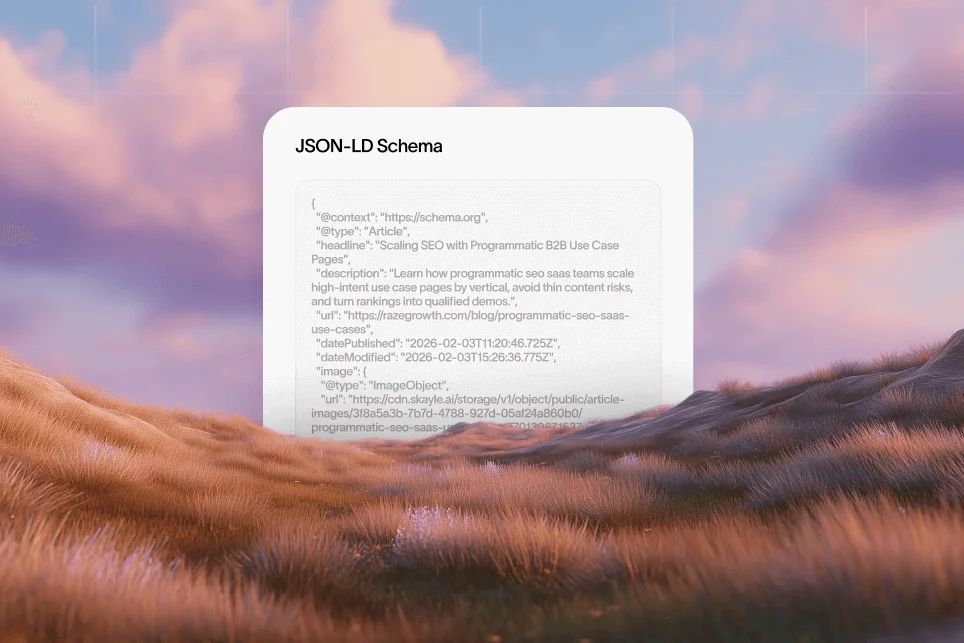
Example JSON-LD (trimmed):
{
 "@context": "https://schema.org",
 "@type": "SoftwareApplication",
 "name": "Your Product Name",
 "applicationCategory": "BusinessApplication",
 "operatingSystem": "Web",
 "url": "https://example.com/product",
 "description": "B2B SaaS for workflow automation across marketing and ops.",
 "offers": {
 "@type": "Offer",
 "url": "https://example.com/pricing"
 }
}
Proof block you can run without making up numbers
Baseline: product page is cited inconsistently (or not at all) for “What is X tool?” prompts.
Intervention: add SoftwareApplication + Organization schema, ensure server-rendered JSON-LD.
Expected outcome: within a few crawl cycles, extractability improves; you should see fewer ambiguous summaries and more consistent attribute pull (especially when your page is already ranking).
Timeframe: monitor for 2–6 weeks depending on crawl frequency and how often AI answers refresh.
Fix 2: Use FAQPage schema to package objections into citable Q&A
FAQPage isn’t only for “support.” It’s the easiest way to encode buyer objections and evaluation questions into an AI-friendly format.
Wellows emphasizes FAQPage and HowTo as schema types that map directly to how AI systems summarize content and produce rich results: Wellows. Growtika also flags FAQ schema as particularly useful for GEO because the Q&A pattern matches answer-engine output styles: Growtika.
High-impact FAQ placement (SaaS-specific)
- Pricing page: billing model, contract terms, seat definitions
- Security page: data retention, encryption, compliance scope
- Migration page: time to migrate, supported imports, rollback
- Integration pages: auth method, sync direction, limits
Don’t do this (common misuse)
- Don’t add 40 vague questions. AI models won’t quote fluff.
- Don’t answer with marketing language. Use literal answers.
- Don’t repeat the same questions across every page; make FAQs page-specific.
Example JSON-LD (two questions):
{
 "@context": "https://schema.org",
 "@type": "FAQPage",
 "mainEntity": [
 {
 "@type": "Question",
 "name": "Does your product support SSO?",
 "acceptedAnswer": {
 "@type": "Answer",
 "text": "Yes. SSO is supported via SAML 2.0 for eligible plans. Admins can enforce SSO and manage access by role."
 }
 },
 {
 "@type": "Question",
 "name": "Is there a free trial?",
 "acceptedAnswer": {
 "@type": "Answer",
 "text": "A free trial is available on request. Trial scope depends on plan and security requirements."
 }
 }
 ]
}
Fix 3: Deploy HowTo schema for workflows that prospects actually follow
HowTo schema is the structured equivalent of a clean runbook. It’s ideal for:
- “How to set up X”
- “How to migrate from Y”
- “How to connect A to B”
Both Wellows and Growtika highlight HowTo as a priority type because step-based answers are easy for AI systems to quote verbatim when the steps are clean and specific: Wellows and Growtika.
The SaaS twist: write steps like you’re reducing support tickets
A good HowTo page is not a blog post. It should:
- Put prerequisites at the top (plans, permissions, API access)
- Use step titles that match UI labels
- Include failure modes (“If you see X error, do Y”)
Example JSON-LD (trimmed):
{
 "@context": "https://schema.org",
 "@type": "HowTo",
 "name": "Connect Your Product to Slack",
 "step": [
 {
 "@type": "HowToStep",
 "name": "Generate an API token",
 "text": "In Settings, open API, then create a token with workspace permissions."
 },
 {
 "@type": "HowToStep",
 "name": "Authorize the Slack app",
 "text": "Click Connect Slack and approve the requested scopes in your Slack workspace."
 }
 ]
}
Design implication: schema won’t save messy steps
If your steps are buried in long paragraphs, HowTo schema becomes a thin wrapper over poor structure. Use short step text, and keep each step “quotable.”
Fix 4: Organization schema + sameAs links to remove brand ambiguity
AI answers are entity-driven. If your brand has naming collisions, multiple products, or inconsistent descriptions, citations become unstable.
Growtika calls out Organization schema as a GEO priority because it clarifies entity identity and trust signals: Growtika. Visalytica also recommends building connected entity graphs using properties like sameAs, about, and mentions to strengthen machine understanding: Visalytica.
What “good” Organization schema does in practice
- Connects your brand to authoritative profiles (sameAs)
- Standardizes name, URL, logo usage
- Helps AI systems distinguish your product from similarly named tools
Example JSON-LD (trimmed):
{
 "@context": "https://schema.org",
 "@type": "Organization",
 "name": "Your Company",
 "url": "https://example.com/",
 "sameAs": [
 "https://www.linkedin.com/company/yourcompany",
 "https://www.youtube.com/@yourcompany"
 ]
}
A practical linking rule
Only include sameAs profiles you actually control and keep updated. Broken or outdated profiles create contradictions—exactly what you’re trying to avoid.
Fix 5: Add reviews/ratings only when they’re verifiable and not misleading
Reviews can help when they’re real, attributable, and consistent. They can also backfire if you mark up testimonials in ways that don’t match visible content.
Genesys Growth notes that schema markup for SoftwareApplication and reviews is a core element of optimized B2B SaaS product pages, specifically for improving search comprehension and enhancements: Genesys Growth.
What to do (and what not to do)
Do:
- Mark up review content that is visible on the page
- Use consistent sources and update cadence
- Treat reviews as a “proof layer,” not as a growth hack
Don’t:
- Invent aggregateRating values
- Mark up third-party review snippets you can’t verify
- Hide review text behind tabs that don’t render server-side
If you can’t do it cleanly, skip it. AI answers reward trust, and schema spam is a long-term liability.
Fix 6: Deliver JSON-LD in a way bots can actually fetch and parse
Most schema projects fail for one boring reason: the markup doesn’t reliably show up for crawlers.
Technovora specifically recommends rendering schema server-side and ensuring it appears in the initial HTML, because client-only injection can be missed or inconsistently processed in AI parsing pipelines: Technovora.
Visalytica’s best-practice guidance also supports JSON-LD as the scalable format for teams shipping lots of pages and templates: Visalytica.
Delivery checklist for modern SaaS stacks
This is where engineering teams usually want something concrete. Use this list to avoid the usual implementation traps.
- Render schema in the initial HTML for each page template.
- Keep one canonical JSON-LD block per schema object type per page (avoid duplicates).
- Ensure the schema matches visible page content (names, claims, offers).
- Avoid referencing URLs that redirect (use the final URL).
- Use stable IDs where relevant (helps prevent entity fragmentation).
- Don’t block schema URLs or related assets via robots rules.
- When pages are programmatically generated, validate schema at the template level and sample across edge cases.
- Keep schema generation tied to a source of truth (CMS fields, product database).
If you’re doing this across large sets of pages, the limiting factor is rarely “writing markup.” It’s governance and consistency. That’s why Skayle treats structured publishing as infrastructure, not a one-off project; see our take on SEO infrastructure systems.
Fix 7: Validate, monitor, and iterate based on citation coverage
Schema is not “set and forget.” AI answers shift as competitors publish, as your product changes, and as engines adjust how they cite.
Wellows explicitly recommends monitoring after schema deployment to track improvements in AI summaries and rich-result behavior, then refining based on what appears in results: Wellows.
Validation you should do every time
- Validate JSON-LD syntax (basic parser pass)
- Validate rich result eligibility where applicable
- Confirm the schema is present in rendered HTML as crawlers see it
Monitoring that ties to revenue (not vanity)
Track three layers:
- Answer inclusion: are you appearing in AI answers for your prompt set?
- Citation quality: are you cited on pages that can convert (product/pricing/docs)?
- Downstream behavior: do those visits engage, sign up, request demo, or activate?
If you want a repeatable workflow, start with a citation gap review and then push fixes into refresh work. Skayle lays out how to find and close those gaps in this guide to citation coverage and how to handle implementation details in our AI Overviews optimization playbook.
Where tools fit (without turning this into a tooling rabbit hole)
Schema generators can help teams bootstrap consistent markup, especially for SoftwareApplication, FAQPage, and HowTo templates. Single Grain summarizes how generators support these key types with template-based workflows: Single Grain.
Tools won’t solve wrong schema choices, bad page structure, or broken rendering. Treat generators as accelerators, not decision-makers.
Common mistakes that quietly suppress AI citations
These are the failure modes that show up repeatedly in SaaS audits.
Mistake 1: Marking up pages that don’t answer anything
If the page is all positioning and no substance, schema just makes the emptiness more obvious. AI systems need facts, steps, and constraints.
Mistake 2: Mismatching schema and visible content
If your markup claims “free trial,” but the page says “talk to sales,” you’ve created a contradiction. Contradictions reduce trust.
Mistake 3: Duplicating schema across templates without page-specific data
Copy/paste SoftwareApplication schema across features pages and never change fields. Now you’ve created entity duplication.
Mistake 4: Hiding key information behind client-side rendering
Technovora’s point is practical: if schema doesn’t appear in the initial HTML, different crawlers will see different realities. That inconsistency is poison for extraction: Technovora.
Mistake 5: Over-optimizing for rich results and ignoring AI answer patterns
Rich results can help, but AI answers are often built from:
- clean lists
- short paragraphs with direct definitions
- tables that summarize comparisons
LLM Clicks recommends pairing schema with tables and structured formatting so AI systems can lift comparisons more accurately, especially on feature and product positioning pages: LLM Clicks.
FAQ: structured data questions SaaS teams ask in 2026
How long does it take for schema changes to affect AI answers?
There’s no guaranteed SLA. In practice, you should plan to monitor for 2–6 weeks after deployment, because you’re dependent on crawl frequency and how often answer engines refresh their source sets.
Should every SaaS page have schema?
No. Prioritize pages where extraction changes outcomes: product, pricing, key integrations, high-intent help articles, and comparison pages. Randomly marking up low-value pages adds maintenance cost without improving citation coverage.
Is FAQPage schema still worth it if Google limits FAQ rich results?
Yes, because the value is not only rich snippets. FAQPage creates a machine-readable Q&A object that matches how AI answers are composed, which is why both Wellows and Growtika emphasize it for AI visibility: Wellows and Growtika.
What’s the best schema type for a SaaS pricing page?
Often it’s a combination: Organization (entity), FAQPage (objections), and Offers within SoftwareApplication or Product where accurate. The “best” choice depends on whether pricing is public, plan-based, or quote-based.
Do we need Product schema or SoftwareApplication schema?
For SaaS, SoftwareApplication is usually the better fit for the core product entity, and it’s explicitly called out as a priority in SaaS AI search guidance: Onely. Product can still be relevant for bundles, add-ons, or hybrid offerings, but don’t force it.
Can schema alone get us cited in AI answers?
No. Schema improves extractability and reduces ambiguity, but you still need content that answers the query clearly. Onely highlights schema as a complement to clean headings, direct answers, and list formatting, not a replacement: Onely.
What’s the biggest technical mistake teams make with structured data?
Client-side injection that doesn’t reliably render for crawlers. If the JSON-LD isn’t in the initial HTML consistently, you’ll see unstable parsing and inconsistent extraction, which Technovora warns about for SaaS and tech sites: Technovora.
How do we scale schema across hundreds of integration or template pages?
You need a stable data model (fields) and a template system that generates page-specific JSON-LD from that data. Single Grain’s overview of schema generators is useful as a starting point, but you still need governance so templates don’t drift: Single Grain.
What’s a safe way to add reviews schema without risking trust issues?
Only mark up reviews that are visible, attributable, and consistent with what users see. If you can’t verify review sources and keep them updated, skip review markup entirely.
How do we connect schema work to pipeline and conversions?
Track a fixed prompt set and map it to landing pages that can convert. Then measure answer inclusion → citation → click → conversion. Skayle’s focus is connecting that measurement to action so content refreshes and new pages are prioritized based on visibility gaps, not guesswork.
If you want to make structured data measurable—tied to citations, clicks, and the pages that actually drive demos—start by measuring how you appear in AI answers today, then fix the extractability gaps systematically. You can see how Skayle approaches that end-to-end in our platform overview or book a demo to review your citation coverage and schema priorities.
References
- Onely: Best AI Search Strategies for SaaS Companies in 2026
- Visalytica: Schema Markup Best Practices for SEO in 2026
- Wellows: Schema & NLP Best Practices for AI Search Visibility (2026 Guide)
- Growtika: SaaS SEO: The Complete Guide for 2026
- Technovora: The Complete Guide to Schema Markup for SaaS & Tech Companies
- Genesys Growth: Best Practices for Designing B2B SaaS Product Pages – 2026
- Single Grain: Best Schema Markup Generators in 2026
- LLM Clicks: Generative Engine Optimization (GEO): The 2026 SaaS Playbook