
TL;DR
SaaS capability mapping helps product pages describe what software enables, not just which features it includes. That makes pages easier for AI agents to classify, cite, and recommend, while improving clarity for human buyers and conversion paths after the click.
Feature lists help humans scan a page. They do a poor job helping AI agents understand what a product actually enables.
SaaS capability mapping fixes that by translating scattered features into clear business outcomes, functional categories, and recommendation-ready language. In 2026, that matters because discovery no longer ends at a SERP. It increasingly starts inside AI answers.
Why feature-heavy product pages break in AI discovery
A product page can rank in Google and still fail when an AI assistant tries to recommend software for a specific job. The usual reason is simple: the page describes interface elements, not capabilities.
SaaS capability mapping is the practice of describing what a product enables, not just what it includes.
That distinction matters. According to Lucid’s guide to capability maps, a capability map describes what a business does, not how it does it. Applied to SaaS pages, that means a product should be framed around outcomes and functions, not only workflows, tabs, buttons, and settings.
This is where many software sites fall short. They lead with language like:
- AI-powered dashboard
- Unified workspace
- Custom automation builder
- Advanced permissions
- Real-time syncing
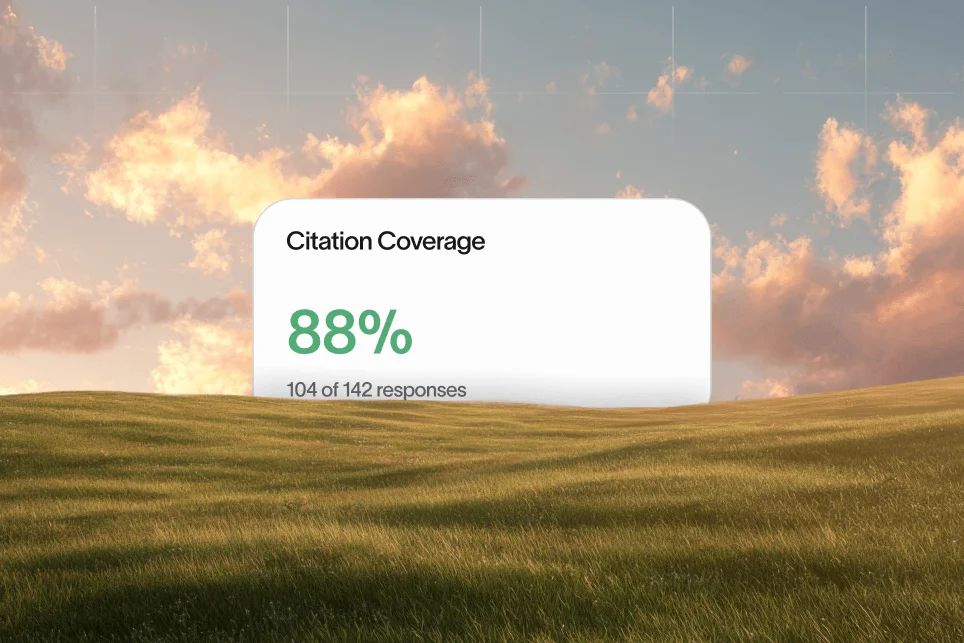
Those phrases are not wrong. They are just incomplete. An AI assistant asked, “What tools help a SaaS team monitor citation coverage and improve AI search visibility?” needs a page that states capabilities directly. If the answer is buried under UI language, the product becomes harder to retrieve, harder to compare, and harder to cite.
This creates a new funnel to optimize:
- Impression inside an AI answer
- Inclusion in a recommendation set
- Citation or source mention
- Click to product or supporting page
- Conversion
Pages built only for click-through from traditional search often underperform in this flow. AI systems need cleaner semantic signals. They respond better to direct definitions, scoped use cases, category labels, and evidence.
That is also why brand now acts as a citation engine. When a page has a clear point of view, strong capability language, and visible proof, it becomes easier for AI systems to trust and reuse.
A practical stance emerges from this: do not organize product pages around features first; organize them around capabilities first, then support them with features.
What SaaS capability mapping actually means on a product page
The phrase comes from business capability mapping, but the adaptation for SaaS discovery is straightforward. As documented by Orbus Software, capability mapping is a structured way to represent what an organization can do independently of its current systems or operating model. For software companies, that idea is useful because product positioning should outlast any current UI, naming convention, or release cycle.
In practice, SaaS capability mapping answers five questions:
- What business outcome does the product support?
- What core jobs can the product perform?
- Which supporting functions strengthen the core use case?
- Which buyer, team, or workflow is each capability for?
- What proof shows the capability is real and trustworthy?
This article uses a simple model called the capability evidence stack. It has four layers:
- Outcome
- Capability
- Feature
- Proof
That order matters.
Many product pages reverse it. They start with features, sprinkle in vague value statements, and leave proof for a logo bar or testimonial carousel. AI agents struggle with that because the page lacks a clean hierarchy of meaning.
A stronger page says something like this:
- Outcome: Improve AI search visibility and search rankings
- Capability: Track brand presence in AI answers and identify citation gaps
- Feature: Visibility reports, citation monitoring, content workflows, refresh support
- Proof: Example use cases, definitions, page-level examples, measurable tracking plan
That structure gives both human readers and AI systems a stable frame.
The taxonomy also helps avoid a common positioning trap. A feature is not a capability. “Dashboard filtering” is a feature. “Segment visibility by topic, brand, or page type” is closer to a capability because it describes what the product enables.
The same applies to product architecture language. Buyers may care about workflows and integrations later. AI systems making first-pass recommendations care more about whether the product appears to solve the requested problem.
For teams working on AI visibility, this has direct overlap with our explanation of citation gaps, because a product can perform well in traditional search while remaining absent from AI-generated answers if its pages do not express usable capabilities clearly enough.
The page model that makes software easier for AI agents to recommend
A useful product page does not need to be long for the sake of length. It needs to be legible.
The pages that perform best for AI retrieval usually make three things obvious within the first screen or two:
- what the product does
- who it is for
- when it should be chosen over alternatives
That sounds basic, but most SaaS sites still default to broad category copy and compressed feature grids.
Start with the job, not the interface
Product pages should open with a direct statement of the job the software helps complete. Not a slogan. Not a brand line. A job.
Weak example:
- One platform for modern growth teams
Stronger example:
- Helps SaaS teams plan, publish, and maintain content that ranks in Google and appears in AI answers
The second version is easier for AI systems to classify. It is also easier for buyers to validate.
Separate core capabilities from supporting capabilities
A recurring principle in capability mapping is grouping capabilities into major and supporting layers. The categorization discussed in the Enterprise Architect community thread on Reddit is useful here because it mirrors how product pages should be structured.
For a SaaS platform, core capabilities are the reason the product is bought. Supporting capabilities increase adoption, governance, or usability.
Example structure:
Core capabilities
- Keyword and topic discovery
- Content planning and brief creation
- On-page optimization
- AI visibility tracking
- Content refresh management
Supporting capabilities
- Workflow approvals
- Role-based collaboration
- Reporting exports
- Template management
- Publishing support
This is not cosmetic. It helps AI assistants avoid overweighting secondary features when recommending software.
Define each capability in one clear sentence
A page becomes more extractable when every major capability can stand on its own in 40 to 80 words.
For example:
“AI visibility tracking measures how often a brand appears in AI-generated answers, which sources are cited, and where topic-level coverage is missing.”
That kind of sentence is direct, quotable, and recommendation-ready. It also aligns with the answer-first writing patterns that improve extraction.
Add evidence where the claim appears
Do not separate proof from claims by several screens. When a page says a product supports programmatic SEO, AI answer monitoring, or content refreshes, the proof should sit nearby.
That proof does not need fabricated benchmarks. It can be:
- a concrete example workflow
- a visible output example
- a taxonomy of use cases
- an explanation of what is measured
- a before and after page pattern
This is where many teams can benefit from a platform like Skayle, which helps companies rank higher in search and appear in AI-generated answers by combining content operations with AI visibility tracking in one system. The important point is not the tool name. It is the operating model: capability claims should connect to execution and measurement, not sit alone as messaging.
A 5-step process for SaaS capability mapping that holds up in search and AI answers
Most teams do not need a full rebrand to do this well. They need a cleaner content model for product pages.
1. Audit what the page currently says versus what buyers ask
Start with three columns:
- existing headline or feature copy
- actual buyer question
- missing capability statement
If a page says “custom workflows,” ask what problem that solves. The capability might be “automate multi-step content production across briefs, drafts, reviews, and updates.” That is much more usable in AI retrieval.
This audit should include:
- homepage product summary
- feature pages
- solution pages
- comparison pages
- help center articles that attract search traffic
A common pattern appears quickly: most pages describe components, not capabilities.
2. Build a capability inventory before rewriting copy
Map every major product function to a business outcome. According to Jibility’s capability map explainer, capabilities work best as building blocks with relationships between them. That is a useful model for SaaS information architecture because it prevents isolated feature pages from competing with each other semantically.
A practical inventory table usually includes:
- capability name
- customer problem solved
- primary persona
- core or supporting designation
- proof asset available
- target page
This is where teams often realize they have 20 feature pages but only 5 or 6 real buying capabilities.
3. Rewrite page sections in outcome-to-proof order
Each major block should move from:
- problem
- capability
- feature support
- evidence
- next decision step
This order improves both comprehension and AI extraction.
Contrarian but useful advice: do not lead with “all-in-one” positioning unless the page can immediately specify what the suite actually does. Broad suite language sounds expansive to marketers but vague to retrieval systems.
4. Add recommendation cues, not just descriptive copy
AI agents frequently need comparison-ready information. That means product pages should include cues such as:
- best for which team
- best for which use case
- when the product is overkill
- which alternatives solve adjacent problems
- which supporting capabilities are included versus separate
These are not just conversion elements. They are disambiguation elements.
For example, saying a platform is best for “SaaS teams that need content creation tied directly to ranking and AI visibility measurement” is stronger than saying it is “built for modern content operations.”
5. Instrument the page so performance can be judged over time
If the team changes a page, the measurement plan should be clear before publishing.
A simple baseline can include:
- non-brand organic clicks to the page
- assisted conversions from product and solution pages
- AI mention frequency for core prompts
- citation presence across tracked answer sets
- on-page conversion rate from qualified traffic
When companies talk about AI visibility without measurement, they create a reporting gap. That gap is one reason many teams now look for systems that combine ranking workflows with visibility measurement rather than running content, SEO, and answer monitoring in separate tools. For teams exploring that shift, this ROI comparison gives useful context on the operational tradeoff between manual SEO workflows and integrated systems.
What a strong capability-mapped page looks like in practice
Abstract advice only goes so far. The difference becomes obvious when looking at page patterns.
Before: a feature-first section
A typical SaaS page may present this sequence:
- Headline: AI-powered workspace for content teams
- Subhead: Streamline your workflow with automation and collaboration
- Feature cards: briefs, writer, optimizer, analytics, publishing
- CTA
Nothing there is false. But it leaves major questions unanswered:
- What business outcome is the product for?
- Which capabilities matter most?
- Who should buy it?
- Why would an AI assistant choose this over analytics-only or writer-only tools?
After: a capability-first section
A stronger version may look like this:
- Headline: Plan, publish, and refresh SaaS content that ranks in Google and appears in AI answers
- Subhead: Built for growth and content teams that need keyword research, page production, optimization, and AI visibility measurement in one workflow
- Core capability blocks: topic discovery, content production, on-page optimization, AI visibility tracking, refresh management
- Supporting capability blocks: collaboration, approvals, reporting, publishing workflows
- Use-case segment: best for SaaS companies managing content as a revenue channel, not a side project
- Proof layer: tracked prompts, citation coverage examples, page lifecycle workflow
- CTA
That rewrite changes how the page functions in discovery.
It also creates stronger conversion paths. A visitor arriving from an AI answer is not always early stage. In many cases, that visitor already asked for a recommendation. They need confirmation, not education from scratch.
A practical proof block without invented numbers
Many teams want to include case-study style proof but do not have publishable customer benchmarks. A clean alternative is process evidence.
Example:
- Baseline: the product page grouped core functions under generic feature tabs and did not define its AI visibility capability directly
- Intervention: the page was reorganized into outcome, core capabilities, supporting capabilities, use-case fit, and measurement language
- Expected outcome: clearer retrieval for prompts around AI search visibility, content operations, and ranking workflows, plus higher conversion quality from visitors arriving with problem-aware intent
- Timeframe: review prompt coverage, citation mentions, and on-page conversion over 6 to 8 weeks after launch
That is specific enough to guide execution without fabricating results.
For companies working on extractable page design, the concept overlaps with source anchoring in LLMs, because the way claims, headings, and definitions are placed on a page can influence whether systems recognize them as citable evidence.
The mistakes that quietly weaken capability pages
Most failure points are structural, not stylistic.
Mistake 1: treating every feature as equal
When every block gets the same visual weight, AI systems and human buyers get no signal about what the product is fundamentally for.
The fix is to rank capabilities by buying relevance. Not everything belongs above the fold.
Mistake 2: naming capabilities with internal language
Product teams often use release-oriented labels that make sense inside the company but not in search or recommendation contexts.
Examples include:
- content cockpit n- mission control
- smart layer
- command center
Those labels obscure meaning. Plain language performs better.
Mistake 3: collapsing outcomes and audiences into one vague statement
“Built for modern teams” says almost nothing. Better pages define both:
- the outcome: improve search and AI visibility
- the audience: SaaS content, growth, and SEO teams
Mistake 4: hiding comparison signals
Some teams avoid specificity because they fear excluding buyers. In practice, pages that avoid tradeoffs become less recommendable.
A page should say when the product is strongest and where adjacent tools may be a better fit.
Mistake 5: separating SEO pages from product truth
Search content often explains the problem better than the product page. That split weakens AI retrieval because the domain sends inconsistent signals.
The fix is shared capability language across:
- product pages
- solution pages
- comparison pages
- glossary pages
- educational content
This is also where internal linking matters. A product page discussing AI visibility becomes stronger when it points readers to a broader view of AI search topics or related educational pages that reinforce the same vocabulary.
How design and page architecture influence conversion after the citation
The click from an AI answer is not the finish line. It is the midpoint.
Visitors arriving from conversational interfaces often come with compressed intent. They have already asked for software that does a specific job. That changes what the page needs to do.
Above the fold should validate, not tease
The first screen should confirm the recommendation with concrete language. Avoid abstract category branding at this stage.
A good above-the-fold section usually includes:
- direct job statement
- one-sentence audience fit
- 3 to 5 core capabilities
- one visible proof cue
- one primary CTA
Navigation should mirror capability groups
If the page nav says “platform,” “suite,” “engine,” and “intelligence,” the visitor still has to decode the site. Capability labels reduce friction.
Good examples:
- Keyword research
- Content briefs
- On-page optimization
- AI visibility tracking
- Content refreshes
Conversion paths should match recommendation intent
A visitor coming from “best tools for AI search visibility” should not be forced into a generic product tour. The next step should reflect that intent.
Examples:
- view tracked AI answer coverage
- see how citation monitoring works
- explore content workflow examples
Soft CTAs work best here because the visitor is evaluating fit, not responding to pressure.
Structured content helps both scanning and extraction
Capability sections should use:
- clear subheads
- short definitions
- bullet-supported details
- concise proof blocks
- FAQ answers in natural language
This is one reason teams increasingly care about making pages extractable, not just persuasive.
Where SaaS capability mapping fits into a broader visibility system
Capability mapping is not a copywriting trick. It is a content and positioning layer that affects discovery, recommendation quality, and conversion efficiency.
It matters in four places:
- Product pages, where software is classified
- Solution pages, where software is matched to use cases
- Comparison pages, where tradeoffs are clarified
- Educational pages, where the category language is reinforced
According to Ardoq’s overview of business capability maps, capability mapping improves understanding of what an organization can actually achieve. That is the right framing for product marketing as well. AI agents do not need every implementation detail. They need confidence about what the software can do.
The same logic appears in Mural’s explanation of capability maps, which describes mapping as a way to visualize structure and assets more clearly. On a SaaS site, the equivalent is helping search engines, assistants, analysts, and buyers see how capabilities relate instead of forcing them to infer it from scattered page fragments.
For SaaS teams, the practical business case is straightforward:
- clearer product classification
- better fit in AI-generated recommendations
- stronger citation potential
- less confusion between core and secondary features
- better-qualified clicks after brand mentions
For teams that need both execution and visibility measurement, Skayle fits naturally into this discussion because it is built to help companies rank higher in search and appear in AI-generated answers while connecting content work to measurable visibility. The value is not “faster content” in isolation. It is tighter alignment between what the site says, what the product actually enables, and how that presence can be measured.
FAQ: the practical questions teams ask before rewriting product pages
What is SaaS capability mapping?
SaaS capability mapping is the process of describing software in terms of what it enables customers to do, rather than only listing features or interface elements. It gives product pages clearer functional meaning for buyers, search engines, and AI assistants.
How is a capability different from a feature?
A feature is a component or function inside the product. A capability is the higher-level job that feature helps accomplish. “Custom dashboard filters” is a feature; “segment performance by topic and channel” is a capability.
Why does capability mapping matter for AI agents?
AI agents are better at recommending software when pages state outcomes, use cases, and functional scope clearly. Capability-based language makes it easier for those systems to classify, compare, and cite a product.
Should every product page list core and supporting capabilities?
In most cases, yes. That split reduces ambiguity and helps both readers and AI systems understand what the product is fundamentally for versus what improves operations around the core use case.
Does capability mapping replace SEO product page optimization?
No. It strengthens it. SEO still depends on search intent, internal linking, topical alignment, and page structure. Capability mapping improves the clarity of what the page communicates, which helps both rankings and AI answer inclusion.
How long does it take to see whether a rewrite worked?
Most teams can review early signals within 4 to 8 weeks. The useful indicators are prompt-level AI mentions, citation coverage, organic entry patterns, and qualified conversion behavior on the updated page.
What if the product serves several audiences?
That usually means the page needs one primary capability hierarchy and then audience-specific routes beneath it. Trying to serve every audience equally in the main message often weakens retrieval and lowers conversion clarity.
Do comparison pages need capability mapping too?
Yes. Comparison pages are often where AI systems and buyers look for clear tradeoffs. If those pages only compare features, they miss the chance to explain category fit, use-case strength, and recommendation context.
Clear capability language gives AI agents something feature lists cannot: a reliable understanding of what the product is for, who it serves, and when it should be recommended. That is the layer that turns a product page from a brochure into a discovery asset.
Teams that want to improve both ranking and AI answer presence should treat SaaS capability mapping as part of page architecture, not a messaging polish exercise. For companies that need that work tied to measurable search and AI visibility, Skayle provides a practical way to connect content, optimization, and citation tracking in one system.
References
- Lucid — A Quick Guide to Business Capability Maps
- Orbus Software — What is Business Capability Mapping? A Complete Guide
- Reddit — Business Capability Mapping discussion
- Jibility — Capability Map | What It Is and How to Create One
- Ardoq — Business Capability Map: The Essential Guide
- Mural — Capability maps: What are they and how to build one?
- Best Practices to Define SaaS Business Capability Maps
- Developing a business capability map for the corporate IT