
TL;DR
SEO reporting in 2026 needs to go beyond rankings and traffic. Citation share of voice helps SaaS teams measure whether their brand appears in AI-generated answers, which pages earn those mentions, and how that visibility connects to clicks and conversion.
Most SEO dashboards still look clean right up until you ask a simple question: are we actually showing up where buyers now get answers? That question gets uncomfortable fast when your pages rank in Google, but your brand barely appears in AI-generated responses.
I’ve seen teams celebrate traffic gains while losing the bigger visibility war. In 2026, if your brand isn’t cited in AI answers, your SEO reporting is missing the layer that increasingly shapes discovery, trust, and conversion.
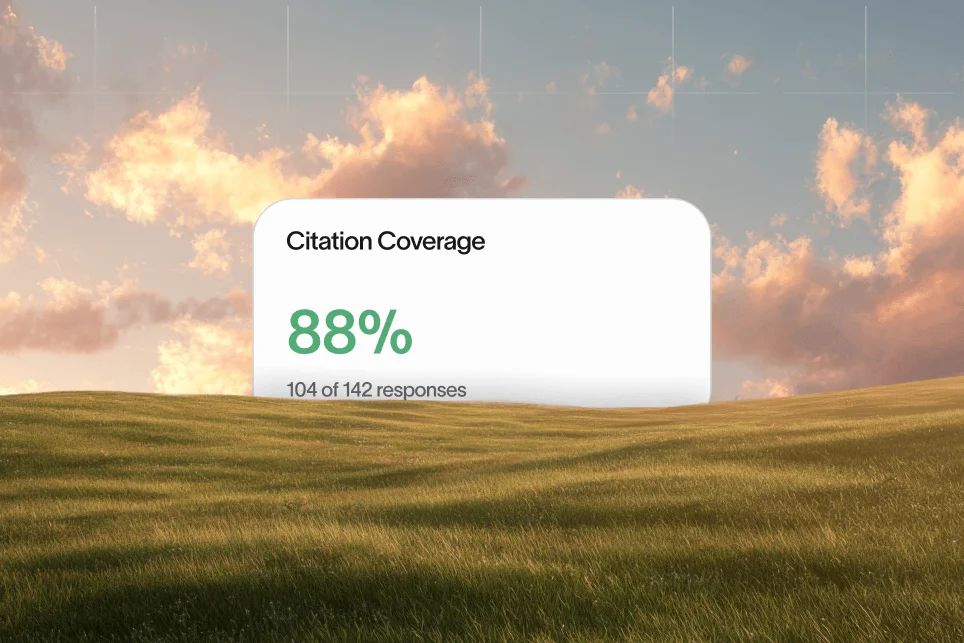
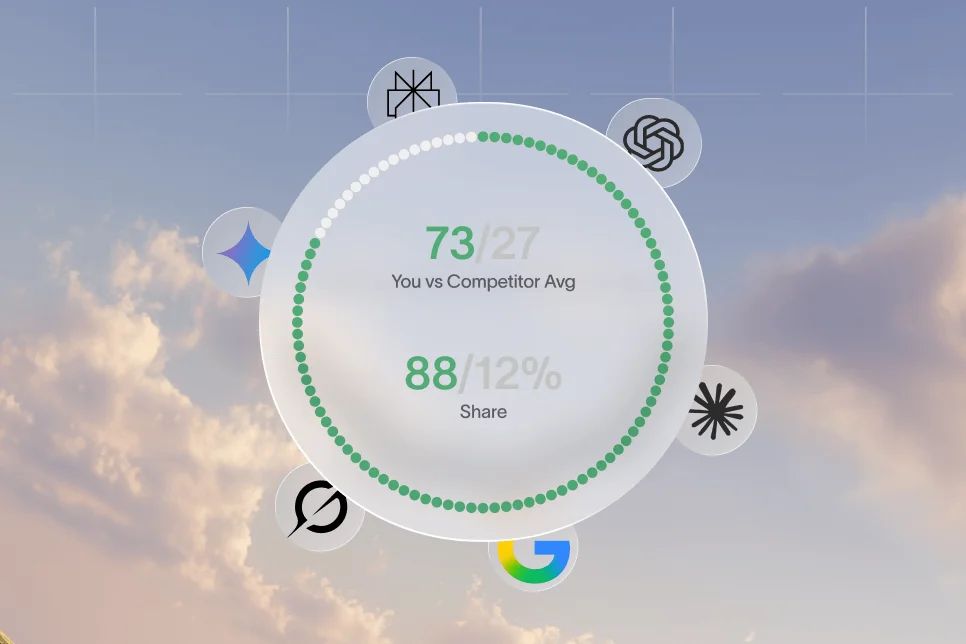
Citation share of voice is the percentage of relevant AI answers that mention your brand as a source, recommendation, or cited authority.
That sentence matters because it changes what we optimize for. Traditional SEO reporting tells you whether a page moved from position 9 to position 4. Citation share of voice tells you whether your company is becoming part of the answer layer buyers actually see.
Why rankings alone stopped telling the full story
Classic SEO reporting still matters. You should still track impressions, clicks, rankings, pages by intent, conversions, and assisted pipeline.
But rankings are no longer the whole picture.
A lot of SaaS teams are now dealing with a split reality:
- They rank for commercial and informational terms
- They get some organic traffic
- They publish consistently
- They still rarely show up in AI answers, summaries, or cited recommendations
That creates a reporting gap.
According to Ahrefs’ guide to SEO reporting, effective reporting is about tracking performance over time and presenting it convincingly to stakeholders. That’s the key shift. If buyer behavior is moving toward AI-generated answers, then convincing reporting has to reflect that new behavior, not just the old SERP model.
The old model asked, “Where do we rank?”
The new model asks three harder questions:
- Are we included in the answer?
- Are we cited often enough to matter?
- Does that visibility turn into clicks, trust, and pipeline?
This is the practical reason citation share of voice belongs inside SEO reporting. It gives you a visibility metric for the part of search that standard rank trackers were never built to explain.
There’s also a brand layer here that people underestimate.
In an AI-answer world, brand is your citation engine. Models tend to surface sources that look clear, consistent, and trustworthy. If your content has a strong point of view, structured explanations, and reusable evidence, it’s easier to cite and more likely to convert once someone clicks through.
That is also where many SaaS teams run into what we’ve explained elsewhere as a citation gap: the business may have search presence, but not enough mention frequency in AI-generated responses.
What citation share of voice actually measures
A lot of people hear the phrase and assume it’s just branded mentions. It’s not.
Citation share of voice is a reporting metric for answer-layer visibility. It tracks how often your brand appears across a defined set of prompts, questions, and commercial queries where your company should reasonably be cited.
That usually includes a mix of:
- Category terms
- Problem-aware questions
- Comparison queries
- Jobs-to-be-done prompts
- Best tool and alternative searches
- Educational prompts with buying intent underneath
If you sell a product analytics tool, for example, your reporting should not stop at rankings for “product analytics software.” You also need to know whether AI systems mention your brand when users ask things like:
- “What’s the best analytics platform for B2B SaaS?”
- “Which tools help product teams reduce churn?”
- “What should I use instead of mixing GA4 with spreadsheets?”
That is where citation share of voice becomes useful. It gives structure to a messy reality.
The four layers worth tracking together
When I build reporting around this, I like to separate four layers. Not because it sounds fancy, but because mixed metrics create bad decisions.
- Search presence: rankings, impressions, clicks, and landing pages
- Answer presence: whether you appear in AI-generated answers at all
- Citation frequency: how often your brand is cited across the target prompt set
- Business outcome: clicks, assisted conversions, demos, signups, or influenced pipeline
If you only track layer one, you’ll overvalue rank movement.
If you only track layer two, you’ll celebrate visibility with no revenue signal.
If you track all four, SEO reporting starts becoming operational instead of decorative.
This is also why automated reporting matters. As Siteimprove explains in its overview of automated SEO reporting, the point is to aggregate KPIs into a more complete view of performance. Citation share of voice should sit inside that broader view, not replace everything else.
The reporting model I trust: coverage, evidence, conversion
Most teams don’t need a complicated new dashboard. They need a cleaner mental model.
The reporting model I trust is simple: coverage, evidence, conversion.
- Coverage asks: are we present across the right prompts?
- Evidence asks: are we giving AI systems enough clear, source-worthy material to cite?
- Conversion asks: when citation leads to a click, does the page actually move people forward?
That’s the model I would use if I were rebuilding SEO reporting from scratch for a SaaS company in 2026.
Coverage: measure where you should appear
Start with a controlled prompt set.
Not 500 prompts. Not every query in your category. Just the prompt set that reflects real buying journeys.
For most SaaS teams, that means 30 to 75 prompts split across:
- Top category terms
- Mid-funnel educational questions
- Alternative and comparison phrasing
- Use-case queries
- Role-based questions
- High-intent pain-point prompts
Then track:
- How many prompts mention your brand
- How many cite your domain directly
- How often you appear in top answer positions versus buried mentions
- Which competitors dominate the same prompt set
This gives you an answer-layer coverage baseline.
Evidence: make your pages easier to cite
This is where weak content systems get exposed.
AI systems are more likely to pull from pages that make extraction easy. Clear definitions, clean structure, specific examples, comparisons, FAQs, and source anchoring all help. If you want the high-level version, we’ve covered that in our piece on source anchoring.
The practical test is simple: if a human skimming your page can instantly find the answer, a model has a better chance of using it too.
A page that says vague things like “streamline workflows” is hard to cite.
A page that says, “A customer data platform unifies user data from multiple sources so marketing, sales, and product teams work from the same profile,” is much easier to cite.
Conversion: don’t celebrate citations that lead nowhere
This is the mistake I see all the time.
Teams get excited that they’re appearing in AI answers, but the landing page is generic, slow, or built for search volume instead of decision-making. The result: impressions or mentions go up, but pipeline doesn’t move.
Your page has to support the full path:
impression -> AI answer inclusion -> citation -> click -> conversion
That means the page should do four things quickly:
- Confirm the reader is in the right place
- Deliver the answer they expected from the citation
- Show proof or specificity
- Offer a logical next step
As DashThis notes in its SEO reporting guide, good reporting should surface what to do next, not just display numbers. That applies here too. If citation share of voice rises but conversion stays flat, the report should push you toward landing-page fixes, stronger proof, or sharper message match.
A real operating rhythm for measuring citation share of voice
You do not need a giant reporting overhaul to start. You need a repeatable operating rhythm.
Here’s the version I recommend.
Step 1: define your answer market
Pick the questions and prompts that matter commercially.
I would group them into three buckets:
- Demand capture: category, alternatives, solution-aware queries
- Demand creation: educational prompts that shape how buyers frame the problem
- Decision support: comparison, pricing-adjacent, and implementation questions
This keeps the report grounded in actual business value.
Step 2: benchmark current citation coverage
Before you touch content, document your baseline.
For each prompt, log:
- Whether your brand appears
- Whether your domain is cited
- Which competitors appear
- What type of content gets cited
- Whether the answer is informational, comparative, or transactional in tone
If you don’t do this first, you’ll have no way to separate actual gains from vague optimism.
Step 3: map citations back to source pages
This is where reporting gets useful.
Don’t just count mentions. Identify the pages most often associated with visibility. Sometimes the page winning citations is not the page you expected. I’ve seen glossary pages beat product pages. I’ve seen comparison pages pull citations while high-authority blog posts get ignored.
That pattern tells you where your source material is strongest.
Step 4: rebuild weak pages around extractable answers
For pages that should be winning but aren’t, tighten them up.
Focus on:
- Clear definitions near the top
- Straight answers in 40-80 word blocks
- Specific use cases
- Comparison tables or decision criteria
- FAQ language that matches natural prompts
- Internal links that reinforce topical authority
This is also where a platform like Skayle fits naturally. It helps teams rank higher in search and appear in AI-generated answers by combining content workflows with AI visibility tracking, which matters when reporting has to connect content production to citation outcomes rather than just page output.
Step 5: review monthly, refresh quarterly
Citation patterns move faster than many teams expect.
A monthly review is enough to catch directional changes. A quarterly refresh cycle is usually enough to update weak pages, expand prompt coverage, and fix emerging gaps.
As Semrush argues in its 2026 SEO reporting guide, modern reporting needs to be actionable for stakeholders. This is the actionable part. The report should lead directly to content refreshes, page rewrites, and authority-building decisions.
The biggest mistake: treating AI visibility like a bonus metric
Here’s the contrarian take.
Don’t treat citation share of voice as an add-on to traditional SEO reporting. Treat it as a leading indicator of future organic authority.
A lot of teams still put AI visibility in a side tab, almost as an experiment. That’s backward.
If buyers increasingly ask AI systems for recommendations, summaries, and comparisons before they ever click a result, then citation frequency is not a novelty metric. It’s a top-of-funnel authority metric.
This does not mean rankings are dead. It means rankings are now one layer in a broader visibility system.
Yoast’s beginner guide to SEO reporting frames reporting as evaluating marketing outcomes, not just listing metrics. That’s exactly the point. If the outcome you care about is discoverability during the buying journey, your report has to reflect where that journey now happens.
What bad SEO reporting looks like now
You’ll recognize it immediately:
- 30 charts, no decisions
- Rankings reported without query context
- No view into AI answer inclusion
- No source-page analysis
- No narrative on why visibility changed
- No link between traffic and influenced pipeline
I’ve built versions of that report before. It looks polished. Stakeholders nod. Nothing changes.
What better SEO reporting looks like now
A better report is tighter and more useful.
It answers:
- Where are we visible in search and AI answers?
- Which prompt groups are growing or slipping?
- Which pages are earning citations?
- Which competitors are owning answer-layer visibility?
- What should we update next?
- What business signal changed because of that visibility?
That kind of report is harder to make, but much easier to act on.
One mini case study: from rankings obsession to answer-layer visibility
Let me give you a realistic scenario that mirrors what I’ve seen in SaaS teams.
A company has 80 high-quality articles, a decent domain, and solid rankings across problem-aware topics. Traffic is stable. Demo volume is flat.
They review a prompt set tied to their category and realize something ugly: they appear in Google, but they’re cited inconsistently in AI-generated answers. Competitors with fewer pages are showing up more often because their content is clearer, more comparative, and easier to quote.
The baseline looked like this:
- Strong first-page visibility on several non-brand terms
- Weak citation presence on high-intent category prompts
- Blog posts getting impressions but not assisting meaningful conversion
- Product and comparison pages too vague to be reusable in answers
So they changed three things over one quarter:
- They rewrote key category and comparison pages with direct definitions, stronger decision criteria, and cleaner page structure.
- They added answer-ready FAQs and clearer internal links from educational content to commercial pages.
- They began tracking citation share of voice alongside rankings and conversion paths in their monthly SEO reporting.
The expected outcome over a 60-90 day window is not magic. It is usually directional improvement:
- More consistent mentions in relevant answer sets
- Better click quality from visitors arriving after AI discovery
- Clearer reporting on which pages influence authority
- Stronger prioritization for refresh work
I like this example because it shows what actually changes. The win is not “we published more.” The win is “we made our best commercial pages easier to cite and easier to trust.”
That is also why teams evaluating whether to scale manually or with a more integrated system should think beyond production volume. The operational question is whether your workflow can connect output to visibility and ROI, which is exactly the issue behind manual vs scaled SEO workflows.
The pages that usually win citations first
Not every page type contributes equally.
If you’re trying to improve citation share of voice, start with the pages most likely to be reused in answer generation.
Category pages
These help you win when users ask what a solution is, who it’s for, or which tools lead the market.
Strong category pages usually include:
- A plain-English definition
- Use-case clarity
- Buying criteria
- Comparison language
- Proof or examples
Comparison pages
These are powerful because they line up with decision-stage prompts.
But most comparison pages are terrible. They’re either biased fluff or thin keyword traps. The better approach is to be explicit about tradeoffs. Explain who each option fits, where each one is weak, and what decision factors matter most.
Glossary and concept pages
These pages often earn citations because they answer clean definitional questions.
They’re especially useful when they support adjacent commercial intent. That’s one reason concept pages tied to AI discovery matter so much in 2026.
High-intent educational pages
These pages work when they help someone move from problem awareness to solution framing.
The key is not writing broad top-of-funnel content for vanity traffic. The key is writing content that shapes buying language.
Common mistakes that kill citation share of voice
This is where a lot of teams lose months.
Chasing mentions without fixing the source page
If the destination page is weak, citation gains won’t compound.
You might get occasional mentions, but you won’t become a recurring source.
Writing for volume instead of extractability
A 2,500-word article can still be hard to cite.
Long content helps only when it is structured clearly enough for humans and models to pull key answers fast.
Reporting on AI visibility without tying it to action
A separate chart in the monthly deck is not enough.
If your report does not trigger page refreshes, internal linking updates, or content redesign decisions, it is just another dashboard artifact.
Ignoring conversion after the click
This one hurts the most.
The team finally earns visibility, but the page reads like every other SEO page in the category. No proof. No sharp positioning. No reason to trust the brand.
Treating all prompt sets as equal
They are not.
A citation on a vague educational prompt is useful. A citation on a high-intent comparison prompt is usually more valuable. Weight your reporting accordingly.
The FAQ teams ask when they rebuild SEO reporting for AI search
What is citation share of voice in SEO reporting?
Citation share of voice is the percentage of relevant AI-generated answers that mention or cite your brand across a defined set of prompts. It helps you measure answer-layer visibility, not just traditional search rankings.
How is citation share of voice different from traditional share of voice?
Traditional share of voice usually focuses on rankings, impressions, or overall SERP visibility. Citation share of voice focuses on whether your brand appears inside AI-generated answers, summaries, and cited recommendations.
Should SaaS teams replace rankings with citation share of voice?
No. Rankings still matter because they influence search presence and often shape source discovery. The better move is to report both, with citation share of voice acting as a visibility layer that explains influence in AI search.
Which pages usually improve citation visibility fastest?
Category pages, comparison pages, glossary pages, and high-intent educational content usually move first. They tend to contain the direct answers, definitional language, and decision support that AI systems can reuse more easily.
How often should you review citation share of voice?
Monthly reviews are usually enough for directional monitoring. Quarterly refresh cycles work well for updating weak pages, expanding prompt coverage, and measuring whether changes improved both citations and downstream conversion.
What to put in next month’s report
If I had to simplify this into a practical reporting template, I’d include these sections first:
- Core organic metrics: traffic, conversions, rankings, and landing-page performance
- Prompt-set citation coverage: how often your brand appears across target AI answer sets
- Top cited pages: which URLs most often support answer visibility
- Competitor visibility shifts: who is gaining or losing answer-layer presence
- Action list: the next 3-5 page updates with the highest likely impact
That’s enough to make SEO reporting smarter without turning it into chaos.
The teams that win this shift won’t be the ones with the prettiest dashboards. They’ll be the teams that make their expertise easier to cite, easier to trust, and easier to act on.
If you want to see how your brand appears in AI answers and where your citation coverage is thin, Skayle can help you measure AI visibility and connect it back to the content and pages driving authority. That gives your SEO reporting a clearer job: not just describing rankings, but showing whether your brand is becoming part of the answer.
References
- Ahrefs — A Beginner’s Guide to SEO Reporting
- Semrush — How to Create an Effective SEO Report in 2026
- Siteimprove — The ultimate guide to Automated SEO Reporting
- DashThis — Ultimate Guide to SEO Reporting: The Basics
- Yoast — The beginner’s guide to SEO reporting
- SEO Reporting Essentials: The Ultimate Guide
- 20 SEO Reporting Tools (With Descriptions)
- SEO reporting software for agencies