TL;DR
Automated GEO is a system: build a prompt pack, map citation coverage, rewrite pages into extractable answer blocks, add structured data, and track citations over time. Use refresh triggers tied to citation changes, not just traffic. The goal is consistent inclusion, citation, clicks, and conversions.
In early 2026, I watched a SaaS team ship “great SEO content” for months and still get ignored by AI answers. Rankings were fine, but the moment buyers started asking ChatGPT-style questions, the brand disappeared from the conversation.
Generative Engine Optimization rewards a different kind of page: one that’s easy to extract, hard to misunderstand, and safe to cite.
Why GEO feels unfair in 2026 (and why automation is the only sane response)
If you’re coming from classic SEO, GEO can feel like the rules changed overnight. You do the work—research, writing, on-page, internal links—and then an AI answer summarizes the entire topic without sending the click.
Here’s the part most teams miss: you’re not just competing for rankings anymore. You’re competing to be the source.
When an LLM answers, it’s doing three things fast:
- Deciding which sources are trustworthy.
- Extracting a small number of reusable “answer chunks.”
- Assembling them into a response that sounds confident.
If your content isn’t chunked, structured, and instrumented, you’ll never know whether you’re winning.
Point of view: Don’t treat GEO like “SEO with a new acronym.” Treat it like a production system: citation targets in, extractable blocks out, measurement wired to refresh loops.
The funnel you’re actually optimizing now
Most SaaS teams still design for: impression → click → conversion.
For Generative Engine Optimization, the funnel is:
- Impression (search / AI answer request)
- AI answer inclusion
- Citation (your brand/domain appears as a source)
- Click (when the user wants detail or proof)
- Conversion (demo, trial, self-serve)
If you only optimize step 5, you’ll lose before the buyer even sees you.
What “automated” GEO really means
Automation here doesn’t mean “push button, publish 500 pages.” It means you stop relying on heroic manual effort to:
- find what AI systems are citing
- rewrite content into extractable units
- add machine-readable structure
- monitor whether citations are increasing or decaying
- refresh pages before they go stale
You can do that with lightweight workflows: templates, prompt packs, a spreadsheet, and a couple of scheduled tasks. You don’t need a big team, but you do need consistency.
The tools you’ll end up touching
I’m going to reference a few systems most teams already have:
- Google Search Console for query + page performance
- Google Analytics (or your equivalent) for on-page engagement
- Bing Webmaster Tools for additional crawl/index signals
- Schema.org for structured data vocabulary
- An automation layer like Zapier if you want scheduled workflows without engineering
None of these “solve” GEO alone. They just make the system measurable.
The CITE Loop: the framework I use to make pages extractable
If you remember one model from this guide, use this:
The CITE Loop = Collect → Isolate → Tag → Evaluate.
It’s designed to be referenced in one line because that’s how teams actually work.
Collect: build a citation target list, not a keyword list
Classic SEO begins with keywords. GEO begins with questions.
You want a list of:
- the exact questions buyers ask
- the exact phrasing an AI answer tends to produce
- the sources that get cited today
This matters because LLMs are pattern machines. If you structure around the patterns they already reward, you’ll converge faster.
Where to collect from:
- “People also ask” and SERP questions (still useful)
- your sales calls and support tickets
- internal site search logs
- competitor comparison pages (what buyers are skeptical about)
If you need a baseline for how Google thinks about content quality and structure, keep Google Search Central open while you work. It’s not an AI citation manual, but it’s still the best public spec for how Google evaluates pages.
Isolate: turn one article into 12 answer blocks
Most articles are written like essays. LLMs cite like engineers.
An “answer block” is a short unit that stands on its own:
- 40–80 words
- one clear claim
- one definition or recommendation
- optionally: one constraint, tradeoff, or example
This is the contrarian part: stop trying to write the “ultimate guide” first. Write the blocks that could be quoted.
You can still publish a long-form pillar page, but the pillar must be composed of quote-ready modules.
Tag: make it machine-readable, not just readable
LLMs don’t require schema to understand you, but machine-readable structure reduces ambiguity.
In practice, tagging includes:
- descriptive headings that mirror questions
- consistent definition patterns (“X is…”)
- lists that map cleanly to steps
- schema where it’s appropriate (FAQ, HowTo, Organization)
If you’ve never implemented FAQ schema correctly, start with the canonical reference: FAQPage on Schema.org.
Evaluate: measure citations like you measure conversions
A painful truth: most teams can’t tell you whether they’re cited.
So they ship content, hope for the best, and call it “brand building.” That’s not a system.
Evaluation means:
- a repeatable set of prompts
- a repeatable way to log results
- a refresh trigger when coverage drops
You don’t need perfect data. You need directional consistency.
Steps 1–3: build a citation inventory and write extractable blocks
These first three steps are where automation starts paying off. You’re building inputs you can reuse across dozens of pages.
Step 1: Create a “prompt pack” that mirrors buyer intent
A prompt pack is 20–50 questions you run every month against the AI surfaces your buyers use.
I build prompt packs around intent stages:
- Problem-aware (“Why is onboarding churn high in B2B SaaS?”)
- Solution-aware (“What’s the best onboarding software?”)
- Vendor-aware (“How does X compare to Y?”)
- Proof-seeking (“Does this work for startups with <10k MRR?”)
Automation idea (simple): store prompts in a Google Sheet, and run a scheduled reminder (or Zapier task) that forces someone to execute and log results on the same day each month.
What you log per prompt:
- Was your brand mentioned? (Y/N)
- Was your domain cited? (Y/N)
- Which URL was cited?
- What was the surrounding claim?
This becomes your citation inventory. Not a vanity dashboard—an actual list of “what to fix next.”
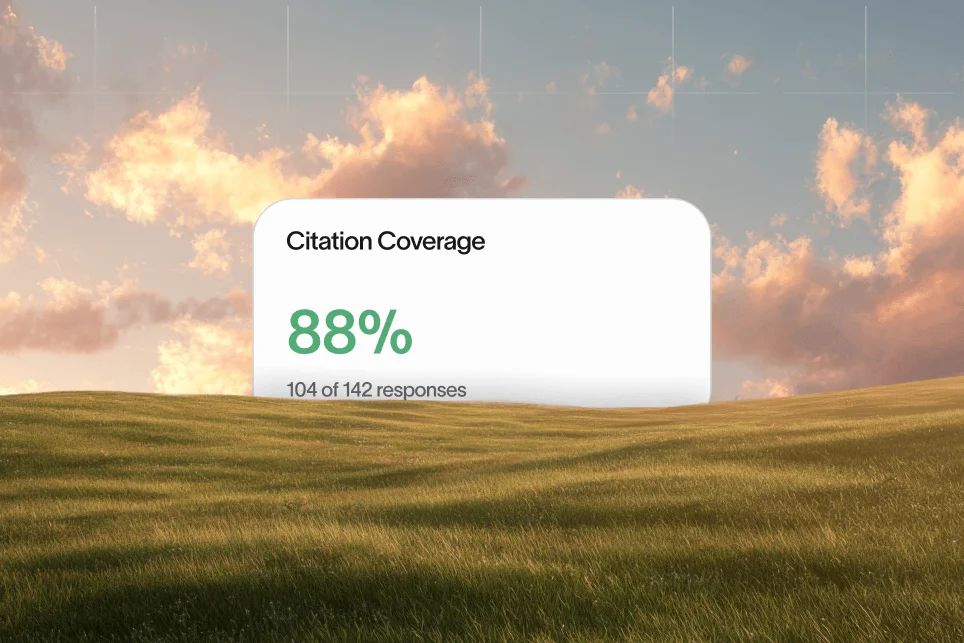
Step 2: Build a “citation coverage map” per topic cluster
This is where teams usually get messy.
They track rankings by keyword, but GEO needs tracking by question set and page type.
Create a simple matrix:
- Rows: your prompt pack questions
- Columns: the page you want cited
- Cells: status (Not cited / Cited / Wrong page cited)
The “wrong page cited” category matters more than you think. If an AI system keeps citing a mid-funnel blog post when you need a product page or a comparison page, you’re leaking conversion potential.
Step 3: Rewrite one page using the “Answer Block Stack” pattern
This is the writing pattern I use when I need a page to be extractable:
- A one-sentence definition (plain language)
- A constraints paragraph (when it does not apply)
- A step list (3–7 steps)
- A “common mistakes” mini-list
- A proof section (case format: baseline → change → expected outcome → timeframe)
Here’s a concrete before/after example you can copy.
Before (hard to cite): “Generative search is changing how people find information, and brands need to adapt by creating helpful content that stands out.”
After (easy to cite): “Generative Engine Optimization is the practice of structuring content so LLMs can extract a correct answer, trust the source, and cite the URL.”
Notice what changed:
- defined the term
- named the mechanism (extract → trust → cite)
- removed vague language
Automation idea: turn this pattern into a template your writers must fill. If you use a CMS like WordPress, you can enforce the structure with reusable blocks.
Steps 4–5: add machine-readable structure and wire up measurement
This is the part that feels “technical,” but it’s usually where citations get unlocked. Not because schema is magic—because structure prevents misinterpretation.
Step 4: Add structured data that matches the job of the page
Don’t sprinkle schema everywhere. Match schema to intent.
What I use most often:
- FAQPage for question-led sections (when answers are truly on the page)
- HowTo for step-by-step processes (when steps are stable and actionable)
- Organization + product markup where relevant (especially for brand/entity clarity)
Two practical notes from the trenches:
- If your FAQ content is fluff, FAQ schema can backfire. You’re literally telling machines “this is the answer.” Make sure it’s real.
- Keep the FAQ answers short and specific. 2–3 sentences wins.
Start with the source of truth: Schema.org and validate in your toolchain.
Step 5: Instrument for “citation lift,” not just traffic
If you can’t measure it, you’ll never prioritize it.
Here’s a measurement plan you can implement without inventing new analytics:
Baseline (week 0):
- Run your prompt pack.
- Count prompts where you are cited.
- Record which URLs show up.
Target (week 6):
- Increase “cited prompts” by a specific number (pick a realistic target like +20–30% relative lift).
- Reduce “wrong page cited” instances.
Instrumentation:
- Log prompts + outcomes in a spreadsheet.
- Track page-level changes in Google Search Console (queries, clicks, impressions).
- Track engagement and conversion events in Google Analytics (scroll depth, CTA clicks, demo submissions).
This is also where crawl/index hygiene matters. If Google can’t crawl consistently, you won’t stabilize.
If you’re dealing with slow TTFB or inconsistent rendering, fix the basics. A surprising number of GEO failures are actually infrastructure problems. Use something like Cloudflare for caching/CDN and performance guardrails if you’re not already.
The “boring” design details that change conversion after the click
Once you earn the citation, you need the click to convert.
I’ve made this mistake: we optimized a page to be cited, got more qualified visits, and conversions stayed flat because the page read like a Wikipedia entry.
What fixed it:
- a strong above-the-fold promise (what you’ll get in 30 seconds)
- a proof element near the top (logos, numbers you can substantiate, or customer quotes)
- a CTA that matches the reader’s stage (not always “Book a demo”)
- a table or checklist that makes the page skimmable
Citations are a distribution channel. You still need persuasion.
Step 6–7: refresh loops that make citations compound (instead of decay)
Most teams treat content refresh as a quarterly project. GEO punishes that.
AI answers shift fast because:
- new sources get published
- products change
- models update
- user phrasing changes
So your system needs a refresh loop.
Step 6: Set refresh triggers based on citation signals
Here are refresh triggers I trust more than “traffic is down”:
- You were cited for a prompt last month and not cited this month
- A different URL is getting cited for the same question (cannibalization)
- The cited snippet misrepresents your positioning (you’re being used for the wrong claim)
- A competitor’s comparison page starts showing up in place of yours
Automation idea: schedule a monthly “citation review” meeting with a strict agenda. If you want to make it semi-automatic, push tasks into your PM tool when a logged prompt flips from Cited → Not cited.
Step 7: Run a weekly “GEO maintenance checklist”
This is the checklist we use to keep the system from collapsing into chaos. It’s intentionally operational.
- Re-run the top 10 revenue-adjacent prompts (the ones that lead to demos/trials).
- Log brand mention + citation + URL per prompt.
- Flag any “wrong page cited” cases.
- Check Google Search Console for indexing anomalies on the target URLs.
- Verify structured data validity (especially FAQPage/HowTo).
- Add or tighten one definition block on the page.
- Add one concrete example (snippet, workflow, or decision rule).
- Update internal links to point toward the page you want cited (avoid splitting authority).
- Re-check page speed and rendering if you changed layout.
- Ship the refresh and record the change log (date + what changed).
This sounds like work—because it is. The win is that it becomes repeatable, and repeatable beats sporadic brilliance.
A practical “proof block” format you can use without making up results
When you publish, include at least one mini case format. If you don’t have hard results yet, be honest and make the measurement plan explicit.
Example structure:
- Baseline: “This page is not cited for any of our top 20 prompts, and the AI answers cite general blogs instead.”
- Intervention: “We rewrote the page into answer blocks, added FAQ schema, and aligned headings to the prompt pack language.”
- Expected outcome: “Within 4–8 weeks, we expect citations to shift toward this URL for at least 3–5 of the prompts, with higher-intent clicks.”
- Timeframe + measurement: “We will measure via monthly prompt pack logs plus query movement in Search Console.”
It’s not sexy, but it’s real. And it’s the kind of specificity that makes your page easier for an LLM to trust.
Mistakes that silently block LLM citations (and what to do instead)
Most GEO failures aren’t “content quality” problems. They’re structure and positioning problems.
Mistake 1: Writing for keywords instead of questions
If your H2s are “Best Practices” and “Benefits,” you’re writing for nobody.
Fix: rewrite headings as questions your buyer actually asks. The heading becomes a retrieval hook.
Mistake 2: Publishing one giant page with no extractable units
I’ve seen 4,000-word guides that look authoritative and still don’t get cited because no paragraph stands alone.
Fix: force 40–80 word answer blocks. Make them boringly clear.
Mistake 3: Hiding your POV to sound “neutral”
Neutral content gets summarized, not cited.
Fix: add one explicit stance with tradeoffs. Example:
Don’t create 200 programmatic pages before you have a citation map.
Do build a citation inventory first, then scale pages only where you can prove extractability and conversion.
Tradeoff: you’ll publish fewer pages early. Upside: you’ll publish pages that actually become sources.
Mistake 4: Treating schema as decoration
Schema isn’t confetti. If you mark up low-quality FAQs, you’re telling machines to trust weak answers.
Fix: only mark up answers you’d be comfortable putting in a sales deck.
Mistake 5: Measuring traffic and calling it GEO
Traffic can go up while citations stay flat.
Fix: keep two scorecards:
- SEO scorecard (rankings, clicks, conversions)
- GEO scorecard (prompt coverage, citations, wrong-page citations)
If you only have one dashboard, you’ll optimize the wrong thing.
FAQ: Automated Generative Engine Optimization
How is Generative Engine Optimization different from SEO?
SEO is primarily about ranking and earning clicks from traditional results. Generative Engine Optimization focuses on making your content extractable and trustworthy so LLMs can reuse it in answers, often with citations. In practice, that means more modular writing, clearer definitions, and stronger measurement around prompts and citation coverage.
What’s the fastest way to know if AI systems cite my site today?
Build a small prompt pack (20 questions) and run it monthly across the AI surfaces your buyers use, then log whether your domain is cited and which URL appears. Pair that with Search Console data to see whether the cited pages are gaining impressions and clicks. Without this log, you’re guessing.
Do I need schema markup to win at GEO?
You don’t “need” schema to be understood, but you do need structure to be extracted consistently. Schema helps reduce ambiguity, especially for FAQs and step-by-step processes. Use it only when the content genuinely answers the question on-page, and validate it against Schema.org references.
How do I automate GEO without publishing low-quality AI content?
Automate the workflow, not the writing quality. Use templates for answer blocks, scheduled prompt-pack reviews, and refresh triggers based on citation changes. Keep a human in the loop for claims, examples, and positioning—those are the parts that earn trust.
What should I optimize for after I finally get cited?
Once you get cited, optimize the post-citation click experience: above-the-fold clarity, proof elements you can substantiate, and a CTA that matches intent. Citations are distribution; conversion still depends on page design and messaging. If your cited page reads like an encyclopedia, you’ll waste the win.
How long does it take to see citation changes after a refresh?
In practice you should plan for weeks, not days, because discovery and re-ranking/re-selection takes time across systems. Set a 4–8 week measurement window, re-run the same prompt pack monthly, and watch for “wrong page cited” improvements as well as total citation coverage. If nothing moves, your answer blocks and positioning probably aren’t distinct enough.
If you want, we can walk through your current Generative Engine Optimization setup and map the fastest path from “not cited” to “consistently referenced” using your own prompt pack—what are the 10 buyer questions you most want to own in AI answers?