
TL;DR
A programmatic feature library helps SaaS companies turn product capabilities into structured pages that rank in Google, surface in AI answers, and capture long-tail buying intent. The key is not publishing more pages, but building a controlled system around clear feature data, reusable templates, strong internal linking, and proof-rich content.
Most SaaS companies overinvest in blog content and underbuild the pages that match how buyers actually search. A programmatic feature library fixes that by turning product capabilities, use cases, integrations, and comparisons into a structured search asset that can rank in Google and surface in AI answers.
For Programmatic SEO for SaaS, the goal is not page volume by itself. The goal is to create high-intent, reusable pages that give search engines and AI systems clear evidence about what the product does, who it serves, and when it is the right choice.
Why feature libraries now matter more than blog volume
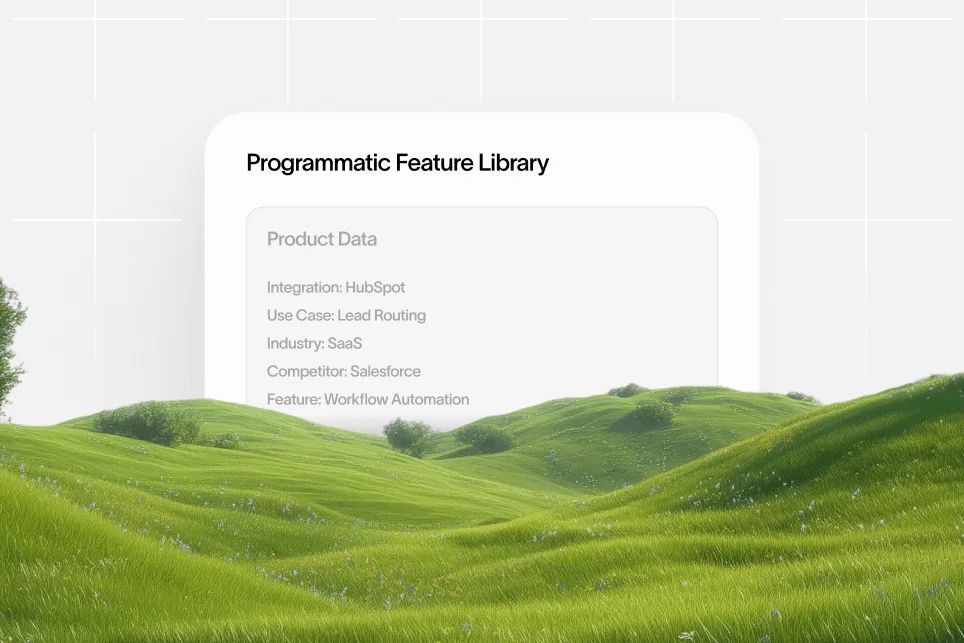
A feature library is a connected set of landing pages built around product capabilities instead of editorial topics. Each page targets a specific query pattern such as a feature name, a use case, an audience segment, a competitor comparison, or an integration pairing.
That structure matters because search behavior has shifted. Buyers still use Google, but they also ask tools like ChatGPT, Perplexity, and Google AI Overviews more specific questions: which tool has role-based permissions, which CRM supports workflow automation, which help desk works for remote support teams.
A short answer that stands on its own: a programmatic feature library helps SaaS companies turn product data into scalable, citation-friendly pages for long-tail search intent.
This is where many content programs break down. Blog posts can educate, but they are often too broad, too time-bound, or too weak on product specificity. Feature pages, if built well, do the opposite. They explain capabilities in a structured way that machines can extract and buyers can evaluate.
According to Deepak Gupta’s programmatic SEO guide, programmatic SEO is the automated or semi-automated creation of keyword-targeted pages using templates and structured data. That definition is useful because it separates programmatic work from ordinary content scaling. The advantage is not speed alone. The advantage is consistency across a large set of pages that all map to clear intent.
The business case is straightforward:
- Blogs capture informational traffic.
- Feature libraries capture product-aware and solution-aware traffic.
- Structured pages are easier for AI systems to summarize and cite.
- Reusable templates reduce the cost of expanding coverage.
- Connected page types improve internal linking and topical authority.
This is also why Programmatic SEO for SaaS should not be treated as a content hack. It is site architecture work. It changes how a company presents its product knowledge to both humans and machines.
A practical point of view belongs here. Do not build thousands of thin pages to imitate marketplace giants. Build a smaller library of pages with dense, reusable product evidence. Thin scale creates indexing problems, poor conversions, and weak AI citation potential. Structured depth beats page count.
For teams rethinking their broader search approach in 2026, our guide to SEO covers why ranking now depends on both classic search signals and AI answer visibility.
What belongs inside a programmatic feature library
A feature library should not be a random collection of landing pages. It should be a controlled content system built around repeatable page families.
The most useful 4-part model is the intent-to-feature library model:
- Core capability pages that explain what the feature is and what problem it solves.
- Use-case pages that connect the feature to a job, workflow, or team need.
- Comparison pages that frame the feature against alternatives or competitors.
- Supporting proof pages that add examples, limitations, FAQs, and integration context.
This model works because it mirrors real buying behavior. People rarely search for a feature in isolation. They search for a feature plus a situation, competitor, or outcome.
Approved research consistently points in the same direction. Seomatic’s roadmap for SaaS highlights integration pages, comparison pages, and alternatives pages as core categories for SaaS programmatic efforts. Those page types work because they align with decision-stage intent, not just top-of-funnel curiosity.
A practical library often includes pages like these:
Core capability pages
These target terms such as:
- workflow automation software
- knowledge base search
- role-based permissions
- AI meeting notes
- customer segmentation tools
Each page should answer five basic questions fast:
- What is the feature?
- Who needs it?
- What problem does it solve?
- How is it different from adjacent features?
- When is it the deciding factor in a purchase?
Use-case pages
These attach the feature to a workflow or persona:
- workflow automation for RevOps
- AI meeting notes for sales teams
- customer segmentation for product marketers
- knowledge base search for support teams
These pages often convert better than generic feature pages because they narrow the relevance immediately.
Comparison and alternatives pages
These are especially valuable in B2B SaaS because buyers compare at the feature level before they compare at the brand level. A prospect may not search a category term first. They may search whether one product supports bulk actions, audit logs, multilingual help centers, or Salesforce sync.
Tripledart’s 2026 guide explains this shift well: SaaS teams can move from broad category keywords toward more specific, automated programmatic pages built around long-tail intent. That is exactly where feature libraries outperform generic blog production.
Supporting proof pages
These pages are often overlooked. They include:
- integration-specific evidence
- feature availability by plan or use case
- implementation examples
- glossary-style explanations tied to product pages
- FAQ pages tied to individual capabilities
These pages strengthen citation potential because AI systems favor pages with clear, extractable answers.
How to plan the library before a single page gets published
Most failed programmatic projects fail before launch. The issue is usually not templates. The issue is weak source data, loose page logic, or a mismatch between keywords and actual product value.
The planning process needs to start with inventory, not ideation.
Start with a product evidence sheet
The source dataset should include every feature, variant, audience, use case, competitor gap, and supporting proof element that can be expressed on-page. This does not need to be complex, but it does need to be complete enough to support controlled page creation.
A useful source sheet typically includes columns such as:
- feature name
- plain-language definition
- buyer problem solved
- primary audience
- secondary audience
- workflow or use case
- integration relevance
- competitor overlap
- screenshots or proof assets
- internal links to related pages
- primary keyword target
- secondary keyword variants
- CTA type
This is the point where Programmatic SEO for SaaS becomes operational. If the product team cannot explain the feature clearly, the SEO team will struggle to create pages worth indexing.
Cluster by query pattern, not by org chart
Many SaaS teams structure libraries the way they structure product menus. That is a mistake. Search demand does not follow internal navigation logic.
Instead, group pages by query pattern:
- feature + software
- feature + for persona
- feature + for industry
- product + competitor
- product + integration
- alternative to competitor + key feature
As documented in Deepak Gupta’s Dev.to article, programmatic SEO changes the model from manually writing every page to generating pages from structured datasets. That only works if the dataset maps cleanly to how people search.
Build a launch set before full expansion
A sensible launch is usually 20 to 50 pages, not 500. That is enough to test indexing, rankings, engagement, and conversion patterns without flooding the site with weak inventory.
A strong initial set might include:
- 8 core feature pages tied to highest-value product capabilities.
- 8 use-case pages tied to the clearest buyer workflows.
- 6 competitor or alternative pages tied to common sales objections.
- 4 integration-supporting pages tied to ecosystem demand.
This smaller set gives the team enough signal to refine the template and page logic before expanding.
Define measurement before launch
If there is no measurement plan, the team will default to page count and impressions. Those are weak success metrics on their own.
The better baseline includes:
- indexed pages after 30 and 60 days
- impressions by page family
- clicks by page family
- assisted conversions
- demo requests or signups from feature pages
- branded and non-branded citations in AI answers
- internal link contribution to pipeline pages
If a company uses a platform such as Skayle, it can combine page creation with visibility tracking to understand whether those pages rank in search and appear in AI-generated answers. That matters because a feature library should be measured as a ranking system, not just a publishing exercise.
How to build pages that rank, get cited, and still convert
Template quality is where most feature libraries either compound or collapse. The page cannot feel auto-generated, even if the production process is partially automated.
The best pages use a repeatable structure while still giving each URL distinct value.
The page anatomy that works in practice
A high-performing feature page usually includes these blocks:
- A direct headline matching the feature and buyer intent.
- A short definition in plain English.
- A problem-solution section tied to a workflow.
- A capability breakdown with concrete subfeatures.
- A comparison section against adjacent or competing options.
- Proof elements such as screenshots, examples, or customer scenarios.
- Internal links to use-case, integration, and comparison pages.
- A concise FAQ block.
- A CTA tied to evaluation, not hype.
That structure works for both SEO and AEO because it gives search engines a clear topical map and gives AI systems clean answer candidates.
What to write in the first screen
The opening 100 words matter disproportionately. The page should define the feature, state who it is for, and clarify the specific problem it solves.
For example, a weak opening says a tool “streamlines collaboration.” A stronger opening says the product offers role-based permissions so admins can control workspace access by team, function, and account type. That second version is easier to rank, easier to cite, and easier to trust.
What makes a page citation-friendly
AI answers tend to pull from pages that are explicit, structured, and unambiguous. That means every feature page should include:
- one-sentence definitions
- scannable lists
- clear subheadings
- direct answers to likely buyer questions
- differentiated language, not generic SaaS copy
- visible proof of how the feature works in context
This is one reason our guide to making AI-assisted articles more human matters even for programmatic pages. Machine-readable structure helps rankings, but human specificity helps trust and citations.
A mini case scenario worth modeling
Consider a SaaS company with a generic “Features” hub and a blog that ranks for educational terms but produces few product-qualified conversions. The baseline is common: broad traffic, weak product discovery, and limited visibility for feature-led searches.
The intervention is a 30-page library organized around capability pages, persona-specific use cases, and feature comparisons. Each page uses the same template, but the copy changes meaningfully based on user problem, adjacent features, and internal links.
The expected outcome over the first 60 to 90 days is not instant traffic explosion. It is cleaner indexing, broader long-tail keyword coverage, more product-led clicks, and stronger AI answer inclusion for feature-specific questions. The exact lift depends on domain authority, crawl health, and product-market clarity, so the measurement plan matters more than vanity forecasts.
The conversion layer many teams miss
A feature library is not just a traffic asset. It is a mid-funnel conversion surface.
That changes page design decisions:
- CTAs should match buyer stage.
- Product visuals should support comprehension, not decorate the page.
- Comparison tables should reduce evaluation friction.
- Internal links should move visitors to adjacent proof, not trap them in a dead-end feature page.
If the query is exploratory, a CTA to learn more may be enough. If the query is evaluative, a product demo or use-case walkthrough fits better. The page should respect intent instead of pushing the same conversion action everywhere.
The common mistakes that turn programmatic pages into dead weight
Programmatic SEO for SaaS has a reputation problem because many teams use it badly. The failure pattern is predictable.
Mistake 1: Publishing too many pages before proving one template
This creates thin inventory and weakens crawl efficiency. SmartClick Agency’s implementation guide emphasizes scaling large volumes of landing pages, but volume only works when the page model is already validated.
The better move is to validate one template across a narrow set of intents first, then expand.
Mistake 2: Reusing the same copy with keyword swaps
This is the classic low-quality programmatic trap. If every page says the same thing with a different noun inserted, the site adds little value.
Each page needs unique problem framing, distinct proof, and different internal link relationships. Template consistency is good. Semantic sameness is not.
Mistake 3: Ignoring design and readability
Programmatic pages often look machine-made because teams focus on text output and ignore layout. That hurts both trust and conversions.
A page should visually separate definition, feature detail, comparisons, and FAQs. Even strong copy loses impact when everything is packed into one repetitive block.
Mistake 4: Chasing informational keywords with product pages
Not every query should map to a feature page. If the user wants a broad educational answer, a product-led page will underperform.
The contrarian stance is simple: do not force blogs to become product pages, and do not force product pages to act like blogs. Use blogs for education and feature libraries for evaluation-stage intent. Mixing those jobs usually weakens both.
Mistake 5: Treating reporting as separate from page decisions
Disconnected reporting is one of the biggest operational issues in SEO teams. If rankings, AI visibility, conversions, and content maintenance live in separate tools, teams struggle to see what deserves expansion, pruning, or refresh.
This is where a ranking and visibility platform can help. Skayle is built to help companies rank higher in search and appear in AI-generated answers, which makes it relevant when teams need one system for content execution and AI visibility measurement rather than fragmented reporting.
How to expand beyond the first 30 pages without losing quality
Once the initial set shows signs of traction, expansion should follow evidence, not enthusiasm.
Expand by page family, not by random requests
The first scale decision is whether one page family is outperforming the others. In many SaaS categories, use-case pages convert better than generic capability pages because they express the job to be done more clearly.
If that pattern appears, expansion should go deeper into the winning family:
- more personas
- more industries
- more adjacent workflows
- more feature-plus-integration combinations
This keeps the library coherent.
Refresh pages as product and SERP language changes
Feature libraries age faster than many teams expect. Product names change. Buyers adopt new phrasing. Competitor positioning shifts.
That means refresh workflows matter. Page updates should focus on:
- definition clarity
- screenshots or proof assets
- competitor references
- internal links to newer page families
- FAQ sections tied to new objections
- AI answer visibility for the target query set
Teams dealing with a growing page base usually need a maintenance process, not one-off edits. That is the same reason content teams increasingly rely on automated maintenance workflows when search coverage starts to scale.
Add structured proof, not just more copy
Growth does not always require longer pages. Sometimes the next useful layer is more structured evidence:
- short examples of who uses the feature
- screenshots of the feature in context
- plan availability notes
- setup expectations
- links to integrations or workflows
These elements improve both user confidence and extractability for AI systems.
Use competitor pages carefully
Competitor and alternatives pages are often among the highest-intent assets in a feature library. Gracker AI’s overview points to companies such as Zapier and Atlassian as examples of SaaS players using programmatic SEO as a core growth lever.
The lesson is not to imitate their page volume. The lesson is to understand the structural model: they create pages that match buyer comparison behavior at scale.
For smaller SaaS teams, the right approach is selective coverage. Build comparison pages only where there is meaningful overlap, clear differentiation, and enough product evidence to make the page useful.
The questions teams ask before committing resources
How large should the initial feature library be?
Most SaaS teams should start with 20 to 50 pages. That is enough to validate the template, indexing behavior, and conversion path before scaling into hundreds of URLs.
Should every feature get its own page?
No. Only features with distinct search intent, buyer significance, or comparison value deserve standalone pages. Minor settings or support details usually belong inside broader capability pages.
What is the difference between a feature library and a help center?
A help center explains how to use the product after adoption. A feature library helps prospects understand what the product can do before they buy. The intent is different, so the page structure should be different too.
Do programmatic feature pages work for early-stage SaaS?
Yes, but the scope should stay tight. Early-stage teams usually benefit more from a focused library around their strongest differentiators than from broad category coverage.
How long does Programmatic SEO for SaaS take to show results?
Most teams should expect a testing period of 60 to 90 days for early indexing, ranking, and engagement patterns. Meaningful performance depends on domain strength, page quality, internal linking, and whether the pages map to real buying intent.
Where this fits in a modern search system
A programmatic feature library is one of the clearest ways to move beyond blog-led SEO without abandoning content quality. It gives SaaS teams a way to capture long-tail demand, support product evaluation, and increase the chances of being cited in AI-generated answers.
The companies that benefit most are not the ones publishing the most URLs. They are the ones building the cleanest relationship between product data, search intent, and proof. That relationship is what makes the pages rank, what makes them citeable, and what makes them convert.
For teams that want a more complete view of where they stand, the next step is not publishing blindly. It is understanding which product topics already earn visibility, where citation coverage is thin, and which page families deserve expansion. Skayle helps companies measure AI visibility, create ranking-focused content systems, and connect execution to outcomes instead of disconnected reporting.
References
- Deepak Gupta — Programmatic SEO Guide: Scale to Millions of Organic Visits
- Seomatic — Programmatic SEO Roadmap for SaaS
- Deepak Gupta on Dev.to — Automating Growth: Building Programmatic SEO for B2B SaaS
- Tripledart — Programmatic SEO For SaaS: How To Do It The Right Way
- SmartClick Agency — Programmatic SEO for SaaS: Implementation Guide
- Gracker AI — Programmatic SEO for B2B SaaS
- Averi — Programmatic SEO for B2B SaaS Startups
- 8 Best Programmatic SEO Tools for SaaS Teams in 2026