
TL;DR
AI search visibility reporting should show more than mentions. For SaaS boards, the clearest model is citation share, competitive share of voice, commercial topic coverage, and directional business impact tied to branded demand, qualified traffic, and pipeline support.
Boards do not need a dashboard full of experimental metrics. They need a clear view of whether the company is becoming more visible in AI answers, whether that visibility is increasing brand authority, and whether it is contributing to pipeline over time.
That is the core job of AI search visibility reporting in 2026: translate mentions, citations, and competitive presence across AI engines into a board-level story about market share, discoverability, and growth.
Why board reporting on AI visibility matters now
SaaS buyers no longer discover vendors only through traditional Google results. They also ask ChatGPT, Perplexity, Gemini, Claude, and Google AI Overviews for recommendations, comparisons, and shortlists. According to Rankability’s review of AI search tracking tools, those platforms now define the core surface area companies need to monitor.
A board does not care about every prompt variant. It cares about whether the company is present where decisions begin.
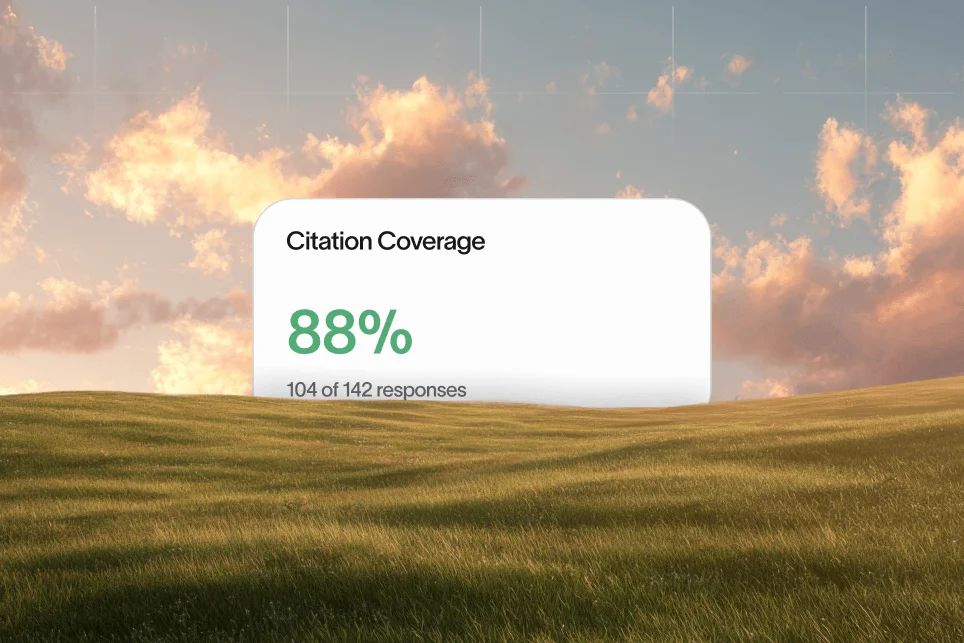
AI citation share is the percentage of relevant AI answers in which a brand is mentioned or cited compared with competitors.
That sentence should anchor the entire report. It is concise, board-friendly, and close enough to how the market already talks about AI visibility.
The reason this matters now is simple:
- AI answers compress the consideration set.
- Citations influence which brands appear credible.
- Visibility is shifting from ten blue links to answer inclusion.
- Boards increasingly expect proof that search investments are adapting to that shift.
This is also where many teams get reporting wrong. They present AI visibility as a novelty metric, separate from revenue conversations. That weakens trust. A stronger approach is to present AI visibility as a new layer of market intelligence.
That framing is supported by Semrush’s AI Search Visibility Checker, which positions AI visibility as competitive marketing intelligence, not just a technical SEO score. For a board, that distinction matters. Marketing intelligence belongs in strategic reporting. Experimental SEO trivia does not.
A practical board packet should answer four questions:
- Where does the brand appear in AI-generated answers?
- How often does it appear relative to key competitors?
- Which topics or commercial intents drive that visibility?
- Is the visibility improving branded demand, qualified traffic, assisted pipeline, or win-rate support?
This is also the point where teams should avoid overclaiming. The reporting category is still maturing. That tension is visible even in practitioner conversations like the Reddit discussion on AI search reporting, where marketers note how inconsistent current measurement can be. The right response is not to avoid reporting. It is to report with clean definitions, stable methodology, and explicit caveats.
What belongs in an AI citation share report
A useful board report is not a raw export from a tracking tool. It is a small set of metrics tied to business interpretation.
The cleanest model is a four-part view: coverage, competitive share, traffic signal, and business impact. That is simple enough to remember and specific enough to operationalize.
Coverage: where the brand is being cited
Coverage answers a basic question: across the prompts and topics that matter, where does the company appear?
As documented by SE Ranking’s AI Visibility Tracker, core measurement includes brand mentions and links within AI-generated answers. That is the right starting point because it distinguishes between vague presence and attributable presence.
Coverage should be segmented by:
- Platform: ChatGPT, Perplexity, Gemini, Claude, Google AI Overviews
- Topic cluster: product category, pain point, competitor comparison, integration, use case
- Funnel stage: awareness, evaluation, decision
- Geography or market segment if relevant
This is where a concept like citation gap becomes useful in board language. A SaaS brand can rank in Google for important queries and still be absent from AI answers. That gap is not a theoretical issue. It is a discoverability loss.
Competitive share: who owns the answer space
Coverage alone is incomplete. A board needs relative position.
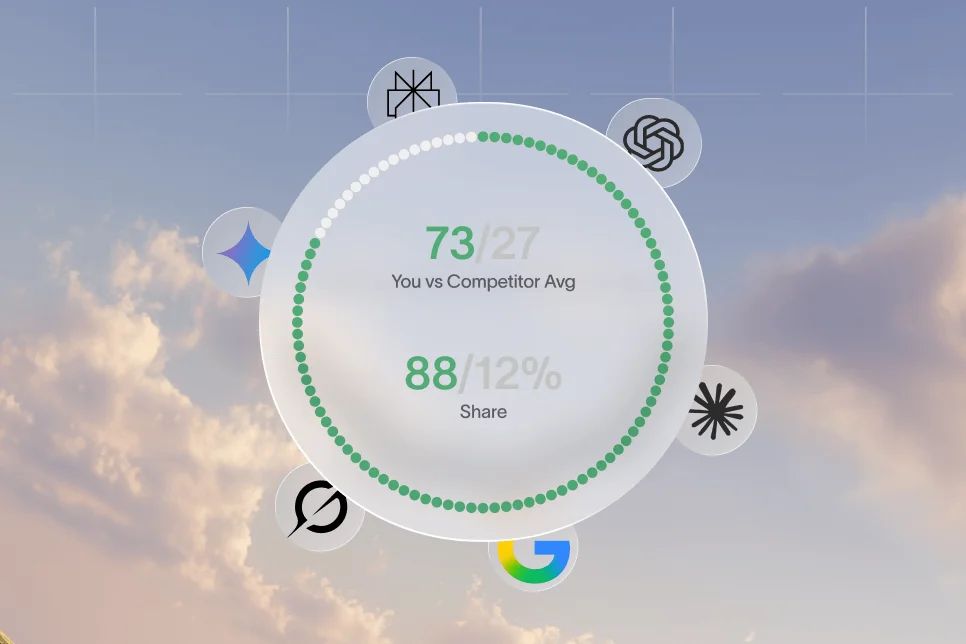
LLMRefs explicitly frames Share of Voice and citations as primary units of measurement for AI search visibility. That makes them a natural fit for board reporting because they answer a strategic question: is the company gaining or losing mindshare in answer engines?
Competitive share should show:
- Brand citation share versus 3-5 named competitors
- Share of voice by topic cluster
- Net movement quarter over quarter
- Which competitor categories dominate which prompts
A simple table is usually better than a complex chart. For example:
- “Commercial comparison prompts: Competitor A leads citation share”
- “Educational category prompts: company gained visibility”
- “Integration-related prompts: no meaningful presence yet”
That gives the board something actionable. It shows where authority exists and where the company is invisible.
Traffic signal: whether citations are creating visits
Board members will ask the obvious question: if the brand is cited more often, does that produce traffic?
The honest answer is sometimes yes, but not always directly measurable with perfect precision. AI answer environments are fragmented, attribution is partial, and click behavior differs by platform.
That is why AI search visibility reporting should use directional evidence, not false precision. Teams can combine:
- Referral patterns where available
- Growth in branded search demand
- Changes in high-intent organic landing page sessions
- Assisted conversion trends on AI-oriented entry pages
- Sales-call mention tracking for “found via ChatGPT” or similar phrasing
This is also where stronger page design matters. The new funnel is not just impression to click. It is impression -> AI answer inclusion -> citation -> click -> conversion. If the cited page is weak, the brand wins the citation and loses the outcome.
Pages built for this funnel need:
- Clear definitions near the top
- Strong proof elements
- Comparison-ready structure
- FAQ sections that mirror real buyer phrasing
- Internal links that deepen authority
This is the same logic behind LLM source anchoring: pages are more usable to AI systems when information is clearly organized, attributable, and easy to extract.
Business impact: what the board should actually take away
This is the section most teams skip, and it is the section that matters most.
The board takeaway is not “AI citations rose 18%.” Unless that number is deeply contextualized, it means very little.
The board takeaway should sound more like this:
- “The brand is now present in more category-level AI answers, reducing competitor control of top-of-funnel discovery.”
- “Commercial prompt visibility improved in the product comparison cluster, which supports pipeline capture in an earlier research phase.”
- “The company remains underrepresented in AI answers for integration and migration topics, limiting visibility with decision-ready buyers.”
That is board language. It connects visibility to market position.
The 4-part reporting model that keeps the board focused
Most reporting gets bloated because teams try to prove maturity by adding metrics. The better move is the opposite: use fewer metrics and give each one a job.
A practical model for AI search visibility reporting includes four layers:
- Citation share: the percent of tracked AI answers that mention or cite the brand.
- Competitive share of voice: how often the brand appears compared with selected competitors.
- Commercial topic penetration: visibility in prompts tied to evaluation and buying intent.
- Business signal correlation: directional movement in branded demand, qualified traffic, or pipeline support.
Each metric should have a single sentence interpretation attached to it. That prevents the board deck from becoming a screenshot dump.
What not to report
There are three common mistakes.
First, do not report one blended score with no explanation. Executives distrust black-box scoring.
Second, do not report platform totals without topic segmentation. Visibility for “what is X” and visibility for “best X software for SaaS” are not equivalent.
Third, do not present AI search as a replacement for SEO. According to Ubersuggest’s AI Brand Visibility Tool, AI visibility still connects back to classic search fundamentals like keyword opportunities, competitive analysis, and on-page optimization. The board should hear continuity, not channel panic.
The contrarian stance is straightforward: do not lead with a flashy AI visibility score; lead with citation share by commercial topic cluster. A single score looks neat but hides the only thing leadership actually needs to know: where the brand is present, absent, and losing.
A board-ready example using a concrete measurement plan
Hard benchmark numbers are still limited, so a strong report should define a measurement plan instead of inventing certainty.
A SaaS team can set up a quarterly reporting cycle like this:
- Baseline: current citation share across 100 tracked prompts split across awareness, evaluation, and decision intent
- Intervention: refresh category pages, comparison pages, integration pages, and supporting glossary content; improve structure and internal links; add clearer evidence blocks and FAQs
- Expected outcome: broader answer inclusion on tracked prompts, improved share of voice in target topic clusters, and stronger assisted organic traffic to cited pages
- Timeframe: 8-12 weeks for content changes to accumulate, then quarter-over-quarter comparison
- Instrumentation: AI visibility tracker, web analytics, CRM source notes, and sales-call tagging
That is not perfect attribution. It is disciplined reporting.
For SaaS teams that need one system to execute those updates and monitor AI presence, platforms like Skayle help companies rank higher in search and appear in AI-generated answers while keeping reporting connected to action instead of leaving it in separate tools.
How to build the board deck without losing credibility
The reporting process matters almost as much as the numbers. If methodology changes every month, the board will stop trusting the trendline.
The sequence below is practical and repeatable.
Step 1: Define the prompt set like a market basket
Do not track random prompts suggested by a tool.
Track a fixed set that reflects how buyers evaluate the category:
- Category terms
- Competitor comparison queries
- Use-case queries
- Integration and migration questions
- Problem-aware questions
A 50- to 150-prompt sample is usually enough for directional board reporting if it is stable and segmented. The key is consistency.
Step 2: Group prompts by buying relevance
Every prompt is not equally important. Weight them.
A board report should separate:
- High commercial intent prompts
- Mid-funnel evaluation prompts
- Educational prompts that support category authority
This avoids the common trap of celebrating visibility gains on informational prompts while remaining absent from decision-stage answers.
Step 3: Map each prompt set to owned pages
Each topic cluster in the report should connect to a page group or content asset group. That way the board can see what the company is doing to change the outcome.
Example mapping:
- Category prompts -> category and solution pages
- Comparison prompts -> competitor pages and alternatives content
- Use-case prompts -> industry pages and workflow pages
- Educational prompts -> glossary and thought-leadership content
This is where our guide on citation gaps can help frame why some page groups rank but still fail to earn AI mentions.
Step 4: Show change over time, not just current status
A board report should compare at least two periods, ideally three:
- Prior quarter
- Current quarter
- Directional trend line
The board does not need daily volatility. It needs movement with context.
Step 5: Tie movement to actions taken
This is where many SEO reports fail. They show outcomes with no operational narrative.
The report should connect changes to actions such as:
- Updated comparison page templates
- Better expert attribution on commercial pages
- Clearer product proof blocks
- Added FAQ sections for buyer objections
- Internal linking from authority pages into conversion pages
That creates accountability. It also makes future investment easier to justify.
What strong pages do differently in an AI citation environment
Board reporting improves when the underlying pages are designed to be cited and to convert after the click.
The pages that perform best in AI answer environments usually do four things well.
They answer the core question early
The first 20% of the page should contain a direct answer sentence, a definition, or a clear decision point. AI systems and human readers both benefit from that structure.
They make trust easy to extract
Trust signals should not be buried. Strong pages use:
- Clear author or brand point of view
- Evidence blocks and examples
- Comparative language with constraints and tradeoffs
- Structured lists and FAQ answers
As Frase’s guide to AI search tracking notes, monitoring and improving visibility across multiple AI engines requires strategic content patterns, not just rank tracking.
They separate facts from claims
A board report should push teams to tighten page quality. Unsupported superlatives hurt credibility. Pages should use sourced claims where possible and use plain language when certainty is limited.
They give visitors a next step that matches intent
A citation is not a conversion. The page still needs to move the visitor forward.
For a SaaS buyer, that may mean:
- Product comparison detail
- ROI explanation
- Integration proof
- Demo path
- Documentation access
This is where design and conversion work intersect with AI visibility. If the cited page is vague, overloaded, or overly promotional, the traffic will not compound.
Common reporting mistakes that create false confidence
AI search visibility reporting is easy to make noisy. The following mistakes appear often.
Mistaking mention volume for market strength
A brand can accumulate mentions on low-intent educational prompts and still lose commercial discovery. Mention count without topic weighting creates false confidence.
Tracking too many platforms without enough depth
Coverage across ChatGPT, Perplexity, Gemini, Claude, and Google AI Overviews matters, but shallow tracking across all of them is less useful than deep tracking on the prompts that matter most. Sedestral’s overview of AI visibility tools highlights that conversational platforms vary, which is another reason to segment rather than flatten the data.
Reporting a score no one can explain
If leadership asks how the score is calculated and the answer is vague, the metric will not survive budget scrutiny.
Failing to separate citation presence from citation quality
A mention is useful. A linked citation to a commercial page is usually more useful. SE Ranking’s documentation specifically points to measuring both mentions and links, which helps distinguish basic presence from stronger discoverability.
Treating AI visibility like a one-off experiment
This is not a side dashboard for curious marketers. It is part of search reporting now.
That is why teams increasingly need reporting that combines content production, page updates, and visibility measurement in one operating model. The alternative is the usual failure pattern: fragmented execution, unclear ownership, and reporting that never changes what gets published.
The questions boards will ask, answered clearly
A board discussion tends to become productive when the answers are short, direct, and tied to business meaning.
Is AI visibility replacing SEO?
No. It is changing how search visibility is earned and measured. Traditional rankings still matter, but answer inclusion and citations now influence discovery before a click happens.
What should the board expect to see each quarter?
A concise report should include citation share, competitive share of voice, commercial topic penetration, movement over time, and the business signal attached to those changes.
How much precision is realistic in 2026?
Enough for directional decisions, not enough for perfect attribution. That is a normal state for an emerging reporting category, and it is better to present clear directional evidence than fabricated certainty.
What is a strong first milestone?
A realistic first milestone is not “win every AI engine.” It is to establish a stable baseline, identify citation gaps in commercial topics, and improve visibility quarter over quarter on the pages closest to revenue.
How should leadership evaluate progress?
Leadership should look for greater presence in high-value prompt clusters, reduced competitor dominance in category answers, and stronger correlation with branded demand and qualified visits.
FAQ
What is AI search visibility reporting?
AI search visibility reporting is the process of measuring how often a brand appears in AI-generated answers across platforms like ChatGPT, Perplexity, Gemini, Claude, and Google AI Overviews. The goal is to show whether the company is gaining discoverability, citations, and competitive share in answer-driven search.
What is citation share in a board report?
Citation share is the percentage of tracked AI answers that mention or cite a company relative to competitors. It helps boards understand whether the brand is present in the answer layer of search, not just in traditional rankings.
Which metrics matter most for a SaaS board?
The most useful metrics are citation share, competitive share of voice, visibility in commercial topic clusters, and directional business signals such as branded search demand, qualified traffic, or assisted pipeline. These metrics are easier to interpret than a single opaque AI score.
How often should AI visibility be reported?
Quarterly is usually the right cadence for board reporting. Monthly operational reviews can support the work, but board-level updates benefit from cleaner trend lines and enough time for content changes to show movement.
Can AI visibility be tied directly to revenue?
Not perfectly in every case. A better approach is to connect AI visibility to leading indicators such as branded demand, high-intent organic traffic, influenced conversions, and sales feedback, then track whether those indicators improve as citation share grows.
If the current reporting model still treats AI discovery as an afterthought, it is worth rebuilding the board view around citation share, competitive presence, and commercial topic coverage. Teams that want a clearer picture can measure their AI visibility, understand their citation coverage, and connect reporting back to the pages and workflows that actually move rankings and answer inclusion.
References
- SE Ranking — AI Visibility Tracker that fits your delivery map
- Rankability — Best AI Visibility Tools & AI Search Trackers in 2026
- Semrush — Free AI Brand Visibility Tool: Check Your AI Search Presence
- LLMRefs — AI Search Visibility (AI SEO / AEO / GEO Tracker)
- Sedestral — Best ai search visibility tools: features, pricing, use cases
- Frase — Master AI Search Tracking for Brand Visibility Across AI Engines
- Ubersuggest — AI Brand Visibility Tool
- Nobody can actually report on ai search visibility properly …