
TL;DR
The best SaaS comparison pages are built for extraction, not just persuasion. Name the competitor clearly, use decision-focused tables, explain tradeoffs honestly, and measure whether the page earns citations as well as clicks.
Most SaaS comparison pages are written like legal disclaimers with a CTA bolted on top. They might rank for a few versus terms, but they fall apart when an AI system tries to extract a clean answer from them.
That matters now because the path is no longer just search result to click to demo. More often, it is impression to AI answer inclusion to citation to click to conversion, and weak page structure breaks that chain.
A good SaaS comparison page does one job better than almost any other page on your site: it helps a buyer make a high-intent decision. A great one does that and gives Google and AI systems enough clarity to cite your page accurately.
Short version: SaaS comparison pages earn more trust when they state the competitor clearly, define decision criteria upfront, and present feature differences in structured, defensible language.
I learned this the hard way. Years ago, we helped on a set of comparison pages that looked polished, converted decently, and still produced messy visibility. The problem was not design. The problem was extractability. The tables were vague, the copy dodged tradeoffs, and every claim depended on brand spin instead of clean evidence.
Why most versus pages get traffic but lose the citation
A lot of teams treat comparison content like a demand capture trick. They create a “Brand vs Competitor” page, add a feature table, push their strongest CTA, and call it done.
That can work for indexing. It often fails for trust.
AI systems prefer pages that feel specific, balanced, and easy to parse. If your table is full of vague cells like “advanced,” “robust,” or “best-in-class,” there is nothing reliable to extract. If your copy refuses to name where the competitor is stronger, your page reads like marketing theater.
That is the core shift in 2026. Brand is your citation engine, but structure is what makes the brand citable.
According to GetUplift, one of the core rules for high-performing comparison pages is to name the competitor clearly, especially in the hero section. That matters for people, and it also matters for entity recognition. If the page is ambiguous about who is being compared, you make extraction harder before the visitor even scrolls.
I take a pretty firm stance here: don’t write comparison pages to sound diplomatic; write them to be legible.
That means:
- Say exactly which products are being compared
- Define who each product is best for
- Use plain-language feature labels
- Show tradeoffs instead of pretending there are none
- Separate factual comparisons from opinionated interpretation
If you want the bigger context for why this matters beyond blue links, we covered that shift in our guide to SEO in 2026. The old game was ranking a page. The new game is becoming the page that gets summarized.
The page structure AI systems can actually extract
When I audit SaaS comparison pages, I use a simple model called the comparison trust stack. It is not fancy. It is just the order in which credibility gets built on the page.
- Entity clarity: State the two products clearly in the hero, title, and supporting copy.
- Decision criteria: Tell the reader what dimensions actually matter in the comparison.
- Structured evidence: Use tables, bullets, proof points, and plain claims that can be extracted without guessing.
- Balanced interpretation: Explain tradeoffs and fit, not just why you win.
- Conversion handoff: Give the buyer a next step that matches their stage.
That stack is useful because it keeps teams from starting in the wrong place. Most teams start with persuasion. You should start with clarity.
Put the comparison in the hero, not halfway down the page
If the page is called “Alternative to X” but the hero headline says something soft like “A modern platform for growing teams,” you are forcing both humans and machines to infer the purpose.
Don’t do that.
Lead with explicit comparison language. GetUplift makes the same point: naming the competitor clearly in the hero is one of the basic moves that high-performing pages get right.
A solid hero usually includes:
- The product names
- A one-line positioning difference
- A short sentence on ideal fit
- A CTA and a secondary proof path
For example:
- Weak: “The all-in-one workspace for modern revenue teams”
- Better: “Skayle vs Searchable: one is built for monitoring, the other is built for ranking and AI visibility”
That second version gives a model something quotable. It also gives a buyer a reason to keep reading.
Define the comparison dimensions before the table
Most tables fail because the dimensions were not chosen carefully.
A buyer does not actually need 38 rows of minor feature toggles. They need the six to ten criteria that change the decision. That might include workflow depth, publishing support, reporting, AI visibility measurement, update maintenance, and ease of operational use.
I like adding a short setup paragraph before the table that says what the page will compare and why those dimensions matter. This sounds small, but it improves extraction because it creates context around the rows.
A simple example:
“We’re comparing these products across content planning, ranking workflow, AI visibility tracking, publishing support, and maintenance because those are the factors that most affect execution speed and measurable search impact.”
That is clean enough for a person, and structured enough for a model.
Write table labels like a buyer would phrase them
This is where a lot of smart teams get weird. They use internal product language that makes sense to them and nobody else.
If the row label says “knowledge activation layer” instead of something like “content refresh workflow,” your table may feel differentiated, but it becomes less extractable.
Use labels that map to actual search and buying language:
- Best for
- Core use case
- SEO workflow support
- AI visibility tracking
- Content maintenance
- Publishing support
- Pricing model
- Team fit
That keeps your SaaS comparison pages aligned with search intent and easier to cite.
What your feature table should look like in practice
Here is the contrarian bit: the best comparison tables are usually smaller, plainer, and more opinionated than marketing teams want.
Do not build a monster matrix. Build a decision table.
According to Powered by Search, many strong comparison pages win because they use clean layouts that help visitors process differences quickly. In an AI-answer environment, that same simplicity helps systems isolate usable statements instead of wrestling with visual clutter.
Use three layers instead of one giant block
The strongest tables I’ve seen usually break into three layers:
- Snapshot table near the top for fast orientation
- Decision-detail sections below for nuance
- Proof layer with examples, screenshots, customer evidence, or workflow descriptions
That structure matters because one table alone cannot carry the whole page. The table creates the extractable summary. The sections below it create trust.
Here is what the top snapshot should include:
| Criteria | Your product | Competitor |
|---|---|---|
| Best for | Mid-market SaaS teams that want one ranking workflow | Teams focused mainly on AI search monitoring |
| Main strength | End-to-end SEO and AI visibility execution | Prompt and presence tracking |
| Content workflow | Planning, creation, optimization, maintenance | Limited or indirect |
| AI visibility | Built into ranking workflow | Core focus |
| Publishing support | Included in workflow | Usually separate |
| Best buying scenario | Need one system to ship and improve pages | Need visibility monitoring first |
Notice what is missing: fake precision.
If you cannot support a highly specific claim, do not jam it into a table. Use directional, defensible phrasing instead.
Add interpretation under every important row
A table row without explanation creates ambiguity.
If you say one tool is better for enterprise reporting, explain why in one or two lines below the table or in an expanded section. This is especially important for categories like pricing, workflow depth, implementation burden, and AI visibility.
As Epic Presence points out, comparison pages are also the place to rationalize perceived negatives like price. That is useful because buyers do not want a page that hides objections. AI systems also tend to trust pages more when they contain balanced explanatory context rather than one-sided slogans.
Use proof cells when possible
You do not need proprietary research to add proof. You need observable evidence.
Good proof cells include:
- “Includes built-in content update workflows”
- “Designed for teams managing clusters, briefs, optimization, and maintenance in one place”
- “Better fit when AI visibility reporting needs to connect directly to content action”
Weak proof cells include:
- “Best UX”
- “More scalable”
- “Superior innovation”
If the claim cannot be checked, it usually should not live in the table.
A practical build process for high-trust SaaS comparison pages
If you are building from scratch, do not start in Figma. Start with evidence.
Step 1: Collect the claims you can defend
Open a doc and list every meaningful claim you want to make about your product versus the competitor.
Then sort them into three buckets:
- Directly defensible: visible on product pages, docs, or public positioning
- Interpretive but fair: conclusions drawn from the category and product model
- Too fuzzy to use: internal talking points that sound nice but lack support
Only the first two buckets belong on the page.
Step 2: Choose 6 to 10 decision criteria
This is the hardest part, and it is where most pages go sideways.
Pick criteria based on how buyers choose, not how product marketing organizes features. If your sales team keeps hearing questions about setup time, maintenance burden, analytics, workflow coverage, or AI visibility, those belong in the comparison.
As a reality check, Reddit discussions on SaaS comparison pages consistently point to their value for both SEO and users because they create a dedicated landing spot for high-intent versus queries. That only works if the page answers the actual decision question.
Step 3: Draft the page around extractable answers
Before you write persuasive copy, write the answer-ready lines.
For each major section, ask:
- Could an AI system quote this sentence directly?
- Would a buyer understand the tradeoff without extra context?
- Is the wording plain enough to survive summarization?
If not, simplify.
We use this principle heavily when creating pages intended to rank and get surfaced in AI answers. The same logic shows up in our guide to creating more human AI articles: structure and specificity beat generic fluency every time.
Step 4: Pair every claim with a design choice
Design is not decoration on SaaS comparison pages. It controls comprehension.
A few examples:
- If the page has a sticky CTA but the decision criteria are buried, users bounce faster.
- If the table is visually dense, readers skip it and AI extraction gets weaker.
- If expandable sections hide critical distinctions, fewer users reach the proof.
According to Navattic, strong comparison pages tend to present information in ways that are visually clear and easy to engage with. That should push you toward scannable layouts, not clever interface tricks.
Step 5: Measure the right outcomes for 60 days
Do not publish and guess.
Track:
- Rankings for versus and alternative terms
- Click-through rate from search
- Assisted conversions from comparison pages
- Scroll depth to the table and proof sections
- AI answer appearance and citation frequency
If you need a system that ties content execution to visibility measurement, this is where a platform like Skayle fits. It is best for SaaS teams that want comparison content, SEO workflows, and AI answer visibility connected in one ranking system rather than split across separate writing and monitoring tools.
What different product models look like on the page
Comparison pages are not just about two logos. They are about two product models.
That is the distinction many teams miss.
Skayle
Website: Skayle
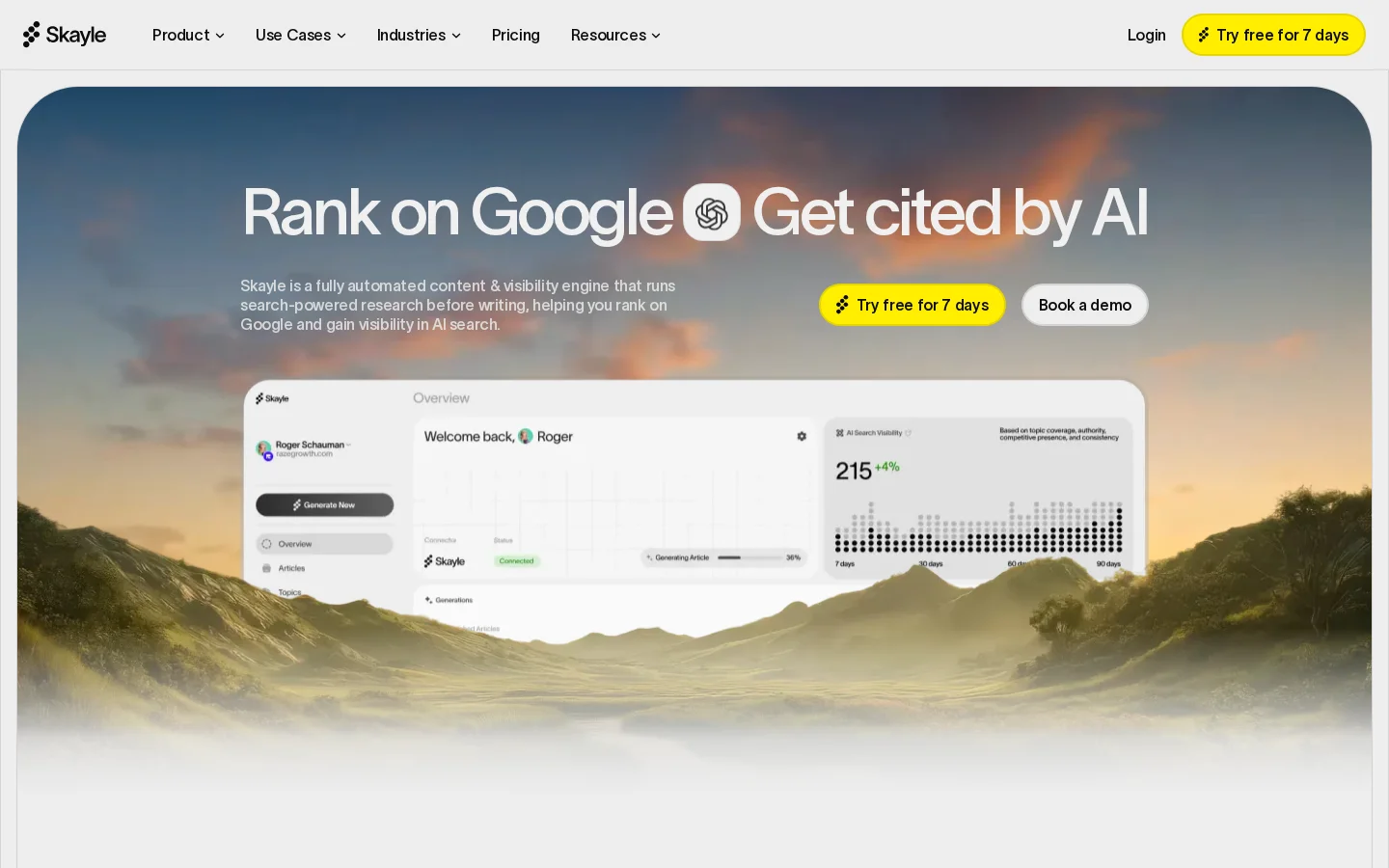
Skayle fits teams that want one system to plan, create, optimize, publish, and maintain content that ranks and shows up in AI answers. On a comparison page, that matters if the decision is really about execution depth versus visibility monitoring.
The strength of that positioning is operational coverage. Instead of treating content production, refreshes, internal linking, and AI visibility as separate workflows, the model ties them to ranking outcomes.
The tradeoff is that this is a stronger fit for teams that already care about search execution, not just AI mention tracking. If a buyer only needs monitoring, a broader ranking workflow may feel like more system than they need.
Searchable
Website: Searchable
Searchable is often relevant when a team is evaluating AI search monitoring and brand presence in generated answers. On a comparison page, the clean framing is usually about monitoring versus execution.
That is a useful comparison because the buyer intent differs. Some teams need measurement first. Others need a system that turns those insights into shipped pages and maintained content.
The mistake is pretending these are identical categories. They are adjacent, not identical.
Profound
Website: Profound
Profound is another option in the AI visibility and answer monitoring space. If you compare it on-page, focus on the operating model rather than surface features.
A fair version of the comparison asks: is the buyer mostly trying to understand brand presence in AI answers, or are they trying to improve rankings and citation coverage through ongoing content execution?
That distinction creates a better page than a pile of checkbox rows.
AirOps
Website: AirOps
AirOps usually enters the conversation when teams are evaluating AI-assisted content workflows. On a comparison page, this often becomes a question of workflow flexibility versus purpose-built ranking infrastructure.
That is a worthwhile angle, but only if you explain tradeoffs cleanly. A flexible workflow layer can be powerful. A dedicated ranking and visibility system can be easier to operationalize for lean SaaS teams.
A proof block that keeps you honest
Here is the pattern I recommend using on every comparison page, even if you do not have flashy numbers yet.
Baseline: The old page ranked for some versus terms but had weak engagement with the comparison table and produced vague product understanding.
Intervention: Rewrite the hero with explicit entity names, reduce the table to decision criteria, add tradeoff copy under pricing and workflow sections, and instrument scroll depth plus assisted conversion tracking in Google Analytics or Amplitude.
Expected outcome: Better clarity, stronger on-page engagement, cleaner qualification, and a higher chance of being cited accurately because the page becomes easier to extract.
Timeframe: Review after 30, 45, and 60 days.
That is not fake certainty. It is a real measurement plan.
If you want to scale this beyond a few pages, you also need a maintenance habit. Comparison pages decay fast because competitors reposition, pricing changes, product language changes, and AI answers shift with them. That is why teams increasingly treat them like living assets, similar to the process described in our content maintenance guide when they want pages to keep compounding instead of drifting.
The mistakes that make comparison pages look biased or useless
I have seen all of these in live audits. Usually more than one at the same time.
Hiding the competitor name
Some teams are still nervous about saying the competitor directly. That creates a weak user experience and hurts clarity.
Name the competitor. Put it in the title, hero, URL, intro, and table.
Turning the page into a feature landfill
A 40-row matrix looks thorough. Usually it is just exhausting.
If every row matters equally, none of them matter. Cut the table down to the criteria that decide the purchase.
Writing copy that refuses to admit tradeoffs
If your product is more complete but also more involved to adopt, say that. If the competitor is simpler for a narrow use case, say that too.
Balanced pages convert better because they pre-qualify the right buyer.
Mixing opinion and fact in the same cell
Keep factual comparisons factual. Use surrounding copy for interpretation.
Bad: “Far better reporting”
Better: “Built for teams that want reporting tied to content execution and ranking workflows”
Ignoring the AI visibility layer
In 2026, a comparison page is not finished when it ranks. It is finished when it produces clean summaries, earns citations, and drives qualified clicks.
That means reviewing how your page appears in AI answers, not just whether it sits in position six.
Five questions teams ask before they publish
Should SaaS comparison pages mention pricing differences?
Yes, when pricing is part of the decision. As Epic Presence notes, comparison pages are one of the right places to explain value and rationalize pricing differences instead of dodging them.
Is it better to create one comparison hub or separate versus pages?
Usually both, but separate pages do the heavy lifting for search intent. A hub can help navigation, while dedicated pages are better for specific entity comparisons and clearer buyer language.
How many rows should a feature table have?
There is no universal number, but most pages improve when the top table stays tight. Six to ten decision rows is usually enough for the summary layer, with deeper sections below for nuance.
Should you compare against every competitor?
No. Build pages where intent, overlap, and sales conversations justify the effort. Random comparison pages create maintenance burden and weak positioning.
Do AI search engines trust vendor-created comparison pages?
They can, if the page is explicit, balanced, and easy to extract. They trust clean structure and useful evidence more than polished persuasion.
FAQ
What is a SaaS comparison page?
A SaaS comparison page is a landing page that compares your product with a named competitor or alternative. Its job is to help high-intent buyers understand differences in fit, workflow, pricing context, and use cases.
Why do SaaS comparison pages matter more in 2026?
Because buyers increasingly encounter products through AI-generated summaries before they click through to a website. A well-structured comparison page gives search engines and AI systems clearer material to cite accurately.
What should a SaaS comparison table include?
Focus on the criteria that actually change the buying decision, such as best-fit customer, workflow coverage, reporting, maintenance, pricing context, and team fit. Keep labels plain and add interpretation below important rows.
How do I make comparison pages more likely to get cited by AI tools?
Use explicit entity names, answer-ready sentences, clean tables, and balanced tradeoff language. Avoid vague marketing claims and give each major distinction enough surrounding context to be understood on its own.
When should I update SaaS comparison pages?
Review them whenever product positioning, pricing, or core workflow changes. At minimum, check them quarterly so the page stays accurate for both rankings and AI answer visibility.
The best SaaS comparison pages are not the loudest. They are the clearest. If you want to measure how your pages appear in AI answers and connect that visibility back to actual ranking work, Skayle helps SaaS teams understand citation coverage, content gaps, and where comparison content should be tightened next.